
Burnham gives Milburn job chairing Youth Opportunities Unit to implement new jobs/welfare settlement for young people
The government has announced that Alan Milburn has been appointed as chair of the new Youth Opportunities Unit mentioned by Pat McFadden earlier. (See 1.17pm.)
In a news release, it says:
double quotation mark Alan Milburn has been appointed as the chair of the new Youth Opportunities Unit.The new unit will sit at the centre of government, reporting directly to the prime minister, driving the cross-system changes needed to deliver greater opportunities and support for young people …
The responsibilities of the new unit are to:
-Shaping and delivering the government response: Shaping and delivering the cross-government response to the Milburn review, maintaining an ambitious cross-system approach to reform and linking closely to the government's wider agenda on growth, re-industrialisation and devolution.
-Unblocking delivery and driving progress: Unblocking delivery obstacles and supporting secretaries of state to drive progress towards reducing Neet rates.
-Guarantee, service design and devolution: Driving delivery of the Youth Opportunity and Support Guarantee and the Youth Opportunities Service, partnering with Number 10 North, departments, mayors, strategic and local authorities.
-Mobilising partners: Galvanising action beyond central government, working with mayors, securing commitments from employers and voluntary and community organisations, and demonstrating progress.
-Data, metrics and insight: Drawing on data and insight to understand what is and is not working, and addressing gaps in, or barriers to, data sharing to aid delivery.
Political figures who are given non-ministerial government roles often find that, in practice, they have a lot less power than they would like. Government is organised around departments, and within departments the secretary of state normally has the final say.
But the wording of this press release implies that Milburn could end up with considerable authority. If he is in charge of “unblocking delivery obstaclesâ€, that will only happen if he is allowed to apply a robust approach towards “supporting†secretaries of state. This appointment will be seen as confirmation that Andy Burnham is fully committed to implementing this agenda.
Key events
-
Bev Craig says she wants to see Greater Manchester implementing Milburn’s plans for tackling Neets within 12 months
-
Scottish government says it’s doing ‘many’ of ideas Milburn recommends already
-
Funding tax cuts ‘difficult’, says McFadden, when asked about Milburn’s national insurance proposals
-
Corbyn says young people should not ‘pay price for endless war’, while Polanski says Milburn plans are ‘flimsy sticking plaster’
-
Burnham gives Milburn job chairing Youth Opportunities Unit to implement new jobs/welfare settlement for young people
-
McFadden rejects Tory call to repeal Employment Rights Act measures relating to young people
-
McFadden ducks question about whether government backs plan to cut national insurance for younger workers
-
McFadden says government departments being asked to ‘reprioritise spending’ to fund more support for young people
-
McFadden says government wants Milburn to have ‘continuing role’ as report recommendations get implemented
-
Shadow DWP secretary Helen Whately claims Milburn report has trashed Labour’s economic policies
-
McFadden says MPs will get chance to vote on legislating implementing Milburn plans next year
-
McFadden says Jobs Guarantee for young people to be available after 12 months on universal credit, not 18 months
-
Burnham setting up new Youth Opportunities Unit reporting to No 10, McFadden tells MPs
-
McFadden says government also accepts Milburn’s recommendation for personalised benefits system for young people
-
McFadden says government backs Milburn’s recommendation for statutory Young People’s Guarantee
-
Pat McFadden tells MPs cabinet has endorsed need for whole new settlement for young people
-
‘Let’s see what happens next’ – Milburn sounds open to taking government post to help implement his plans
-
Milburn says ‘British promise’ to young people, ‘work hard and build a better life’, is broken and must be restored
-
Milburn explains why he rejected plans that would cut costs more quickly
-
Milburn says relying on supply-side economics alone to tackle youth unemployment has been ‘biggest fallacy’ in policy for 50 years
-
What Milburn is proposing in his report
-
‘Half measures will not do’ – Milburn makes case for wholesale reform as he publishes his youth unemployment report
-
What DWP says about how public spending has been skewed towards pensioners rather than young people
-
What DWP says about what Milburn plan would cost and achieve over 10 years
-
Annual costs and savings from Milburn plans by 2036/37
-
How Milburn plans could cut Neet rate
-
Milburn says his plan to get young people into work will save only £200m a year
-
DWP releases figures showing getting rid of two-child benefit cap has lifted 300,000 children out of poverty
-
What opposition parties are saying about Milburn’s plan
-
Ed Miliband announces first sanctions on Israeli firms working in West Bank
-
Milburn says small firms should be paid £5,000 to hire Neets
-
Milburn says response from Labour MPs to his plans has been ‘incredibly positive’ so far
-
UK unemployment unexpectedly eases to 4.6%, as government prepares to release Milburn report
-
Alan Milburn says youth unemployment plan could cut welfare bill, but overall savings will take years
Bev Craig says she wants to see Greater Manchester implementing Milburn’s plans for tackling Neets within 12 months

Josh Halliday
Josh Halliday is the Guardian's North of England editor.
Andy Burnham's successor as Greater Manchester mayor, Bev Craig, said she wants to implement Alan Milburn's model for tackling the Neets crisis “within 12 months,†describing the current system as “simply not acceptableâ€.
England's mayors would be responsible for huge parts of the proposals to get hundreds of thousands of young people earning or learning under plans set out by Milburn on Tuesday.
Among sweeping changes to health and skills programmes, the mayors of strategic authorities would be responsible for getting young people into work or education up to the age of 24 – which Milburn's report describes as a “fundamental change†from the current system where teenagers hit a “cliff edge†of state support as soon as they reach 19.
A new funding settlement would see the more established authorities – like Greater London, Greater Manchester and South Yorkshire – given committed pots of cash for at least three years to replace the rolling annual grants they receive from central government.
Mayors whose areas underperform in getting young people into work would face financial penalties as part of this model.
Speaking to the Guardian, Craig said her predecessor Burnham now had a “moral imperative in acting fast†on Milburn's recommendations – and said Greater Manchester should be at the front of the queue for these new responsibilities.
Asked whether she was concerned about Milburn's proposed cuts to disability benefits for young people, which by 2036/7 would amount to £3.6bn a year, Craig said that was “not my reading of the 278-page reportâ€.
She added:
double quotation mark There naturally will be a debate on social security that will move through parliament, but my takeaway from this report is that we've got a generation of young people who want to work and want to get into education, who currently aren't supported to be able to do that.
Craig said the status quo was “simply not acceptable†and that nearly 40,000 young people in Greater Manchester were neither earning or learning. According to the Centre for Cities thinktank, Manchester has the third highest number of young Neets in England behind London and Birmingham – although this is not particularly surprising given the size of these cities.
Here are comments on the Milburn report from education unions.
From Matt Wrack, general secretary of the NASUWT, a teachers' union
double quotation mark We reject any approach to getting young people into employment, education and training which is based on punitive cuts to welfare or which seeks to blame schools or teachers.Young people should not be penalised for the wider and prolonged failures of successive governments to create high quality training opportunities, invest in decent jobs and to create the social conditions in which young people can thrive and feel hope for the future.
From Paul Whiteman, general secretary at the school leaders' union NAHT
double quotation mark We welcome the recognition that young people should have an education system which prepares them not only for exams, but for adult life, further study and employment. NAHT has long supported a broad and balanced curriculum, alongside greater parity of esteem between academic, vocational and technical pathways, so that every young person can pursue a route that reflects their talents, strengths and aspirations.
From Jo Grady, general secretary of the UCU, which represents academics
double quotation mark Creating tens of thousands of new jobs in further education would be a welcome step towards tackling youth unemployment. But the government cannot expect colleges to deliver this ambition while presiding over a further education workforce crisis.
Scottish government says it’s doing ‘many’ of ideas Milburn recommends already
The Scottish government has said that “many†of the reforms proposed by Alan Milburn are already being implemented north of the border. In a statement, the Scottish government's education secretary, Mà iri McAllan, said:
double quotation mark We will take time to consider Alan Milburn's report in detail. We are so ambitious for our young people, who face unique challenges in today's economy, having grown up in the nearly 20 years since the global financial crash, through years of Westminster austerity and the economic and social catastrophe of Brexit.Where there is opportunity to collaborate with the UK Government and others for the benefit of young people in Scotland, we will take it. However, many of the reforms it recommends for England – including stronger vocational curriculum and qualifications, tracking of young people's activity and joined up support wrapped around them to help them participate – reflect approaches Scotland has already embedded over many years …
Alan Milburn's interim report notes there are around 40% of 16 to 19-year olds starting an apprenticeship, compared with around 20% of 16 to 18-year olds in England. In Scotland, 95.7% of school leavers are in a positive destination three months after leaving school, the joint second highest on record. For 16-24 year olds, the employment rate is higher in Scotland than in England, and the majority of our economically inactive young people are students.
Brian Leishman was probably the Labour MP most critical of the Milburn plans during the Common statement. He said:
double quotation mark The Milburn Review will consign some people into destitution – the author himself said that it won't be pain-free.How can we think that withdrawing benefits from disabled people and putting them into poverty is acceptable?
In response, Pat McFadden said: “It is a life on benefits that leaves people in poverty.â€
Funding tax cuts ‘difficult’, says McFadden, when asked about Milburn’s national insurance proposals
In the Commons, Pat McFadden sidestepped a question from Oliver Dowden about whether the government would implement Alan Milburn's recommendation for a cut in employer national insurance for young people. (See 2.06pm.) But, when the Labour MP Jonathan Brash asked if ministers would accept this proposals, McFadden gave a more direct reply. Arguing that tax was a matter for the chancellor, he said:
double quotation mark There is already a break in the system for employers with regard to employees under the age of 21.I'm sure the chancellor listens to all representations about tax but he has the difficult job of netting off all these representations whenever there is a fiscal event.
This is what the Milburn report says about cutting national insurance.
double quotation mark While structural reductions in employment taxation cannot be delivered immediately, that should not prevent government from setting a clear direction towards lower payroll taxes. Rather than across the board, poorly targeted and unaffordable cuts in employer national insurance, I propose a different course: targeted support now, followed by a 5-year glide path to lower national insurance costs for workers aged 21 to 24. Businesses need confidence that government's ambition is to reduce, not continually increase, the cost of employing a young person.A start should be made with the 2 sectors which provide the most entry level jobs for young people: retail and hospitality. When fiscal conditions allow, the point at which employers in those sectors pay employer national insurance for 21 to 24 year-olds should double and rise progressively from the current £5,000 threshold to a new one of £10,000. Before the 2025 changes that threshold was £9,100. Unlike a full or partial employer national insurance exemption for 21 to 24 year-olds, increasing the threshold would have the biggest impact on the costs of recruiting low paid young workers and those who work fewer hours. It would especially help employers recruit young people doing ‘Saturday jobs' as once the threshold reaches £10,000, a 21 year-old could work 15 hours a week at current minimum wage rates without the employer paying any employer national insurance. Over time the government should consider how to extend this new employer national insurance relief to other sectors in the economy, focusing on those with the biggest potential to create more entry level jobs for the young.
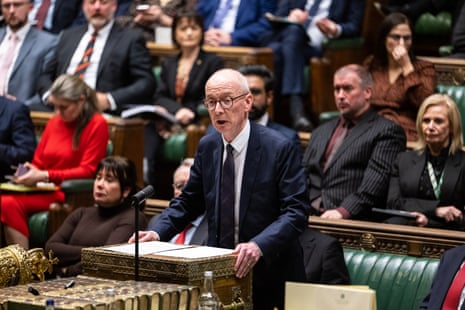
Corbyn says young people should not ‘pay price for endless war’, while Polanski says Milburn plans are ‘flimsy sticking plaster’
In the Commons there was very little outright criticism of the Alan Milburn proposals from Labour MPs, even from the Socialist Campaign Group left. That does not mean there won't be any rebellions when MPs have to vote on legislation next year. But, for the moment, the reception in the party is about as warm as Milburn and Andy Burnham could have hoped for.
Outside Labour, other leftwingers are criticising the plans strongly.
This is from Jeremy Corbyn, the former Labour leader who now leads Your Party in parliament.
double quotation mark I am very concerned by proposals to remove health-related and disability-related welfare payments from under-25s. Why are we forcing young people to choose between support and employment? They need – and deserve – both. These proposals amount to a sanctions regime, which removes the very support that young people need to get into work, and live secure, happy and healthy lives.If the government wanted to help young people, it would recognise that the system is stacked against them, and tackle the crises holding back a generation: the housing emergency, the broken system of student debt, and the climate crisis jeopardising their futures. And it would create unionised, well-paid jobs in the sectors that benefit us all: green energy, social care and public education.
Milburn says that the proposed cuts will not be “pain-freeâ€. This begs the question: painful for who? Our society is defined by grotesque inequality and corporate greed. Why are we targeting young sick and disabled people, and making them pay the price for a crisis they did not create?
We know why these cuts are being made: to fund yet more increases in military spending. Young people should not pay the price for endless war. Instead, we should be rebuilding public services, investing in social housing and protecting our environment. That is what real security means – both for young people, and for us all.
And this is from Zack Polanski, the Green party leader.
double quotation mark These proposals are a flimsy sticking plaster that will do precious little to heal the damage inflicted on young people by successive governments over their lifetimes.Today's young people are suffering some of the worst consequences of over a decade of economic rot, with a lack of meaningful job opportunities compounded by the sky-high cost of housing and essentials that puts dreams of living independently out of reach for millions.
This awful doom-loop will not be solved with handouts to big business to give low-wage jobs to young people in the absence of more meaningful career opportunities, with no plans to actually create new jobs.
In the Commons, Pat McFadden has just finished his statement about the Milburn report. It ran for about two hours and 10 minutes.
Burnham gives Milburn job chairing Youth Opportunities Unit to implement new jobs/welfare settlement for young people
The government has announced that Alan Milburn has been appointed as chair of the new Youth Opportunities Unit mentioned by Pat McFadden earlier. (See 1.17pm.)
In a news release, it says:
double quotation mark Alan Milburn has been appointed as the chair of the new Youth Opportunities Unit.The new unit will sit at the centre of government, reporting directly to the prime minister, driving the cross-system changes needed to deliver greater opportunities and support for young people …
The responsibilities of the new unit are to:
-Shaping and delivering the government response: Shaping and delivering the cross-government response to the Milburn review, maintaining an ambitious cross-system approach to reform and linking closely to the government's wider agenda on growth, re-industrialisation and devolution.
-Unblocking delivery and driving progress: Unblocking delivery obstacles and supporting secretaries of state to drive progress towards reducing Neet rates.
-Guarantee, service design and devolution: Driving delivery of the Youth Opportunity and Support Guarantee and the Youth Opportunities Service, partnering with Number 10 North, departments, mayors, strategic and local authorities.
-Mobilising partners: Galvanising action beyond central government, working with mayors, securing commitments from employers and voluntary and community organisations, and demonstrating progress.
-Data, metrics and insight: Drawing on data and insight to understand what is and is not working, and addressing gaps in, or barriers to, data sharing to aid delivery.
Political figures who are given non-ministerial government roles often find that, in practice, they have a lot less power than they would like. Government is organised around departments, and within departments the secretary of state normally has the final say.
But the wording of this press release implies that Milburn could end up with considerable authority. If he is in charge of “unblocking delivery obstaclesâ€, that will only happen if he is allowed to apply a robust approach towards “supporting†secretaries of state. This appointment will be seen as confirmation that Andy Burnham is fully committed to implementing this agenda.
Marie Tidball (Lab) said she particularly welcomed Milburn's call for a target to close the employment gap for young disabled people. She asked how that would happen.
McFadden said he had already lifted travel restrictions on disability bus passes, with the transport secretary. And he said the DWP has set up an innovation fund to look at ideas that could close the employment gap for disabled people.
Richard Burgon, another Labour MP who was prominent in the backbench revolt over welfare cuts last year, said there was “some really welcome stuff†in the Milburn report. But he asked for an assurance that disabled and sick people would not be forced into poverty by the cuts to Pip and the health element of universal credit.
McFadden said the report was clear that “help will be there for those with both severe, long-lasting disabilities which make work not a realistic possibility, and also [for] those that will have extra costsâ€.
McFadden rejects Tory call to repeal Employment Rights Act measures relating to young people
Desmond Swayne (Con) asked if there were any measures in the Employment Rights Act affecting young people that the government would repeal to help young people find work.
McFadden replied:
double quotation mark We believe that young people should have rights. We believe they should have pay, and we believe that they should have opportunities. If the, idea of the party opposite is to take away those things and think that is the answer to the problem, I'm afraid I disagree.
The Conservative party is committed to repealing all aspects of the Employment Rights Act that it regards as “job-destroyingâ€.
Lara Bird (SNP) said the Milburn report showed that young people had been “failed by a Labour government that has increased the job taxes and has overseen a catastrophic decline in vacanciesâ€.
McFadden said he was not surprised “to hear the SNP reflecting Tory propagandaâ€.
McFadden ducks question about whether government backs plan to cut national insurance for younger workers
Oliver Dowden, the Tory former deputy PM, said the rise in employer national insurance and the Employment Rights Act made firms more reluctant to take on young people. He asked McFadden specifically about three recommendations in the Milburn report.
He quoted paragraph 267 in the report, which says the national insurance threshold changes have had “a profoundly negative impact on business sentimentâ€. Milburn proposed cutting employer national insurance for workers aged 21 to 24. (It does not apply to workers under the age of 21.)
Dowden also asked about paragraph 284 in the report suggesting raising the minimum wage rate for younger people to the full adult rate (a Labour commitment) should be slowed down.
And he also asked about paragraph 304, where Milburn quotes evidence saying “too much regulation [relating to employing young people] will deter employers from employing more young people by limiting employers' ability to flex hours and conditionsâ€.
On regulation, the Milburn report says:
double quotation mark I would propose that when considering the responses to the recent consultation that the goal should be to ensure that the potential impact on youth employment should be a primary consideration, and a cautionary principle should be adopted. I believe this would lead to an approach that aims to limit the potential negative impact on seasonal and temporary work and clearly balances the goal of reducing one-sided flexibility with retaining a dynamic and flexible labour market.
In response, McFadden did not comment on the national insurance questions. And he said the Low Pay Commission already takes into account the impact on employment when setting minimum wage rates.
Labour's Rachael Maskell asked what the government would do to ensure employers did not discriminate against young people with severe anxiety or mental health problems.
McFadden said the government wanted to work with employers to ensure they could offer opportunities to young people.
(This was significant because of what wasn't said. Maskell was one of the lead rebels when Labour MPs rejected welfare cuts last year. She did not fully welcome the Milburn plans, but her question was neutral, not critical.)
Esther McVey, a Conservative former work and pensions secretary, asked McFadden if he realised youth unemployment would rise when the government raised employer national insurance.
McFadden said McVey ignored the fact that Neet numbers rose by 250,000 when the Tories were in power between 2021 and 2024. And he said McVey had not mentioned today's figures showing unemployment falling. (See 9.25am.)