Key events
Please turn on JavaScript to use this feature
The mood has turned in the European stock market now, with the pan-continental Stoxx Europe 600 index down 0.2%. The UK's blue chip FTSE 100 index is down 0.4% – the engineer Rolls Royce is the worst performer across the group, with its shares down 5.5% today.
Rachel Reeves rejects demands for ‘knee jerk’ action on Iran war

Heather Stewart
Rachel Reeves has been updating MPs on the economic consequences of the war in Iran, telling them she won't take “knee jerk action,†that would ultimately drive up costs for consumers.
double quotation mark We are continuing to plan for every eventuality, but we must deal with the economic costs that are already being felt,†the chancellor told the House of Commons.“I reject the demands for a knee jerk response to this crisis that would put household finances at risk through higher inflation and higher interest rates. Every choice that I make will be about keeping costs down for families and for businesses.â€
She's referring to the impact of Liz Truss's spending splurge in autumn 2022, which resulted in higher interest rates as markets took fright – the Treasury intends instead to take a more targeted approach to protecting households, so this is an argument she is especially keen to land.
Reeves acknowledged that the UK economy is particularly exposed to volatile global energy costs, describing this as, “a problem that the previous government failed to address in 14 yearsâ€.
And she confirmed the package of reforms announced today by energy secretary Ed Miliband, who sat next to her in the Commons – including an increase in the Energy Generator Levy, charged on older renewables projects.
Revolut could aim for up to $200bn valuation in 2028 stock market listing – reports
Revolut is aiming for a $200bn valuation in a stock market listing, according to a report from the Financial Times.
It is reported that the fintech firm, which received a full UK banking licence this year, has discussed internally and with some of its investors a target valuation between $150bn to $200bn.
Its founder Nik Storonsky said earlier this week that the bank would IPO in 2028 at the earliest. It is understood that the bank has not established a formal valuation target.
Revolut declined to comment on the report.
Elsewhere today: the UK government is pushing ahead with plans to de-couple electricity and gas prices.
Electricity generators will face higher windfall taxes unless they sign up to long-term fixed-price contracts, in a move designed to protect bill payers from future spikes in the wholesale gas market.
Rain Newton-Smith, chief executive of the Confederation of British Industry, said that while the government was right to focus on energy security, messaging on next steps for the electricity generators levy must be backed by clear timelines to prevent uncertainty.
double quotation mark Electrifying our economy is key to delivering both energy security and bringing down bills. However, the reality is that UK businesses remain exposed to some of the highest energy prices in the developed world, just as they face rising costs elsewhere.If we are to drive competitiveness and growth, the government must continue on this trajectory by: removing ‘non energy' policy costs from electricity bills, targeting industrial energy efficiency support and accelerating the delivery of renewable energy through upcoming auction rounds. A stable, affordable energy system is a prerequisite for a thriving economy enabling UK industry to invest, compete, and grow.â€
US stock futures are rising ahead of the open on Wall Street in a couple of hours. Futures for the S&P are up 0.3%, with futures for the Dow pointing to a 0.6% rise.
There is some AI optimism feeding that rise: last night JP Morgan raised its year end target for the S& 500, citing AI and tech-driven earnings.. Meanwhile Amazon said on Monday that it would invest up to $25bn in the AI company Anthropic, sending its shares up by about 3% in pre-market trading.
Petrol and diesel prices edge lower
Some welcome news for motorists: unleaded has dropped to 157.57p per litre in the UK, down from 158.31p last week, according to figures from the RAC. Diesel is now at 190.13p, down from a peak of 191.54p last week.
But prices are still much higher than usual – and the BBC reported today that fuel thefts have surged by 62% compared with a year ago due to higher prices at the pump.
The fuel theft recovery company Pay My Fuel reported that the average weekly rate of drive-offs per forecourt increased from 2.1 in March 2025 to 3.4 in the same month this year.
The business said the average value of fuel stolen per incident rose by 46% over the same period.
Royal Mail pledges to invest £500m to improve UK deliveries
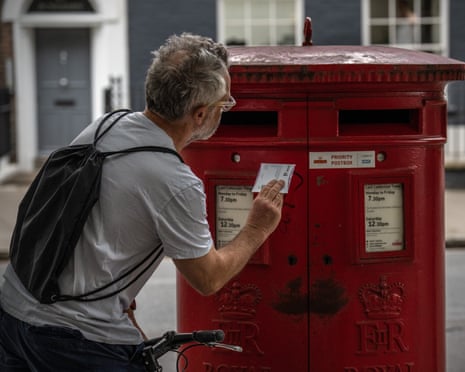
Royal Mail has promised to invest £500m over the next five years to improve its UK delivery service.
The service is now working towards meeting its new postal delivery targets by May next year, after agreeing a plan to roll out changes to scrap second-class post on Saturdays.
It will phase in a new letter delivery model next month, which will see it deliver second-class post every other weekday.
The company said the changes should see it improve first class next day delivery to around 85% within nine months of the reforms, then hit the 90% target set by the regulator Ofcom within a year.
Chief executive Alistair Cochrane said:
double quotation mark We recognise our service hasn't always been the standard our customers rightly expect and we're determined to do better. The plan we've set out today shows how we'll make a step change in performance across the UK, backed by £500 million of investment over the next five years.â€
The postal service was fined a record £21m by Ofcom last year for missing its annual delivery targets for first- and second-class mail, on top of a £10.5m fine in 2024 and a £5.6m fine in 2023.
Natalie Black, Ofcom's director for infrastructure and connectivity, said:
double quotation mark As well as fining Royal Mail £37 million for failing to deliver what customers expect and deserve, we've also been calling on the company to publicly set out a credible plan for change, backed by investment. Now that's published, Royal Mail needs to get on and implement it. Their plan must deliver significant and continuous improvement, with performance getting back on track.â€
CWU general secretary Dave Ward said:
double quotation mark We welcome any serious proposal that seeks to reverse customer service failings at Royal Mail, but what really matters is what happens on the ground to make that change happen.Postal workers remain committed to delivering for the communities they serve, but they need the tools to do this.
They need answers over whether the workforce will be properly resourced and retained, whether they will have a real say over how change is deployed, what manageable workloads look like, and how serious issues are fixed.
Royal Mail's current attitude of running the company with top-down, command and control methods, and prioritising finance over staffing and customer quality must end.
We have reached a negotiators agreement that says these things will be delivered, and we are currently explaining this to our representatives and members before we hold a ballot.
But Royal Mail's track record of sticking to their promises is not great, which is why as part of this agreement we have asked the government and parliament to oversee affairs and continue holding the company to account.
To give Royal Mail any chance at future success, we must also see a change in the remit of Ofcom, and an end to the exploitative labour models our competitors use to undercut Royal Mail and our posties.
We urgently await discussions with the government on all these issues.â€
Last April the Czech billionaire Daniel KÅ™etÃnský completed a drawn-out £3.6bn purchase of Royal Mail's owner, International Distribution Services, after the takeover was approved by a UK government national security review.
That same month the price of a first-class stamp rose, up 5p to £1.70, while the cost of the second-class service rose by 2p to 87p. This year, the price of a first-class stamp increased by 10p, or 6%, to £1.80. The cost of the second-class service went up by 4p, or 5%, to 91p.
AI firms looking for London offices boost British Land
Real estate group British Land has increased its earnings guidance for 2026 and 2027 as it reported “accelerating demand†from AI firms.
Chief executive Simon Carter said:
double quotation mark In campuses, we are seeing accelerating demand from a new wave of AI and innovation-led occupiers, driving strong rental growth in what remains a supply constrained market.
The company said it had recently signed Anthropic, one of the biggest AI companies in the world, for 158,000 sq ft at its One Triton Square office in London's so-called “knowledge quarter†near Euston – the sixth deal it has completed with the business, it said.
The FTSE 100 company now expects to deliver underlying earnings per share of 28.9p of the year to the end of March, ahead of previous guidance. Its shares are up by about 2% this morning.
UK labour market ‘cannot escape effects of war’, says work and pensions secretary
Turning back to the latest batch of UK labour market figures, which showed an unexpected fall in the unemployment rate – Pat McFadden, secretary of state for work and pensions, said:
double quotation mark These figures show that there was an improvement in the labour market at the beginning of the year with unemployment falling below 5%, and 332,000 more people in work than a year ago.But we cannot escape the effects of the war in the Middle East which are likely to feed through to prices and employment in the coming months. We will do everything we can to support the country through this period, including by slashing energy bills by up to 25% for 10,000 manufacturers.
And we're focusing on future proofing and upskilling our workforce through our £2.5 billion investment to get more young people earning and learning alongside personalised support to help sick or disabled people who had previously been written off.â€
It's a cautious open for European markets this morning. The UK's FTSE 100 is up by less than 0.1%. The French Cac 40 has slipped 0.2%, and the German Dax is up 0.5%. But the Stoxx Europe 600, which tracks the biggest companies on the continent, is effectively flat.
Crest Nicholson shares plunge 29% after profit warning

Julia Kollewe
The UK housebuilder Crest Nicholson has issued another profit warning, hit by rising build costs, higher interest rates and worsening consumer confidence in the wake of the Iran war, and has begun talks with its lenders about relaxing its loan conditions. The news sent its shares 29% lower.
Martyn Clark, the chief executive, said:
double quotation mark It is increasingly clear that the current macroeconomic uncertainty is contributing to the prospect of a more prolonged higher interest rate environment, renewed cost pressures and a deterioration in consumer confidence.â€
Following a drop in new enquiries and visitor levels to its sites, Crest now expects to complete 1,400 to 1,500 homes this rather than 1,550 to 1,700 as previously estimated. Build costs have been higher than expected because of higher energy costs, and it anticipates a reduced number of land sales. It has completed one land sale so far, but said:
double quotation mark However, in recent weeks there has been a marked softening in sentiment among prospective land purchasers. Buyers have become more cautious in the face of the uncertain outlook, resulting in reduced engagement in bidding processes and an increased reluctance to transact at market values.â€
This has prompted Crest to slash its underlying profit forecast to £5m to £15m this year, from its previous estimate of £42m to 52m, and warned that “as a consequence of lower expected profitability, it is in the early stages of seeking temporary banking covenant relaxationâ€. Analysts had been expecting a profit of £44m.
The builder now expects net debt of £100m to £120m (previously £15m to £65m) and interest costs of £15m, rather than £10m to £12m. With the Iran war driving oil and gas prices sharply higher, UK inflation is likely to increase, and the Bank of England is expected to raise interest rates in the coming months. Prior to the conflict, economists had been expecting rate cuts.
Anthony Codling, housing analyst at the broker RBC Capital Markets, said:
double quotation mark We don't expect lenders to withdraw funds, but we expect their ongoing support will come at the price of higher interest costs.â€
He said the decision to slow land sales “will hit profits this year, but we agree with the decision not to sell at suboptimal prices, a value over volume approachâ€. The Surrey-based builder closed a divisional office in December and cut 50 jobs.
Primark owner confirms plan to spin off fashion chain
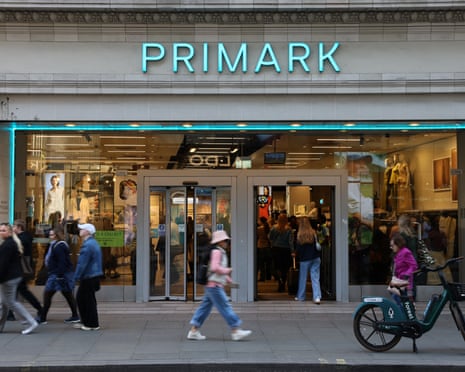
Elsewhere this morning, the owner of Primark has confirmed its plan to demerge the fashion chain from the group.
Associated British Foods – which also owns the bread brand Kingsmill and Twinings tea – said it wants to break up its conglomerate structure by the end of 2027, following a five-month evaluation with shareholders.
It means Primark could become a member of the FTSE 100, the UK's group of blue chip shares, if it joins the stock market.
Dan Coatsworth, head of markets at the broker AJ Bell, said:
double quotation mark For years, ABF said it would never split Primark from the group, arguing that a conglomerate structure provided added benefits. To some extent that is true, as evidenced by ABF regularly having one of its many component parts fall behind and the rest of the group picking up the slack. However, the bigger Primark has got, the stronger the call to let it stand on its own. ABF has finally buckled and pressed the button on the demerger.…Demerging from a conglomerate parent could lead to faster decision making and freedom to explore new growth opportunities. That could involve expanding into new countries or adding smaller stores in high footfall locations that only stock the most popular items.
…Primark is currently experiencing a few bumps in the road amid tougher market conditions. A prolonged Middle East conflict could exacerbate the situation if the oil price stays higher for longer, leading to cost pressures for Primark and weighing on consumer sentiment. While that suggests uncertainty ahead, investors looking at the demerger will be judging Primark on its long-term growth potential, not the next few months.â€
The announcement came as the company reported that group sales fell 2% to £9.46bn in the six months to 28 February and pre-tax profits were down 9% to £632m.
The company said its sugar business performed “below our expectations†and was now expected to report an annual loss, while its grocery business had faced weak trading in the US.
Sales at established Primark stores across the world fell 2.7% in a “difficult clothing marketâ€.
Shares in ABF are down by about 6% this morning.
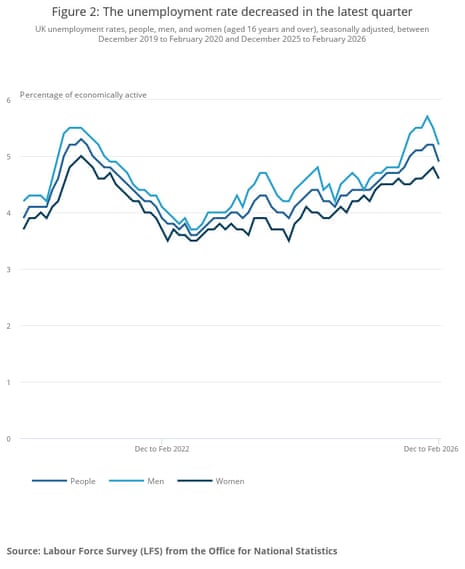
Here's the ONS chart showing the unexpected fall in the UK's unemployment rate in the three months ended in February – though it does not include the impact of the Iran war, which started at the end of that month.
The impact of the war is expected to hurt the labour market in the coming months. The EY Item Club has forecast that unemployment will hit 5.8% by the middle of 2027, with almost 250,000 more people losing their jobs because of the crisis in the Middle East, pushing the number of jobseekers to more than 2.1 million.
Last week the International Monetary Fund warned that UK faced the biggest growth downgrade among the G7 group of countries, with 0.8% forecast for 2026, down from the 1.3% the IMF predicted in January.
Economists are not convinced that the UK's labour market is a healthy one. Thomas Pugh, chief economist at the audit and tax firm RSM, notes that the drop in the unemployment rate was mostly driven by people dropping out of the labour force.
double quotation mark Indeed, employment only rose by 24,000 in the three months to February, well below population growth. What's more, the number of people on payrolls contracted slightly in February. Private sector pay growth ex-bonus also slowed slightly from 3.3% to 3.2%. All this suggests that despite the fall in the headline unemployment rate, the labour market remained weak going into the energy crisis.The provisional data for March suggests the labour market weakened last month. Payrolls dropped by 11,000 and the number of vacancies fell again. The risk is that rising energy prices prompt a big pull back in consumer demand while simultaneously pushing up input costs for businesses, which would push the unemployment rate even higher. We now think the unemployment rate will probably peak at around 5.5%. If energy prices rise higher over the summer as supply becomes even more constricted, the unemployment rate could move towards 6%.
The weak labour market substantially lowers the risk of higher energy prices feeding through into higher wages as they did in 2022 as evidenced by slowing pay growth. Workers are in a much weaker position than they were in 2022 and will find it harder to bid up nominal wages to protect their real incomes. That will lessen the second-round effects that the MPC is most worried about. That, in turn, will temper the need for aggressive rate hikes.
The base case is still for a prolonged interest rate hold, rather than a series of rate hikes, unless inflation goes substantially higher.â€
Unemployment still likely to rise this year, BCC warns
While the latest figures show a fall in the UK's unemployment rate, businesses are warning that it is likely to rise overall this year.
Patrick Milnes, head of people and work at the British Chambers of Commerce, said:
double quotation mark While unemployment has seen a surprise fall to 4.9%, the expectation is that it will rise this year as business uncertainty caused by the Iran War overshadows the UK economy.With the cost of employment also high, and expected to rise as the Employment Rights Act comes into effect, our latest forecast expects unemployment to hit 5.5% this year. The slow-down in wage growth indicates businesses are taking their foot off the gas and the labour market will continue to loosen.
With the conflict in Iran likely to drive higher inflation and weaken growth, the spectre of stagflation is beginning to grow.
This has upended expectations at the start of the year of further interest rate cuts by the Bank of England, increasing the level of uncertainty still further.
The government must move swiftly to show that it understands the problems firms face. Action to ease the cost burdens they face, such as help with electricity bills and reform of business rates would go a long way to demonstrating this.â€
Introduction: Wage growth hits lowest level since November 2020
Good morning, and welcome to our rolling coverage of business, the financial markets and the world economy.
Unemployment in the UK fell from a post-pandemic high in the three months ended in February, the latest figures show.
The unemployment rate unexpectedly dropped to 4.9% in February, according to figures from the Office for National Statistics – down from 5.2% in the previous quarter.
However, wage growth was meagre, hitting its lowest level since November 2020 at just 3.6% for regular earnings excluding bonuses. Total pay, which includes bonuses, also dropped to a five-year low of 3.8%.
Liz McKeown, director of economic statistics at the ONS, said:
double quotation mark The number of workers on payroll remained broadly flat in recent periods, reflecting ongoing weak hiring.Vacancies fell to their lowest level in almost five years, but with unemployment also falling the number of vacancies per unemployed person remains broadly unchanged.
Alongside falling unemployment, the number of people not actively seeking work increased, with data suggesting fewer students seeking work alongside their studies.
Regular wage growth has slowed further with growth at its lowest rate in over five years.â€
Jonathan Raymond, investment manager at Quilter Cheviot, notes that today's release does not capture the impact of the war in the Middle East.
double quotation mark Given today's data does not capture the initial impact of the conflict in the Middle East, we can expect the labour market to soften even more from here on out. Businesses have had hiring plans largely on hold since before the budget, and many will have swiftly put the brakes on again at the outbreak of the war. When combined with other factors including ongoing wage pressures, national insurance increases and changes to business rates, it is difficult to see the labour market making a swift recovery any time soon.The Bank of England's monetary policy committee will reconvene next week to deliver its next interest rate decision, and today's data, as well as what is expected to be an unpleasant inflation print tomorrow, will only further cement expectations for a hold. The conflict in the Middle East has seen energy prices soar, and the full effects will take some time to feed through, adding a fresh inflation risk and complicating the Bank's decision-making process. It will soon have to make a call on how much it looks through any inflation spike and look instead to potential growth implications.â€
Elsewhere, oil is down slightly this morning, with Brent crude – the international benchmark – down by just under 1% to $94.63 a barrel. It reflect some cautious optimism that Donald Trump will be able to secure a peace deal in Iran, despite comments from the US president on Monday night that it is “highly unlikely†he will extend the current ceasefire agreement, which expires on Wednesday.
The agenda
-
10am BST: ZEW's Germany/eurozone economic confidence survey
-
10am BST: Social media and gaming firms give evidence on screen time
-
1.30pm BST: US retail sales for March
-
6pm BST: NatWest virtual shareholder event