
BoE’s Lombardelli: UK’s low-hire, low-fire labour market creating problems

Now, the Bank of England Watchers conference is about to hear from the BoE's deputy governor, Clare Lombardelli.
She starts by talking about the UK's labour market – which is cooling, but through “less hiring rather than more firing.â€
Expounding on points she made in her interview with the Guardian this morning, Lombardelli explains:
double quotation mark The economy has been more resilient to the recent energy cost shock than expected.Activity has held up better than anticipated, unemployment has risen only gradually, and redundancies remain relatively low. That may sound like good news. In lots of important ways, it is.
But a low-hire, low-fire labour market creates its own problems. It protects those already in work while making it much harder for those trying to get in or move on.
This, Lombardelli explains, creates three challenges for the Bank of England:
-
First, it affects how the Bank of England interpret the rise in unemployment. “If those looking for work are poorly matched to the jobs available, higher unemployment may do less to ease wage pressures than it has in the past,†she says.
-
Second, it can weaken productivity and growth – it's harder for workers to find job opportunities.
Lombardelli says “The costs are falling particularly heavily on young people, for whom the first step into work has become harder.â€
-
Third, it can make the economy less able to adapt.
Key events
Former Bank of England policymaker Martin Weale stirs things up at the BoE and its Watchers conference, by suggesting the current UK fiscal rules are inadequate.
Wouldn't it be better to be aiming to cut the national debt by 2% of GDP a year for a decade or two, he suggests, to put the national debt at a “more sustainable levelâ€.
[that would imply rather more rapid pace of consolidation than under the current fiscal rules!).
Resolution Foundation's Ruth Curtice points out that the UK is already consolidating faster than other advanced economies.
Yes, it could try to lower debt faster. But she's not sure you could do it and win an election (a reminder of the political constraints on the public finances…).
The next UK fiscal event, the spring statement, may look more like a budget.
Ruth Curtice, head of the Resolution Foundation, suggests it will be a March budget “unless you think fuel duty will go up by 5p per litre in Julyâ€, and the temporary zero rate of VAT on electricity will suddenly finish at the end of March.
So it may not be called a budget, but it may well include fiscal measures to allow an extension of the freeze on fuel duty and VAT on electricity.
The government must then choose whether to conduct its next spending review then, or later, – and that, Curtice believes, will depend on how the forecast looks.
Former UK chancellors Kwasi Kwarteng and Rachel Reeves are both responsible for pushing up UK borrowing costs, the Bank of England Watchers conference is hearing.
Theo Morris Clarke of Rokos Capital Management is showing us a chart which shows that the gap between expected borrowing costs, and what the UK ended up actually paying, widened after the 2022 and 2024 budgets.
And here it is:
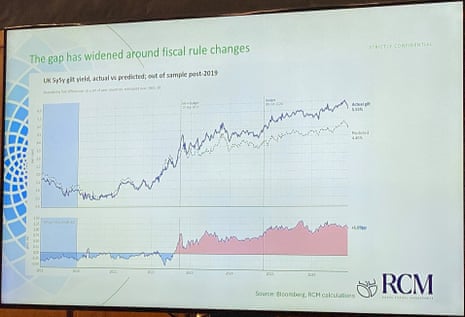
As you may remember, Kwarteng was chancellor during the mini-budget fiasco, when Liz Truss's government planned unfunded tax cuts and a major energy bill support package, without allowing the Office for Budget Responsibility to calculate if they would have breached the government's borrowing rules.
Reeves was less radical in 2024, but did change the UK fiscal rules to focus on the PSNFL debt measure, letting the government borrow more.
Morris Clarke says his calculations show there are “some costs to goverments†when fiscal rules are changed, or ignored.
UK facing ‘lost decade’ for living standards
Back at the Bank of England Watchers conference, delegates are being warned that the UK is facing a lost decade for living standards.
And we don't need a leak inquiry to understand why!
Instead, Ruth Curtice of the Resolution Foundation is here to warn that the 2020s look to be even worse for living standards than the years after the financial crisis.
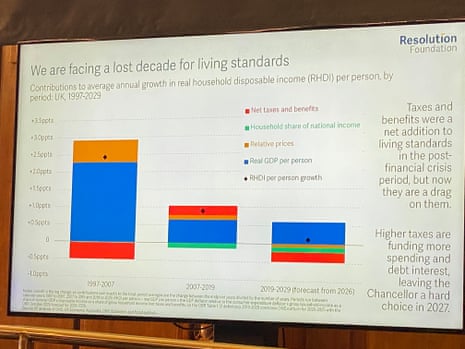
Curtice explains that disappointing productivity is absolutely part of the cause of the post-financial crisis collapse in living standards growth.
But the difference between the 2010s and the 2020s is “most strikingly†due to net taxes and benefits, Curtice says.
They were adding to incomes before the pandemic, but in the 2020s will take away from incomes, she explains.
Treasury: We tightened our security measures, but…
James Bowler also defends the security measures implemented before this autumn's budget.
He says the Treasury introduced a new security marking and much stronger digitally enforced access controls for sensitive material.
These included encryption and restrictions on printing, downloading and forwarding.
The management of access on a need-to-know basis was also tightened, which was meant to prevent sensitive details from leaking.
But, Bowler adds, information was made available to a wider circle on Budget Day.
double quotation mark I would note that, on the day of the Budget and immediate preceding period, there is a necessary widening of the circle of knowledge within government to prepare for its delivery.Such access remains subject to strict confidentiality requirements including on not disclosing to the media or market participants.
Chancellor John Healey can expect to be quizzed about the leak when he appears before the Treasury Committee at 2.15pm on Wednesday.
Chair Meg Hillier says:
double quotation mark “The Treasury still has questions to answer on how market sensitive information which was likely to affect the share price of banks was circulating around newsrooms before it was given to Parliament.I will be pushing for those answers when the Chancellor appears in front of the Committee tomorrow afternoon.â€
Dame Meg Hillier, who chairs the Treasury Committee, is not terribly confident that this leak inquiry will root out the culprit.
Hillier says:
double quotation mark “I suspect that yet another inquiry into the leak of Budget measures will turn up no evidence of a breach but plenty of reassurance that next time it will be even more secure. And so the cycle continues.“We cannot continue to accept this doom-loop of dead-end investigations in which everybody in the Treasury throws their hands up in despair, but nobody is ever found to have done anything wrong.
Inquiry launched into UK budget bank tax leak
Newflash: the UK government has launched a leak inquiry into how the media reported details of its bank tax hours before last month's budget.
James Bowler, Permanent Secretary at the Treasury, has told parliament's Treasury Committee that a probe is underway.
This inquiry will, presumably, examine how Bloomberg reported at 10.45am on budget day that chancellor John Healey would hike bank taxes less steeply than feared, and only increase the bank surcharge by 3%.
That was at least two hours before Healey did indeed announce this in his budget speech.
Bloomberg's report caused bank shares to rise (as we blogged here) – so it is a classic example of a market-moving leak.
Bowler told the Treasury committee in a letter, just released:
double quotation mark I have been assured that no banks, their representatives or their trade bodies were briefed by Treasury on the details of the changes to the Bank Corporation Tax Surcharge before the publication of the Budget and the Chancellor's statement to the House.However, I can confirm that an investigation, lead by the Government Security Group (GSG) in the Cabinet Office, is underway. The Treasury is supporting that work. I won't prejudge its findings.
Wall Street falls in early trading
As feared, the US stock market has opened with losses after today's higher-than-expected inflation reading.
The S&P 500 index, a broad measure of US stocks, has dropped by 0.75%, while the Nasdaq Composite tech index is down 1%.
ING economist James Knightley reports that the markets are now fully pricing in a December increase in US interest rates, saying:
double quotation mark Following on from Fed Governor Chris Waller's comments earlier today that he backs a 25bp hike in December and could even opt for a 50bp hike, Treasury yields have pushed higher, with the 10Y and 2Y up 6bp and 13bp, respectively. Markets are now fully pricing in a 25bp hike at the December Fed meeting, in line with our own forecast, versus 20bp from before Waller's comments.
Wall Street to drop after inflation data
Wall Street is not happy that US monthly inflation rose faster than expected in October.
The futures market shows that the US stock market is going to drop at the open, in under 40 minutes.
The S&P 500 share index is forecast to drop by 0.75%, and the tech-focused Nasdaq is on track for a 1.3% fall.
That's because higher inflation makes interest rate rises more likely.
Fed policymaker Christopher Waller spelled this out to the Bank of England Watchers conference today,
Waller warned that a half-point hike in US interest rates might be needed, saying:
double quotation mark If the October CPI inflation data out later today are similar to the past two monthly readings—with core CPI inflation around 0.3% or even higher—then a stronger policy move may be needed.In that case, I believe a 50 basis point hike in the policy rate should be considered at the December meeting.
Traders will be noting that US core inflation did indeed come in at 0.3% (see previous post).
What was US annual inflation? Good question!
Disappointingly (and frankly embarrassingly) we don't have a new official estimate of US annual inflation.
This is because of the disruption caused by the US government shutdown a year ago.
The BLS explains that it did not collect its usual pricing data in October 2025 “because of a lapse in appropriationsâ€, adding:
double quotation mark For most CPI series, BLS could not publish October 2025 indexes.As a result, BLS cannot publish 12-month percent changes for October 2026 for indexes where October 2025 data are unavailable.
US inflation rises faster than forecast
Newsflash: US inflation rose faster than expected last month, as Americans continued to suffer from rising food and energy prices.
The US Bureau of Labor Statistics has reported that the Consumer Price Index rose 0.4% on a monthly basis, higher than the 0.3% rise forecast by economists.
The report found that food prices rose by 0.5% in October, while energy prices jumped by 0.7% month-on-month.
The index for shelter (housing) rose 0.3%.
Core US inflation, which strips out food and energy, rose by 0.3% for the third month running.
Indexes that increased over the month include recreation, medical care, motor vehicle insurance, household furnishings and operations, and education.
But used car and truck prices, and communication costs, decreased month-on-month.
Lombardelli: AI will make junior economist jobs much more interesting
Q: Does the Bank of England agree with US economist Jason Furman who gave a provocative estimate last week that AI could displace at least half of analytical economics jobs?
Clare Lombardelli agrees that Furman's piece was “very provocative.â€
She then explains that it's “quite astonishing†what AI can do.
She says it will fundamentally change what economics jobs are, and make them rather more interesting.
It will mean that junior economists doing a lot less chart formatting, and more time thinking about the economy.
Does it mean fewer people? Or does it mean people doing much better work?
Lombardelli says there will be “a balance between the twoâ€.
Q: How restrictive is the current Bank rate of 4%, given rising R* around the world and the UK's solid economic growth?
[R* is the neutral rate of interest, where it's neither restricting growth nor stimulating it. Central bankers can be reluctant to estimate it too precisely…]
…and Lombardelli sticks to that position! She explains that the Bank has quite a wide range for its estimate of R*.
4% is just above the top of that range, but only just.
Lombardelli says her estimate is higher than some other members of the comittee.
She adds that interest rates have been less restrictive than the Bank expected.
Asked about the risks of an AI bubble bursting, Clare Lombardelli replies that we are “likely to see lots of changes†around the valuations of AI companies.
But while there may be a lot of volatility, that doesn't mean AI won't be transformative.
Lombardelli won’t rule out back-to-back rate hikes
Q: You said there are reasons to proceed gradually – is that an indication that you wouldn't support another interest rate rise in December?
Lombardelli says we shouldn't take that comment as a signal!
She will not rule out back-to-back increases, and points out that the MPC will have more information by the Bank's next meeting in mid-December.
I wouldn't rule December in or out, or February in or out, Lombardelli states firmly. Every meeting is live.
Onto questions!
Q: Why has the UK labour market showed resiliance, despite recent economic shocks?
Clare Lombardelli suggests the Bank may be “systematically underestimating†the economy's ability to respond to shocks.
The BoE's economic models may underestimate the ability of companies, and households, to react.
Another possibility is that the economy's resilience is being eroded – with companies eating into their profit margins, and households running down their savings.


