‘The dinosaurs did not have a lobby. Fossil fuels do.’ – UN chief

Oliver Milman
Guterres launches into a plea for accelerated action to cut emissions and takes direct aim at the fossil fuel industry. The UN chief has already called on countries to push forward a phase out of fossil fuels, rather than merely hinting at it, here at Cop.
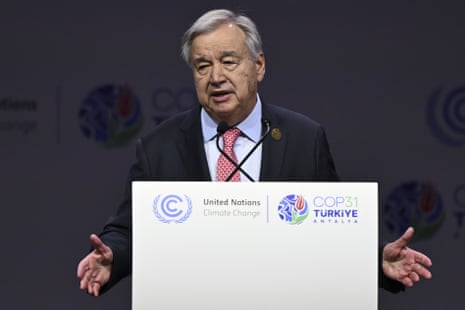
“The case for fossil fuels is collapsing,†he said. “Fossil fuels must go the way of the dinosaurs. And that won't happen on its own. The dinosaurs did not have a lobby. Fossil fuels do.â€
“It's time to kick the habit – and end the fossil-fuel addiction,†he said. Guterres likes a good pun and one of his final climate speeches has a decent one: “It's make or bake time.â€
Key events
Russell Dlamini, prime minister of Eswatini said because of the super El Nino, 20% of people living in Eswatini are facing acute food insecurity. “Behind these figures are families whose welfare dignity and prospects depend on the decisions we make,†he said. “Our responsibility is immediate, its fulfilment cannot be deferred.â€
Adylbek Kasymaliev, prime minister of the Kyrgyz Republic, highlighted the importance of the world's biggest economies supporting smaller ones.
“Climate finance is not charity,†he said. “It is a matter of climate justice and fundamental expression of our shared responsibility.â€
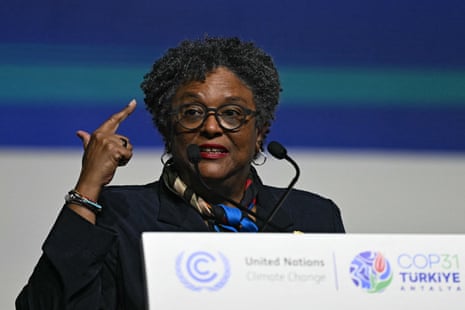
Mia Mottley, prime minister of Barbados, calls out governments for not trying
We just heard from Mia Amor Mottley, prime minister of Barbados. She called out governments who had “not tried hard enough†to curb emissions since the Paris agreement.
She called for natural disaster pause clauses in every international loan. “In case you have not realised it yet – the climate does not negotiate with geopolitics,†she said.
Mottley took Cop26 in Glasgow by storm a few years ago with a powerful speech warning that the world was at a critical “fork in the roadâ€.
Throughout Cop we are speaking to people affected by the climate crisis around the world. In today's story, Guardian environment reporter Pippa Neill met Gill (not her real name), a teacher in London.
In 2026, during the hottest summer on record, she suffered a seizure after experiencing heat exhaustion while teaching. The heatwave was made worse by the climate crisis. This is her story:
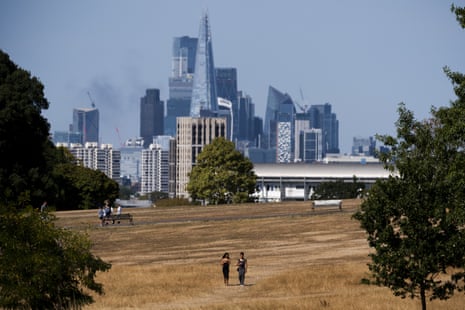
The heat has always made me feel anxious and uncomfortable, but this year was different. The temperature was building up as the summer went on and as it was escalating it was becoming more and more frightening.
It was impossible to get any meaningful rest because I couldn't fall asleep and when I did, I would wake up feeling suffocated because the air was so thick and dry and hot and there was nothing I could do to make myself feel better. Drinking water, using a fan, it didn't help.
It got to the point where I would wake up feeling like I couldn't breathe and with this rising sense of panic where I couldn't really imagine how I was going to get through the day. I felt unsafe.
There was a lot of anxiety among my colleagues too. People were obviously very uncomfortable, they were worried about the kids, worried about themselves.
One day in late June I woke up and I was exhausted and was lacking the motivation that I normally have for work.
I got to work and my classroom was 30C. It used to be the photocopier room but because of demand for space they took the photocopier out. It's a very small room with no windows. It was never designed to be a classroom, it's got no ventilation.
No one was really learning and I was dealing with challenging behaviour and as the day went on I started to feel increasingly unwell to the point where I was dizzy and feverish and I had a really bad headache. I felt like I couldn't concentrate on anything.
I was diagnosed with epilepsy about 20 years ago. It took about a year to get on top of it, but since then it's not something that affects my life in any way, it's extremely well controlled. But on this day, I had my first absent seizure since the diagnosis.
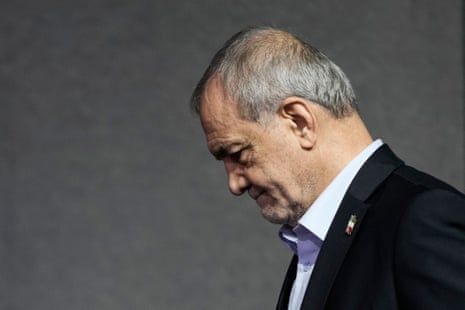
The president of Iran calls out the environmental impacts of war
Masoud Pezeshkian, president of the Islamic Republic of Iran, used his speech to call out the US and Israel's war on Iran and the environmental impacts of war.
“The environment is the silent victim of wars … the destructive impacts will remain after the conflict has ended.â€
“Let us keep in mind that the planet is not an inheritance of a single nation … peace is a prerequisite of environmental protection.â€
Hallo, I'm Matthew Pearce, taking over now from Ajit Niranjan.
Duma Gideon Boko, President of Botswana, has just told the leaders summit that his country needs “predictable global climate finance architectureâ€.
“The scale of mitigation and adaptation required far exceeds the resources available to Botswana and many developing countries … Yesterday is ideal, tomorrow is too late.â€
There are still plenty more world leaders left to speak today – among them the Iranian president, Masoud Pezeshkian, and Zheng Han, China's Special Representative – before another packed day of interventions tomorrow. I'm signing off from the blog for now, but leaving you in the capable hands of my colleague, Matthew Pearce.
Felix Antoine Tshisekedi Tshilombo, President of the Democratic Republic of the Congo, has also spoken about the important of protecting forests and “disarming the war economyâ€, adding that the desire for resources had led to conflicts.
“The world will not succeed in its ecological transition if it leaves Africa in the periphery,†he adds.
Wesley W. Simina, President of the Federated States of Micronesia, is championing efforts to cut methane, a strong but short-lived planet-heating gas, as a powerful way to limit the overshoot that islands fear. He adds that the Pacific nations have not come to Cop just to describe what they stand to lose. “We ask the international community to meet our leadership with action.â€
Surangel Samuel Whipps Jr., President of Palau has said Cop31 “must turn the tideâ€. He said the 1.5C goal was slipping away, adding that overshoot was “existential†for small island states. “In Glasgow [at Cop26] I said ‘you might as well bomb us',†he said, referring to the consequences of failing to act fast. “That might have been easier than watching climate change tear apart our homes piece by piece.â€
He cited the International Court of Justice (ICJ) landmark advisory opinion last year that found failures of climate action may constitute “internationally wrongful actsâ€.
Hassan Sheikh Mohamud, President of Somalia, is echoing the frustrations of several countries that emit disproportionately little carbon dioxide but are battered by extreme weather. “The move away from fossil fuels must be just, and must leave room for countries like mine to develop as well.â€
He has also called for disaster funds to be released earlier, before death tolls come in, and for the rich world to provide more money as grants, rather than loans. “Climate finance is an obligation, not a charity.â€
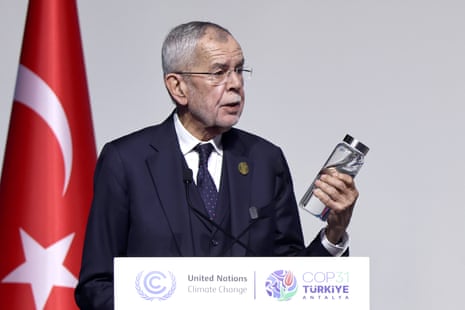
Alexander van der Bellen, President of Austria, has brought a bottle of water straight from the spring to tell a story. Austrians have always assumed they would have clean water – “enough even to water our meadows†– but supplies ran short in some places during this last hot summer. He's arguing that we all, no matter where we live, love our homes – “In Austria, that means snow-capped mountains, lakes, meadows, a white Christmas†– but that our homes are being threatened by burning fossil fuels.
Mohamed Muizzu, President of Maldives, has echoed comments from the Comoros on redesigning the architecture of climate finance and offering specific help to small islands. “We cannot be expected to borrow our way out of a crisis we did little to create.â€
Assoumani Azali, President of Comoros, has detailed the threats hitting the small African island nation in the Indian Ocean. “We are the hardest hit by a crisis to which we have barely contributed.â€
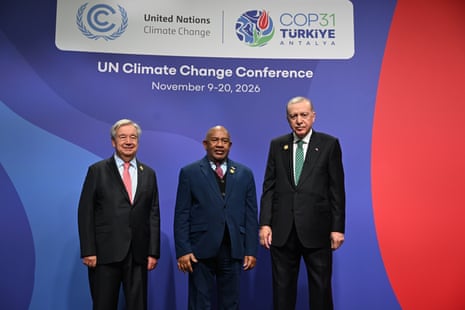
He described the ocean as a vulnerability that was also its future, and called for greater climate finance for island states within multinational development banks. “For islands, equity is not an option. It is a precondition for survival.â€
He's followed by Jakov Milatović, President of Montenegro, who is speaking about his country's efforts to get off coal and diversify its energy mix. He has proposed Montenegro's “ecological state 2.0â€, an initiative that marks 35 years since the country's declaration as the world's first ecological state. The renewal includes actions to hold polluters accountable and guarantee access to national parks.