
Key events
US car parts company First Brands Group forced into liquidation
The US car parts company First Brands Group, which makes things such as spark plugs, wiper blades and motor oil, has gone into liquidation.
A US bankruptcy court rejected a complex restructuring plan negotiated between the company, its lenders and unsecured creditors. First Brands had put forward a proposal to pay back creditors by pursuing litigation against insiders.
The company's crisis and collapse has caused anxiety on Wall Street in recent months. The speed of its implosion spooked investors, and caused losses for some of the largest investment firms. It also sparked wider concerns about fund managers' exposure to troubled ‌borrowers in the opaque markets for private credit.
In an oral ruling, judge Christopher Lopez at the bankruptcy court in Houston described the Chapter 11 reorganisation plans as “unconfirmable under any circumstances,†citing breaches of bankruptcy laws, in part because it sought to defer payment on at least $222m in debts racked up during the company's bankruptcy.
First Brands owes â billions more, accumulated before its bankruptcy, and its efforts to sell off businesses generated only a fraction of what it owes to its creditors. Lopez said:
double quotation mark Unfortunately, time â was not on the debtor's side. The sales process did not render the types of ​sales prices I'm sure everybody wanted.
The company failed in its quest to ​find a buyer ​for the whole business and only sold a few divisions. It sold its Horizon towing business for $64m, its Toledo Molding + Die business for $80m and its Walbro business for $50m.
First Brands' preferred liquidation plan would have set up litigation trusts to help pursue lawsuits in the hope of raising additional money for creditors over time. But under the proposal, the lawsuits would need to bring in $1.9bn before the company could fully repay the administrative claims that must be paid first, Lopez said, according to Reuters.
Creditors who opposed ‌the bankruptcy plan, as well as the US Justice Department's bankruptcy watchdog, expressed doubt that the company's litigation would result in a meaningful recovery from people like ​the company's indicted founder, Patrick James. James and his brother Edward James were indicted on fraud charges in January, but have pleaded not guilty.
First Brands filed for bankruptcy in September with $14m in cash and more than $9bn â in liabilities. The company borrowed an additional $1.1bn from its lenders early in its bankruptcy ​but burned through most of that cash ​by January, forcing it to rely on prepayments from key parts buyers ​like Ford and General Motors.
Some more info on Vistry's £350m grant under the UK's £39bn social and affordable homes programme, to build more than 3,000 homes across the country. The news catapulted the company to the top of the FTSE 250 index – the shares are now up nearly 18%.
Planned homes include:
-
82 homes with West Northants Council at Harlestone Road, Northampton
-
149 homes with Vico, a registered provider, at Mapplewell and Blackmoorfoot Road, Huddersfield in Yorkshire
Vistry is one of Britain's biggest housebuilders which specialises in constructing social and affordable homes in partnership with housing associations, local authorities and build-to-rent investors.
The initial grant, the biggest possible at this stage in the government programme, comes after the company warned it will make a loss of £30m in the first half of the year, bigger than it estimated in May. It has resorted to heavy discounting to attract buyers for unsold homes.
The Green party is not impressed with Andy Burnham backtracking on his previous pledge to dedicate all £39bn of the government's affordable homes programme to council housing.
Green MP Hannah Spencer, who was working as a plumber until she was elected to parliament, said:
double quotation mark This a massive backtrack by Andy Burnham who made a clear pledge to dedicate the £39bn Affordable Homes Programme to building desperately needed council housing. It is another missed opportunity to provide the genuinely affordable housing that is so desperately needed.I hear from so many people who are stuck on waiting lists, living in temporary accommodation or who are homeless. Andy Burnham is continuing to let these people down.
German business confidence rises more than expected
More good news for Germany, whose economy grew slightly more than previously thought in the second quarter, by 0.3%.
Confidence among businesses in Europe's largest economy rose more than expected in August, suggesting the economy is recovering, according to a closely-watched survey.
The Ifo Institute for Economic Research, based in Munich, said its business climate index climbed to 88.8 this month from an upwardly revised 86.7 in July. Analysts polled by Reuters had expected an increase to 87.2.
Clemens Fuest, president of the Ifo institute since 2016 and professor of economics and public finance at the Ludwig Maximilian University of Munich, said:
double quotation mark Despite another rise in energy prices, the German economy is recovering.Companies were more satisfied with their current situation, and they revised their expectations significantly upward. Uncertainty continued to decline.
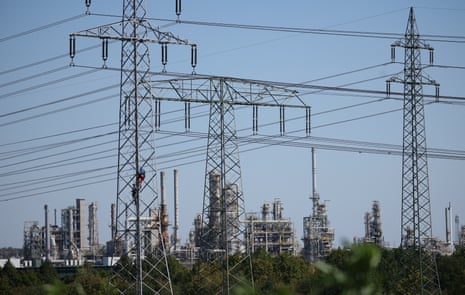
Sentiment in the manufacturing sector improved noticeably, as companies expect production to increase over the next three months, although they remain dissatisfied with their order situation.
Expectations in the service industries also went up. While IT service providers were more confident about their future development, the situation in the transportation and logistics sector remains difficult.
In the trade, retail and wholesale sectors, sentiment also improved.
In construction, confidence increased as firms were less pessimistic about their prospects, although they said their current situation was slightly worse.
Carsten Brzeski, global head of macro at ING, said the German economy is on track for its best economic growth performance in four years.
double quotation mark Despite the obvious headwinds from low water levels [in major German rivers], the never-ending war in the Middle East and the struggle to implement the announced reforms, the German economy has developed an unexpected resilience. In fact, it seems on track to achieve the best growth performance since 2022.
Lego sales rise as World Cup and F1 tie-ups prove to be winners

Sarah Butler
Lego sales have risen by more than a fifth as tie-ups with the football World Cup, Formula One and the hit film KPop Demon Hunters as well as its flower-based and Star Wars kits drive demand.
The Danish toymaker said its revenues increased by 21% to 41.9bn Danish kroner (£4.8bn) in the first six months of 2026, driven by strong growth in the Americas, Europe and the Asia Pacific regions. Sales by its clients to consumers rose by 22%.
Net profit increased 32% to 8.6bn Danish kroner (£1bn) as the group launched 330 new products including its high-tech Smart Play kit, with bricks that emit sounds and light.
Niels B Christiansen, the chief executive of Lego Group, said:
double quotation mark We are very pleased with our strong start to 2026 and the excitement we see for the lego brand. Our portfolio of products offers something for everyone, and culturally relevant brand experiences continue to drive demand across the globe. Our success in the market means we can maintain high investment levels in growth and sustainability for both the short and long term.

He said Lego was expanding solar energy capacity at all of its factories. In June, it began constructing its largest solar installation so far in Billund, Denmark – its main headquarters and the home of the original Legoland park. The site, which will begin operating next year, will feature 160,000 panels able to produce 99 GWh per year. It is designed to match the company's electricity needs in the town.
Lego also said it was also continuing its global shift towards using paper bags in its packaging and expected that to be completed next year.
Lego has led a resurgence in the toy market in the past year – as adults look for an alternative entertainment to phones and TV screens.
So called “kidults†(buyers aged 12 and over) are spending spare cash on expensive Lego sets and collectible figurines. This group is behind £1 in every £3 spent on toys in the UK, and these buyers spent 10% more in 2025 than the year before, according to a study by market research company Circana.
Vistry gets £350m grant to build over 3,000 affordable homes; shares surge
Vistry Group, one of the UK's biggest housebuilders, has bagged a grant of £350m under the government's £39bn social and affordable homes programme, to build more than 3,000 homes across the country.
The news sent its shares soaring, up nearly 17%, catapulting the company to the top of the FTSE 250 index.
Ministers laid out plans on Monday to spend nearly £10bn from the 10-year affordable homes programme on a mix of subsidies housing types in England. Andy Burnham backtracked on his previous ambition to spend the funds entirely on social homes.
Vistry, formerly known as Bovis Homes, said this first allocation of funding is the largest possible in this phase, and much more than the initial funding received under the previous programme.
Under the 2021-26 affordable homes programme, the company received an initial grant of £83m, out of total funding of £278m, which went into the construction of more than 3,5000 affordable homes.
Since then, build costs have gone up. There is also a higher percentage of social rent in the new programme, which means higher grant rates are required.
Vistry has been reconfirmed as a strategic partner by the government, and will be working with other strategic partners, mayors and councils.
Adam Daniels, the Vistry chief executive said:
double quotation mark Vistry has received direct grant funding awards under successive affordable homes programmes for nearly 20 years, and this award reflects our established track record and commitment to delivering much needed affordable homes in collaboration with Homes England and our partner providers.We are delighted that Homes England has made this significant announcement that will create over 73,000 new homes and provide Vistry, its partners and the wider sector with a much-needed stimulus.
We already operate in all of the established mayoral strategic authorities and have established relationships with 29 of the 32 other strategic partners announced this morning. We look forward to continuing to work with councils and Homes England to meet local ambitions to increase housing supply at pace.
Burnham backtracks on spending housing fund only on building social homes
Over here, Andy Burnham has backtracked on his proposal to rip up the government's housing plans and boost social home building.
Ministers laid out plans on Monday to spend an initial £10bn from the 10-year Affordable Homes Programme on a mix of subsidised housing types in England, in line with the Starmer government's policy.
Burnham previously called for the programme to be spent entirely on social homes, which are more heavily subsidised and therefore more affordable than other types of government-funded housing.
He said when launching his campaign to become MP for Makerfield:
double quotation mark There's £39bn allocated over a 10-year period … I'm saying that should be dedicated to council homes. Let's not be coy any more … I'm saying council homes because control matters.
US Treasury's Scott Bessent ‘making mistake' interfering with bond markets, former mentor warns

Graeme Wearden
Scott Bessent's attempt to calm the bond markets and push down America's cost of borrowing have attracted a rebuke from the US Treasury secretary's former mentor.
Billionaire investor Stanley Druckenmiller, who worked with Bessent at George Soros's fund management firm in the 1990s, has warned that his former pupil is courting danger by trying to suppress US bond yields.
Druckenmiller, writing in the Wall Street Journal, argued that the US should “Let the bond market speakâ€, rather than expand its bond purchases in an effort to push up prices, and lower borrowing costs.
double quotation mark Governments defending prices against fundamentals always lose. The only variable is how much they spend before conceding.
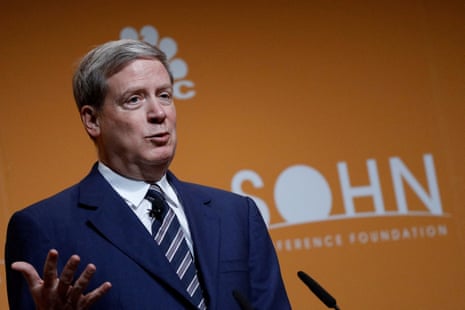
Druckenmiller argues that Washington should heed the rise in borrowing costs – measured by bond yields – and take steps to cut the budget deficit, rather than interfering in the market to push yields down again. He wrote:
double quotation mark The long-term Treasury yield is the most important price in the world. It is also the only fiscal disciplinarian the US has left. Neither party will run on entitlement reform. Both have spent the past decade expanding commitments while ignoring arithmetic.
Druckenmiller's intervention comes after Bessent decided to least double the maximum size of the Treasury's buyback operations, from $2bn (£1.5bn) to $4bn. That move briefly led to a drop in US long-term bond yields, but this quickly reversed.
Druckenmiller said:
double quotation mark The market's verdict was swift and correct: This wasn't liquidity management, it was price management – and a mistake far larger than $4bn suggests.
Ipek Ozkardeskaya, senior analyst at Swissquote, has sent us her thoughts on gold.
double quotation mark Renewed appetite for gold despite elevated long-term US yields is striking and sends a clear message: investors are moving back to the precious metal as:
-
A hedge against unclear US fiscal plans and the lack of conviction in the US administration's capacity to rein in exploding debt when military expenses are adding to already heavy bills.
-
A hedge against inflation, amid questions over the Fed's willingness, or ability (!), to fight inflation independently.
-
A hedge against a potential rout across global risk assets on worries about high valuations, massive AI spending and the growing financing web around the companies involved in building the AI ecosystem – the circularity.
Last Friday, gold cleared an important technical resistance: the $4,530 an ounce level, she noted. The precious metal flirted with the $4,00 offers this morning in Asia before giving back part of the gains. Ozkardeskaya added:
double quotation mark The question is: will gold gather enough momentum to return sustainably above the $5,000 mark?Possibly, yes. The broad de-dollarization trade that's quietly building in the background, justified by global institutions' efforts to diversify away from US Treasuries and toward gold, remains supportive of gold in the longer run. In the shorter run, overbought conditions could lead to downside corrections, giving dip-buying opportunities to long-term bulls.
And zooming out, the present macroeconomic setup – with rising inflation expectations – increases appetite for hard commodities, and alternative assets and hard commodities are also having a moment.
Among them, Bitcoin has rallied strongly since last week, while copper – one of my favourite industrial metals in the AI age – is also pushing higher, with the positive momentum backed by strong backwardation – meaning the spot price is higher than futures prices – which in turn is backed by strong fundamentals: copper supply and inventories struggle to keep pace with strong demand growth driven by electrification and the AI buildout, and the widening demand/supply gap makes traders willing to pay a large premium for copper now, rather than copper delivered later.
Introduction: Gold hits highest level in three months as traders worry about US inflation and bond market jitters
Good morning, and welcome to our rolling coverage of the global economy, the financial markets, the eurozone and business.
Gold has climbed further, hitting its highest level since mid-May, as traders and investors worry about the outlook for US inflation and bond market jitters.
Spot gold hit almost $4,700 an ounce earlier and is now trading at $4,649 an ounce.
Prices jumped last week after the US Treasury Department said it would double its debt purchases of longer-dated bonds, as it scrambled to calm the bond market after a sharp rise in yields. The focus is now on US inflation data and a speech by Federal Reserve chair Kevin Warsh on Friday for clues on interest rate hikes and the bond market.
Cryptocurrencies are also rallying. Bitcoin rose through $80,000 for the first time since May, rising to $80,453 this morning, up more than a quarter in the past week. However the cryptocurrency remains well below the all-time peak of $126,000 reached last year. Ether also climbed, to $2,503.

Meanwhile in the Middle East, just two commodity vessels transited the strait of Hormuz on Monday, the lowest daily tally since early May, with both entering the Gulf, according to shipping data.
The figure was also well below the 10-day average of 14, Reuters reported. However, some ships switch off their navigation transponders on their way through so the real figure could be higher.
Iran said on Monday it had backlisted 45 tankers for violating its rules on passage through the key waterway and threatened action such as fines against vessels engaging in ship to ship transfers with them.
Oil and stock markets have shrugged off the threat of severe sanctions against Iran or any entity maintaining economic ties with Iran from the US, after nearly six months of war.
Brent crude, the global benchmark, has fallen further this morning to $91.41 a barrel, down 76 cents or 0.8%.
Asian stock markets are mostly higher, with Japan's Nikkei up 0.5% and South Korea's Kospi rising 0.7% while Hong Kong's Hang Seng dipped 0.15%.
Launching what he called Operation Economic Outcast on Monday, the US treasury secretary, Scott Bessent, called it an unprecedented campaign and compared it with the D-day Normandy landings, a turning point in the second world war.
However, when asked by a reporter why the US wasn't imposing immediate sanctions, Bessent replied:
double quotation mark Well, we are giving everyone the opportunity to remedy bad behaviour. Why would I want to blow up the global financial system? We believe that it is important to level set and give people a cure period, but they should know that that will move very quickly and that we are serious.
It is unclear how far the Trump administration is prepared to go in confronting China, Iran's biggest trading partner. Tehran vowed retaliation against any country that took part in the US-led isolation campaign.
Germany, Europe's biggest economy, grew 0.3% in the second quarter compared with the previous quarter, driven by exports, according to official figures. That's slightly higher than a preliminary estimate of 0.2%.
Ruth Brand, president of the Federal Statistical Office, said:
double quotation mark The German economy is maintaining the growth momentum seen at the start of the year. As in the first quarter, growth was primarily driven by the positive development of exports.
Total exports of goods and services rose 2%. And wholesale and retail trade performed much better than expected, while investment dipped 0.2%.
The Agenda
-
9am BST: Germany Ifo business confidence for August
-
10am BST: UK gilt auction of 2033 bonds
-
2pm BST: US S&P/Case-Shiller 20-City Home Price Index
-
3pm BST: US Conference Board consumer confidence for August
-
3pm BST: US New home sales for July