
Bank of England’s Lombardelli warns that rates will probably rise unless energy shock fades
Newsflash: A Bank of England deputy governor is warning that interest rates will be raised, if necessary, to combat the risk of persistent inflationary pressures from higher oil prices.
Clare Lombardelli is telling the Sixth Biennial Conference on Macroeconomic Policy in Warsaw that the energy shock due to the conflict in the Middle East is likely to keep pushing UK inflation higher in the coming months.
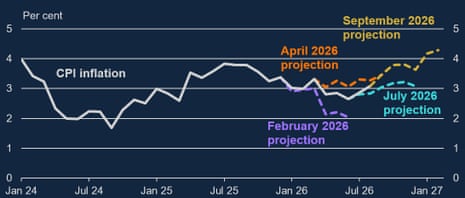
Lombardelli points out that businesses have proved more resilient to higher energy costs than the Bank expected. But…. the longer energy prices remain high and volatile, the greater the risk for pass-through more widely into domestic wages and prices. she says.
Lombardelli is one of six Bank policymakers who voted to leave interest rates on hold last week, outvoting their three colleagues who voted for a rise in interest rates.
She also warns that other global costs could add to inflation, saying:
double quotation mark Strong demand for AI components is already pushing up global export prices and weather-related shocks add upside risks. On the other hand, trade diversion is reducing inflation.
The key question is whether “second-round effects†– where high inflation pushes up wages, fuelling inflation – are developing.
Lombardelli says there is “material uncertainty†about the size and duration of the energy shock.
But unless there is also evidence that the economy is weakening, interest rates will probably have to rise, she says:
double quotation mark The longer higher energy prices persist, the greater the risk that indirect effects build and that inflation expectations, wage bargaining and price-setting behaviour begin to adjust in response.On that basis, policy is increasingly likely to need to tighten if elevated energy prices persist, absent clear evidence of disinflation or weaker activity. But this is by no means suggesting that monetary policy should respond mechanically to movements in energy prices. The key issue is not the spot price of energy itself but the interaction of the underlying economy, higher energy prices, and the nature of their transmission. That, ultimately, is what will determine whether Bank Rate needs to rise.
Key events
Granting independence to the Bank of England was one of the first, and most significant, decision's taken by Tony Blair's first administration.
Almost 30 years later, MPs want to know whether the Bank's remit is still fit for purpose.
The Treasury Committee is launching a new inquiry into the Bank of England, asking whether monetary policy independence is working and if changes are required to ensure the Bank's remit still meets the needs of the UK economy.
Chair of the Treasury Committee, Dame Meg Hillier, wants a ‘robust debate', saying:
double quotation mark “The country and the world has changed significantly since the Bank of England was given the powers to set monetary policy independently by Gordon Brown. The key questions are, how is it working and is the current system fit-for-purpose 30 years later?“Our Committee offers one of the most important and direct avenues for publicly scrutinising the Bank's performance so I'd strongly encourage all of those with informed views and research to get in touch. It's time for a robust debate about how the Bank of England's independence is working.â€
Here's how we covered the news at the time:
A second Bank of England policymaker has played down the risks of an inflationary spiral in the UK.
Swati Dhingra, a dovish member of the Bank's monetary policy committee, argued that Britain was not experiencing the kind of broad-based price rises that occurred in 2022, and also cited weakness in the jobs market.
Dhingra, who like Lombardelli voted to hold interest rates at 3.75% this month, believes the inflationary impact of the Iran war will be clearer by the winter.
Dhingra told a conference organised by the National Institute of Economic and Social Research today:
double quotation mark “I think the timing issue here is that we're going to know from the winter energy pricing what happens there, we're going to know much more about wage settlements and where they end up at, and financial pricing already underway.â€
German car industry indorses tariffs on Chinese autos

Lisa O'Carroll
In the auto sector, the president of the German car industry trade body has for the â first time explicitly endorsed new â tariffs on ‌Chinese car imports.
It is a significant about turn for the auto industry which has previously opposed barriers to trade with China and underlines its nervousness about the future of German car manufacturing in the face of a booming Chinese car industry.
Hildegard Mueller told Handelsblatt ‌that trade defence measures could be deployed once competition has â been distorted beyond a certain point, such as in ‌cases of “proven unfair behaviour.“
She emphasised that China remains an “important sales and sourcing market†and a “significant innovation hub†for the German automotive industry which has significant manufacturing interests in China including 20 Volkswagen Group production lines.
But she warned that the economic environment has changed considerably in recent years saying trade protection instruments “can be used once a certain level of competitive distortion is reached.â€
The paper hints strongly at potential tariffs on hybrids. Where existing rules “fall short,†“targeted new instruments†should also be considered. Necessary adjustments should be made “promptlyâ€, the VDA says.
The VDA's position is in sharp contrast to its position two years ago when it vociferously opposed tariffs imposed by the European Union, a cause that was taken so seriously by the government that it too broke ranks with other EU allies and voted against tariffs on Chinese electric vehicles.
UK retailers cut orders at fastest rate since at least 1983
Newsflash: UK retailers are cutting back on orders at the fastest rate in at least four decades.
The CBI's latest distributive trades survey has found that retailers reported cutting back on order volumes at the quickest rate since the survey began in 1983.
The poll also found that retail sales volumes fell at a steeper rate over the last year, and that a sizeable majority of retailers felt sales in September were poor for the time of year.
Martin Sartorius, lead economist at the CBI, says:
double quotation mark “Retailers reported a steep fall in annual sales volumes in September, with some firms attributing the deterioration to poor consumer sentiment. The persistent sales downturn appears to have prompted retailers to cut back on order volumes at a survey-record pace. This weakness was echoed across the distribution sector, with wholesalers and motor traders also seeing faster falls in sales.“With the Autumn Budget fast approaching, the Government should cut Employer NICs and deliver meaningful business rates reform to lower the cost of doing business and enable retailers and other distribution firms to invest, hire and grow.â€
Housebuilder Vistry slashes profit forecasts as losses balloon

Julia Kollewe
Vistry Group, one of Britain's biggest housebuilders, has cut its annual profit expectations after half-year losses ballooned as it grappled with a £600m pile of unsold homes.
Adam Daniel, the new chief executive of the Bovis Homes and Countryside owner, insisted “the issues can be fixed†as he set out a detailed turnaround plan that involves pulling out of private sales in south-east England and slimming operations to turn Vistry into a more focused, 12,000-homes-a-year builder.
Further job losses loom, however, after Vistry announced new cost savings of £50m, on top of a £25m voluntary redundancy programme and hiring freeze earlier this year. It said it reduced its workforce to 4,150 at the end of July, with 350 people leaving since the summer, according to PA. The company is closing some regional offices, moving from 25 to 12 regions.
Vistry reported a loss before tax of £661.3m for the first six months of the year, versus a profit of £40.9m the year before, dragged back by a £475m writedown and a £73m provision for building safety works.
For the year as a whole, it now expects to post an adjusted profit before tax of £165m, after making an adjusted loss of £83.3m in the first half, far worse than expected.
UK government borrowing costs are continuing to push higher…
Both 10-year and 30-year bond yields are up around 5 basis points, towards the multi-year highs set earlier this month.
Londoners ‘underpaying property taxes by £3.1bn’

Phillip Inman
The Resolution Foundation is hosting a debate this morning to discuss the think tank's analysis of UK property taxes. Held just a few days before the Labour party conference kicks off in Liverpool, it makes the case for an overhaul of council tax and stamp duty.
There is a growing head of steam behind the campaign to reform both taxes, something all governments have resisted over the last 30 years, fearing a backlash from those homeowners who would be charged more and little thanks from those who would benefit.
The think tank's findings show residential property taxes are now “so far removed from modern house prices that Londoners are under-paying by £3.1bn relative to the value of their homes – with the rest of England over-paying in returnâ€.
The report Home Economics makes the point that the UK raises more tax revenue from property than most other advanced economies, and almost twice as much as the 2% OECD average – at 3.7% of national income, or gross domestic product (GDP).
Income and regional inequality is made worse by a regressive council tax. The report says that while 80% of households in London win from the current system, 85% of households in the north east are on track to overpay tax relative to the value of their homes, “with the average overpayment a chunky £710 a year by 2030-31â€.
The report says:
double quotation mark “Just over two thirds of households across England outside the capital overpay relative to a genuinely proportional residential property tax.â€
Stamp Duty is a progressive tax that hits the richest hardest, but the report says it also prevents around 100,000 house purchases every year, about 10% of the annual 1 million sales figure.
It explains:
double quotation mark “This impedes economic growth by restricting beneficial house moves, from downsizing to a smaller property to moving to a new area in search of work.â€
Council Tax and the main rate of residential Stamp Duty in England are set to raise £74bn by 2030-31, according to a forecast by the Office for Budget Responsibility.
Switzerland's central bank hasn't been lured into raising borrowing costs today.
The Swiss National Bank left their benchmark interest rate at zero, the world's lowest level.
US 30-year bond yields hit highest since 2004
Newsflash: America's long-term borrowing costs have just hit their highest level in 22 years.
The yield, or interest rate, on 30-year US Treasury bonds has risen to 5.444%, a rise of almost 4 basis points (0.04 of a percentage point).
That looks to be the highest level since May 2004, as the bond market sell-off continues to worsen.
Norway raises interest rates to 4.5%
Norway's central bank has hiked interest rates this morning, as it tries to dampen down inflation.
The Norges Bank's monetary policy and financial stability committee has decided to raise the policy rate from 4.25% to 4.50%.
Announcing the decision, Norges Bank governor Ida Wolden Bache says:
double quotation mark “Inflation has been above target for several years. By raising the policy rate, we are helping to reduce inflation. It will likely be necessary to keep the policy rate elevated for a time, and the Committee is prepared to raise the policy rate further if needed to bring inflation down to the 2% target within a reasonable time horizonâ€


