Day 4 of Cop31 – recapped
That's all for today. Here are the highlights of the fourth day of the 31st UN climate summit:
-
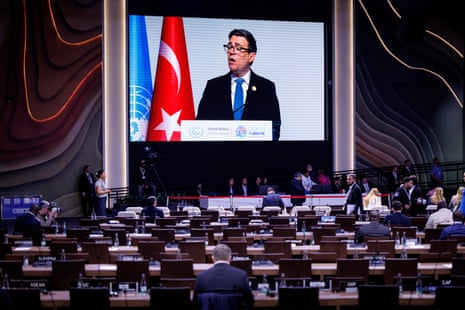
“Britain is back and ready to play its part,†UK prime minister Andy Burnham said in a speech that was criticised at home for a lack of action to back it up.
-
Earth is on track for ‘irrecoverable overshoot' of 1.5C target, scientists announced, with 2.7C of heating expected by the end of the century.
-
Leaders from several poor and low-emitting countries urged rich polluters to stump up more cash and demanding emissions cuts that keep overshoot low and short.
-
Greta Thunberg, the Swedish climate activist, said the planet is “not dying, it is being killed, and we know by who.â€
-
John Kerry, the former US secretary of state, called president Donald Trump the “biggest loser we've seen in a long time†for scrapping action on the climate crisis and ceding the clean energy race to China.
-
Polluting companies have sued governments for nearly half a trillion dollars in secret courts, an analysis found.
Thanks for following – we'll be back tomorrow morning with more.
Key events
We are nearing the end of the first week of the UN climate summit, but in case you're just catching up, here are two handy articles from the Guardian's environment editor, Fiona Harvey:
Will gay, queer and trans visitors to Cop31 be safe? Civil society campaigners have been demanding an answer from authorities at the outset of the UN climate talks.
NGOs wrote to the Cop31 joint presidency and the UN climate chief Simon Stiell to raise concerns over reports of a crackdown on LGBTQ human rights defenders ahead of the summit.
“As the incoming Presidency, Türkiye as the host of Cop31 assumes a formal responsibility to protect and enable the free, safe, and full participation of civil society observers,†they put in their open letter.
“A Cop hosted amid the mass detention of human rights defenders and the criminalisation of civic association raises direct and unavoidable questions about the safety and freedom of feminist, LGBTI+, and environmental civil society to engage meaningfully in the negotiations to come.â€
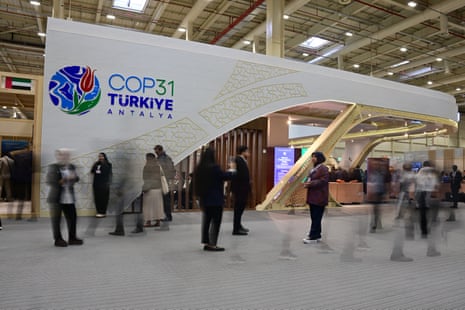
The intervention by five UNFCCC observer constituencies, led by the Women and Gender Constituency, comes after a series of arrests of LGBTQ activists that began in September. Police arrested dozens of people in a series of raids of organisations that campaign for LGBTQ rights and support people with HIV. Since mid-September, more than 80 people are reported to have been in pretrial detention.
In their letter, campaigners call for the immediate release of those held in relation to the crackdown, as well as measures to guarantee the “full and meaningful participation†of LGBTQ people in the summit.
Ahead of Cop31, Ruhat Aksener, Amnesty International's Turkey country director, told the Guardian the raids were an intensification of persecution faced by representatives of the country's LGBTQ communities in the past decade.
“The operation is named ‘My Family Is Safe', which is an irony to be honest, because people in Turkey are increasingly uncertain about their rights and freedoms,†Aksener told the Guardian. “No members of opposition groups feel safe in Turkey right now.â€
At least one climate activist has avoided Cop31 because of the persecution of LGBTQ people. Spencer Scott would have been Sierra Club Canada's representative on site at COP31. But they chose to stay away.
Scott said: “As a queer and trans individual who also is passionate about the environment, protecting wildlife, and also keeping our planet sustainable, having to pick between my advocacy and safety has infuriated me beyond measure. Who I am should not limit the work I can do.†The Cop presidency has been approached for comment.

Oliver Milman
Donald Trump is the “biggest loser we've seen in a long time†for scrapping action on the climate crisis and ceding the clean energy race to China, former US secretary of state John Kerry has said.
Kerry, speaking at the Cop31 climate summit in Turkey, criticized Trump for withdrawing the US from the international climate process and axing measures that reduced planet-heating emissions. Unlike almost all other countries in the world, the Trump administration has sent no delegation to the resort city of Antalya for the annual UN climate talks, which started on Monday.
The US president, who has previously called climate science a “hoax†and called for countries to drill for more oil and gas, again expressed his hostility towards clean energy on Monday. “I will not approve wind turbines because wind turbines are a major loser,†Trump, who has long-held animus towards windfarms, said about potential new legislation that would make it easier to build new energy projects.
Asked about his comments by the Guardian, Kerry said: “[The] first thing they should do is hold up a really big mirror so he can look at a loser, because he's the biggest loser we've seen in a long time on all of these issues.â€
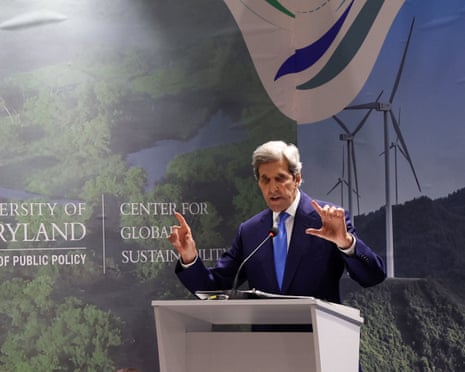
“He's missing the point,†Kerry, a former climate envoy for Joe Biden's administration, added. “He's missing the competitiveness with China. He's missing the marketplace for goods that could be produced in the United States. We could be the supply chain for some of these.â€
Under Biden, the US passed sweeping climate legislation that gave tax breaks for clean energy and electric vehicle manufacturing in a bid to compete with China, which has dominated clean tech.
Republicans eliminated most of this support, however, with Trump instead imposing tariffs on various goods and pouring public money into propping up struggling coal-fired power plants. Coal is the dirtiest of fossil fuels, causing much of the pollution that is dangerously overheating our planet.
“He declared he wanted to beat China, be number one in X, Y, or Z, and he walked away from the battlefield,†Kerry said of Trump. “He totally took America out of that sector. So honestly, if you want to be number one, you don't do it by literally blackballing an entire sector of the economy.â€
Fiona Harvey
The catastrophic collapse of a glacier in Nepal was a warning sign to the rest of the world to put the climate crisis at the top of the global agenda, and for the rich to provide financial aid to the poor to avert further disasters, Nepal's environment minister told the Guardian, as world leaders gathered in Turkey for the Cop31 UN climate summit.
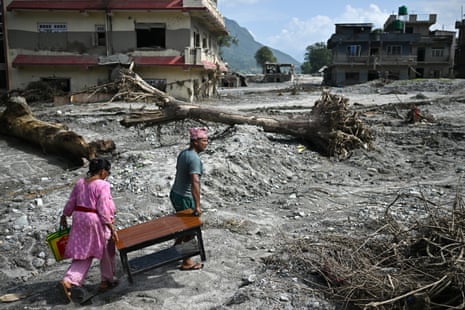
The disaster that struck in August claimed more than 1,500 lives and devastated the small Himalayan country. Gita Chaudhary, Nepal's environment minister, said: “We call the catastrophic climate change event we suffered a mountain tsunami. We lost people, we lost lives, we lost property. Nepal is working for rehabilitation, reconstruction and rebuilding the infrastructure. But the communities, the culture, the lives, we cannot revive.â€
The impact of glacier collapse will be felt far beyond Nepal's borders, as snowmelt and water from the Himalayas feeds about 2 billion people. “We are not responsible. We have made zero contribution to the climate crisis. But we are paying the price,†Chaudhary told the Guardian in an interview. “It is a sign of warning for all. Climate change issues need to be at the top of global discussions. We need to feel the urgency.â€
But she said she was not angry at the rest of the world. “Anger is not the solution. We have hope for Cop31,†she added. “But we need finance [to help poor countries] that is predictable, accessible and grant-based. And we need to limit global warming to 1.5C.â€
Polluters have sued governments for nearly half a trillion dollars in secret courts, analysis finds

Damien Gayle
Fossil fuel and related corporations have sought $440bn from governments through secretive corporate courts, according to a new analysis.
For all the grand efforts of UNFCCC Cop processes, and individual efforts by governments to reduce their reliance on coal, oil and gas, legal measures built into trade deals still give the fossil fuel industry vigorous means to fight back.
So-called Investor-State Dispute Settlement (ISDS) mechanisms, hidden in the text of treaties, mean that corporations can frequently sue governments for policies that endanger their profits. And that includes decarbonisation efforts.
According to research by PowerShift, Global Justice Now and the European Trade Justice Coalition, oil, gas and coal companies have become the biggest users of these tribunals.
So far they have been awarded a total of $86bn, the NGOs say. But that figure is conservative: in almost one-third of all publicly known ISDS cases the claim amount has not been made public.
“It's obscene,†said Nick Dearden, director of Global Justice Now. “The very corporations which have created the climate crisis are demanding eye-watering pay-outs when governments take much needed climate action.â€
Among the cases currently under way is a $300m claim against the UK, after the high court quashed permission for a new deep coalmine in Cumbria. Elsewhere, ExxonMobil launched a claim challenging the EU's Net Zero Industry Act, which obliges the company to pay for carbon storage capacity. But it is developing countries that are the worst affected. Even the threat of a hundred million dollar claim can act as a chilling effect on pro-environmental, pro-climate policies.
Activists at Cop31 are calling on delegates to agree a mechanism to phase out ISDS. Fossil fuel investors claim 70% of ISDS awards, they say, making it a serious barrier to climate action.
Fabian Flues, Investment Policy lead at PowerShift said corporations were weaponising trade and investment agreements. “Governments need to stop this heist,†by cancelling treaties, he said. “Countries like Australia, South Africa and Indonesia have taken significant steps to free themselves from ISDS, and others should follow suit.â€
If you're new to the annual UN climate talks known as Cops – or find yourself asking why they attract so much attention, and whether they even matter – have a listen to my colleagues Madeleine Finlay and Ian Sample break down why they exist and set out the stakes for humanity on our latest episode of the Science Weekly podcast.
Matthew Taylor
One of the biggest issues for Cop31 delegates to grapple with is how the crisis affects public health – from pollution to extreme heat.
The UK prime minister, Andy Burnham, who addressed Cop31 earlier, is being called out in this area today by the Green party of England and Wales over the health impacts of more drilling in the North Sea.
With a decision expected soon on whether to go ahead with the huge new Rosebank oilfield, the Greens are insisting the government must carry out – and publish – an official assessment, setting out the impact on the UK's National Health Service of digging up and burning this vast basin of oil.
Earlier this year the health secretary, Yvette Cooper, said the extreme heat that engulfed the UK during repeated heatwaves had put intense pressure on the NHS.
Climate experts say that extracting more oil from the huge Rosebank oilfield would exacerbate the climate crisis. A study by Oxfam found that the combined lifetime emissions from Rosebank – and the smaller Jackdaw gasfield that was approved last month, would contribute an estimated 65,495 excess heat deaths.
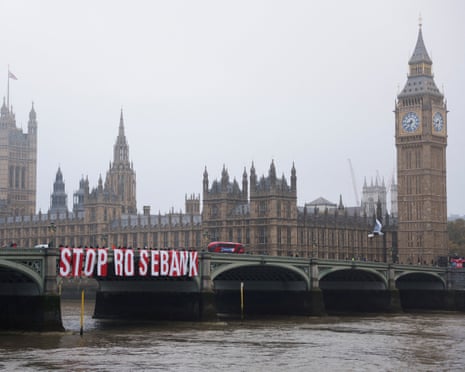
Green MP Carla Denyer said given the UK has a foreign secretary who has called Rosebank climate vandalism, and a health secretary who has admitted this summer's heatwaves put even more pressure on our NHS, “it is a complete dereliction of duty that ministers seem to have not assessed the health impacts of new oil and gas drilling.â€
“After heatwaves are estimated to have cost nearly 3,000 lives, and extreme weather forecast to cause chaos this winter, the government must now come clean on the true impacts of Rosebank,†she added. “And if they haven't done an assessment of the health impacts, they must delay any decision until this has been completed.â€
The decision over the Rosebank field is being carefully watched not just by Green Party supporters, but also by Labour backers and MPs who fear the party is backsliding on some of its climate and wider green policies under Burnham – despite his warm words at Cop today.
On Tuesday more than 20 Labour backbenchers called on the government to reject Rosebank during a debate in parliament.
Denyer, who secured the debate, said in her speech that “the decision whether to approve the climate-wrecking Rosebank oilfield is a defining moment for this government and this parliament.â€
“If the Government are clear that climate change is no longer a distant threat and that fossil fuels are driving climate breakdown, why are they not clear that green-lighting Rosebank, the biggest undeveloped oil and gasfield in the North sea, is a complete dereliction of duty?â€
Earlier Denyer had submitted a parliamentary question to the government asking if an health impact assessment had been carried out before the decision was taken to allow the Jackdaw field to go ahead.
The government did not answer directly but said the decision had been taken “by the energy secretary alone with no involvement from other ministers†which the Greens took to be a tacit “no.â€
Earlier today, climate activist Greta Thunberg told a packed room of journalists: “We are heading towards a future of more genocides and more ecocides and the complete compromise of our basic rights and where basic necessities become luxuries.â€
“It's more clear than ever in spaces like these that the situation could not be any less under control, the planet is not dying, it is being killed.â€
Watch the highlights here:

Joe Pinner
‘Climate change is never far from our minds'
I've been interviewing young climate activists at Cop31 this week and today I spoke to Josie Ann Le Blanc, 28, a member of the Caribbean Youth Environment Network in the Commonwealth of Dominica.
She was drawn to climate advocacy after Dominica experienced two catastrophic extreme weather events in two years: Tropical Storm Erika in 2015 and Hurricane Maria in 2017. The cyclones caused historic devastation and destruction on the island, leaving many dead, missing or homeless.
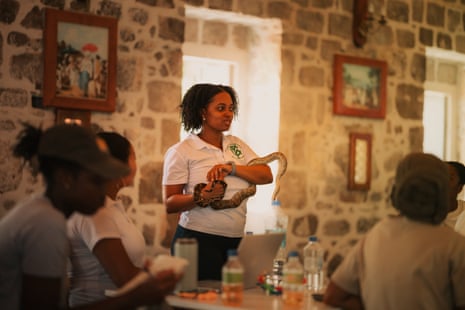
“Being born and raised in Dominica, climate change is never far from our minds. Since the storms in 2015 and 2017, we have also been experiencing record-breaking heatwaves, resulting in droughts, water shortages and health concerns for all, especially those who are particularly vulnerable.
“Climate change continues to mould the way our lives, work and plans for the future are impacted. For me, the climate crisis is not just an environmental concern but also a concern for social justice, economic development and public health.
“At Cop this year, I hope to see stronger commitments towards climate finance, adaptation, loss and damage, and the needs of small island developing states like Dominica. Future climate actions must be informed by those who have lived those experiences and should be inclusive and accountable to those vulnerable communities. Youth should be involved, having meaningful contributions and opportunities to influence decisions and not just be invited to listen.
“Ultimately, climate action should not only be measured by commitments made on international stages but also by the difference made and what communities can feel in their everyday lives.â€
Oliver Milman
The Palestinian conflict has been the focus of this Cop perhaps unlike any other so far. Mohammad Mustafa, the prime minister of Palestine, got a standing ovation when he spoke to delegates today, while yesterday Recep Tayyip ErdoÄŸan, president of Turkey, urged the world to recognize the environmental impacts of the three-year war waged by Israel in Gaza.
“What has taken place in Gaza is not only a genocide, but it is also an ecocide,†Erdogan said. Greta Thunberg, in her appearance at Cop, has also condemned Israel, which denies that its killings in Gaza constitute genocide. It was not invited to the gathering of leaders here.
There are visual reminders all around this summit, with several attenders wearing keffieyahs and plenty of interest in the Palestinian pavilion, which sits alongside those of other countries in the Cop31 venue.
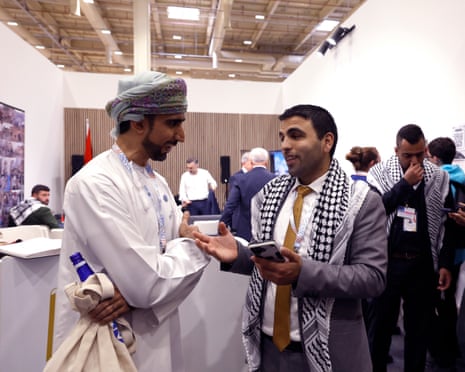
“We are here to talk about the environment, not politics,†said one of the staff at the pavilion. Gaza and the West Bank have issues around air pollution and waste management that the Palestinians want to talk about, although it's hard to separate these things from the impacts of bombardment.
A book for well wishes at the pavilion has been filled with plenty of supportive notes. One of the pavilion's walls is covered in photos of the destruction and horror of the past three years. None of the Palestinians here are from Gaza as the territory's borders remain sealed off by Israel, although some have been able to join the summit via video link.
Damien Gayle
We've been hearing from world leaders for the best part of two days now. But one country we've not heard from is Israel – one of Turkey's closest neighbours. And there is a very good reason for that. They have not been invited.
“As the host country for the leaders' summit, we did not send an invitation to Israel,†Murat Kurum, Turkey's Cop31 president, told local media, according to The National.
“Of course, we will discuss the climate and climate justice here. We say that there can be no climate justice where peace does not prevail.â€
South Korean outlet The Chosun Daily, again citing local media, quoted Kurum as saying: “We will not remain silent about the mass killings in Gaza … Our political stance is clear, and we will maintain this attitude during the conference.â€
But while Israel is notable for its absence, in the Cop31 exhibition space a corner has been set aside for the Palestinian delegation. Featuring black cloth hung haphazardly from the ceiling, in a manner reminiscent of refugee tents, the “Gaza tent†seemed to replicate Gaza itself, Chosun Daily noted.
However, none of Gaza's population was there, only Palestinians from the West Bank. Survivors in Gaza are banned by Israel from international travel.
‘If we all work together we can prevent the next disaster’
Oliver Milman
There was a frenzy of attention upon Greta Thunberg when she appeared this morning in Antalya. I had my toe trodden upon several times in the scrum that formed around someone who spearheaded a surge of global climate activism that has somewhat faded from view amid various other crises in recent years.
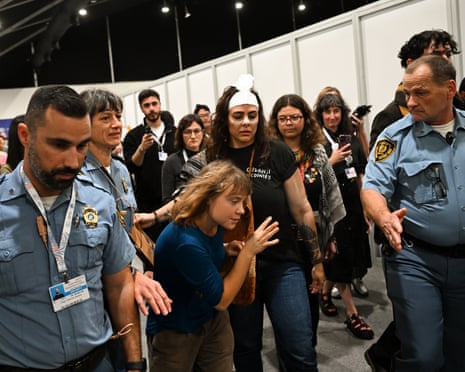
The climate crisis hasn't gone anywhere though, even if political and media attention has, and the activists who stood alongside Thunberg outlined the mounting toll of our overheating planet.
Sagar Dhakal, a Nepalese MP, spoke about how he helped dig people out of the debris of a deadly landslide, caused by a melting glacier along the Nepal-Tibet border, earlier this year. “I don't think there are words in the dictionary to describe it,†Dhakal said.
“Vulnerable countries need support from the developed world, we need to work together,†she said. “If we all work together we can prevent the next disaster.â€
Rikki Dank, an Indigenous Australian who is taking the Australian government to the UN human rights committee over its fossil fuel exports, said that “we need to start demanding better of our governments, not just for ourselves but for our communities.â€
Dank took aim at Anthony Albanese, Australia's prime minister who appeared here yesterday to claim that the co-host was playing its part and was a leader in climate action.
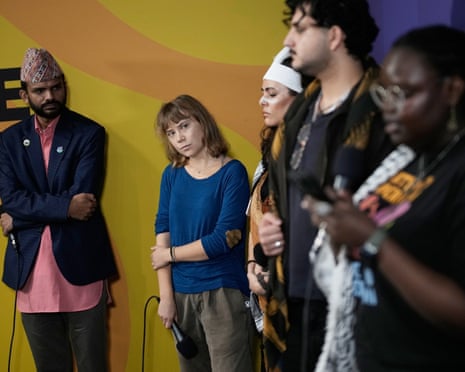
“Our prime minister needs to stop speaking and start listening when we say no to fracking of our country, to stop speaking and start listening when we say no to poisoning of our water and our sacred sitesâ€, she said. “He needs to stop speaking and start listening when the Australian people say no new coal, oil and gas.â€
Mohammed Usrof, founder of the Palestinian Institute for Climate Strategy, said that the fossil fuel economy is underpinning what he called a genocide committed by Israel that has killed 20 members of his own family.
“This militarized fossil economy continues to profiteer off genocide but also the complete devastation of our land,†he said. “There's an intentional act of ecocide and environmental devastation.â€
Usrof said that Israel should be removed from the UN framework on climate change, as well as the UN itself, and called on countries including Turkey to stop providing the fuel that is supplying Israel's military.
Celine Isimbi, born to refugees from Rwanda and the Democratic Republic of Congo and now living in Canada, criticised Mark Carney, the Canadian prime minister, for not showing up at the talks but said that even leaders at Cop31 are failing their people.
“Showing up means nothing when families are under rubble, when families have to be rescued from flash flooding,†she said. “Whether they show up or don't show up, what changes for us on the ground is nothing because they aren't putting their money where their mouths are, they aren't meeting our material demands.â€