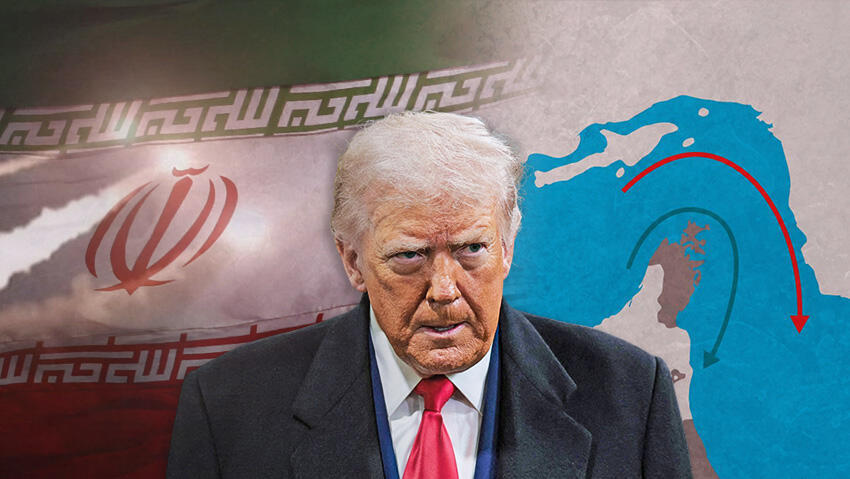
U.S. President Donald Trump has settled on an Iran strategy for the coming months, according to assessments by officials in Israel and other Middle Eastern countries.
(Photo: Anna Moneymaker / AFP, AP)
According to the assessments, Trump does not want a broad confrontation or a sharp deterioration in the fighting before the U.S. midterm elections in early November. He wants to avoid a global energy crisis and a rise in U.S. gasoline prices above $4 a gallon, while a war with Iran is also politically unpopular among voters.
There is also a military calculation. The three months remaining before the elections would allow the United States to accelerate production of munitions, particularly interceptors, and make other preparations for a wider confrontation that is expected to resume later.
The possibility of a broader conflict remains because Washington has concluded that diplomatic efforts with Iran's new regime will not succeed or produce results, according to the assessments. That applies both to reopening the Strait of Hormuz and, more importantly, preventing Iran from obtaining nuclear weapons.
The conclusion is therefore that another significant military confrontation will be required, with Israel participating.
Congress authorized Trump in April to continue a military operation, not a war. That authorization was valid for 60 days, and Trump now needs a pause, or at most low-intensity fighting, to avoid seeking congressional approval for a prolonged war.
That concern is particularly important because Congress could become more difficult for him after the elections, with the Republican majority at risk.
US strikes in Iran
(Video: CENTCOM)


Another significant reason for the administration's decision to avoid escalation in the coming months is the assessment by the Pentagon and U.S. Central Command that airstrikes in their present form have exhausted their ability to pressure the Iranian regime and produce results.
The maritime and economic blockade, by contrast, is viewed as effective and as a threat to the regime's ability to govern and meet the population's needs.
According to U.S. intelligence officials, Iran's military and Islamic Revolutionary Guard Corps have been unable to pay salaries for several months because of the loss of oil revenue. The country is also experiencing repeated power outages, while the rial continues to fall against the dollar.
Iran's economic situation is worsening, and signs of protest are already visible. These include a hunger strike by about 1,500 death-row prisoners at a jail near Tehran, as well as protests by taxi drivers and merchants.
For now, the protests remain limited. Another factor inflaming opposition to the regime is the recent acceleration in executions, including those of people who participated in the major protests in January.
The United States and other Western officials have concluded that intense military action would only allow the Iranian regime to divert public attention from domestic hardship.
Their preferred course is therefore to maintain and possibly expand the economic blockade, even if the Strait of Hormuz remains closed as a result.
The Iranians have recognized this American tactic and are now trying to drag Washington into a wider confrontation, based on the assumption that U.S. military casualties and higher gasoline prices would force Trump to accept a ceasefire on Tehran's terms.
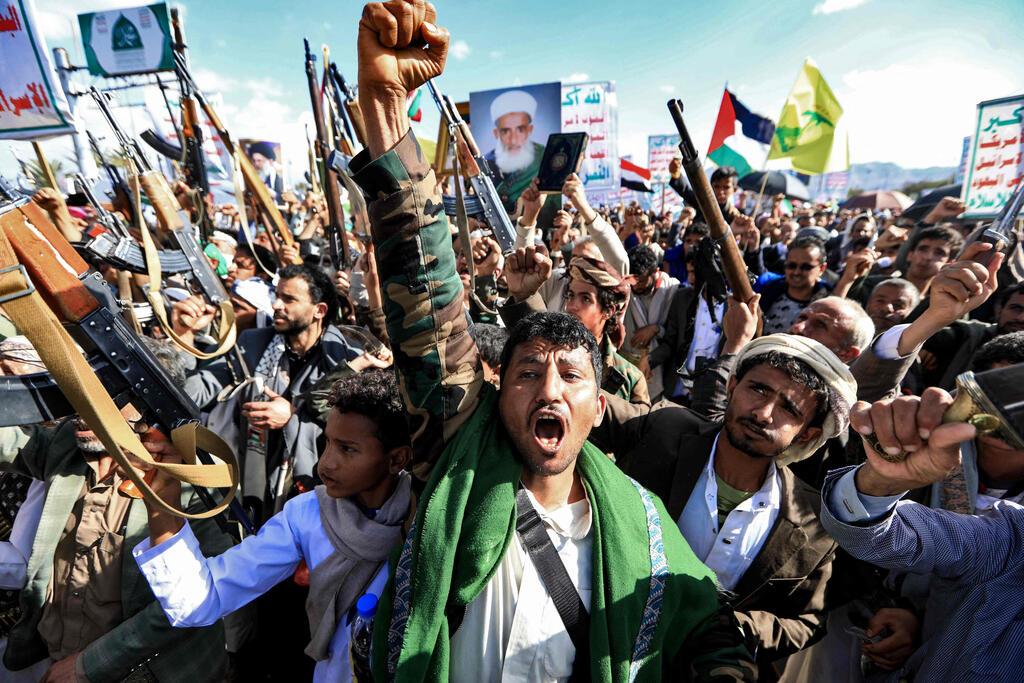
Houthi protesters in Yemen's capital, Sanaa, rally in support of Iran and Hezbollah
(Photo: Mohammed Huwais/AFP)
It is also possible that Iran is pressing Hezbollah to ignite military activity in Lebanon, hoping to make the United States feel compelled to act. The explosive-drone strike on an IDF engineering vehicle may be viewed in that context.
These developments and the resulting U.S. strategy were determined before Prime Minister Benjamin Netanyahu's visit to Washington on Tuesday.
Trump's agreement to meet Netanyahu stemmed in part from the fact that Washington had already made its decisions. That meant the president could not later be accused of surrendering to Netanyahu's pressure or persuasion.
According to officials familiar with the matter, Netanyahu angered Trump by leaking to The Wall Street Journal information about thousands of centrifuges being moved into the Pickaxe Mountain facility.
The disclosure damaged Trump's credibility after he had already said that Iran's nuclear facilities had been destroyed.
Trump's anger surfaced publicly Tuesday when he asked why Netanyahu was discussing the matter instead of telling him directly.
The president was also frustrated because a politically powerful wing of the Republican Party is demanding a harder line against Iran, both over the Strait of Hormuz and the nuclear issue. The leak attributed to Netanyahu made Trump appear weak and unreliable.
Trump agreed to the meeting for two additional reasons.
The first was Netanyahu's cabinet decision allowing progress on the Board of Peace's 20-point plan for the Gaza Strip, including the deployment of an international stabilization force in the area between the old Yellow Line and territory controlled by Hamas.
The second was that Trump may still need Netanyahu even if Likud loses Israel's election.
The U.S. midterms are expected one week after the Israeli election. At that stage, a new Israeli government would probably not yet have been formed, leaving Netanyahu as caretaker prime minister and the leader with whom Trump would have to launch a major campaign against Iran, should he decide to do so at that time.
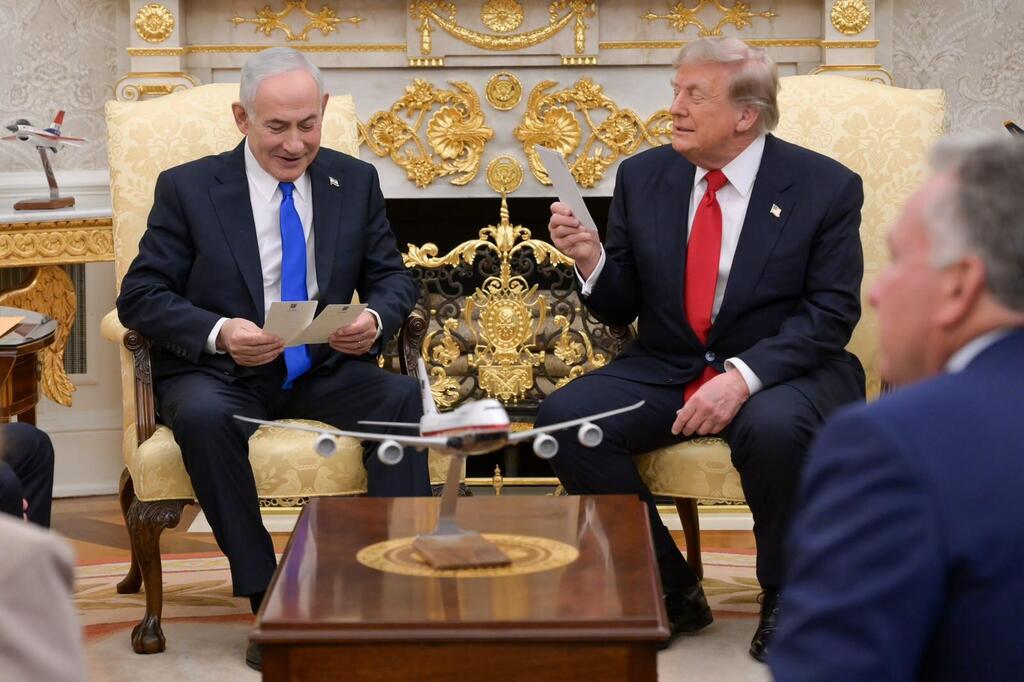
Prime Minister Benjamin Netanyahu and US President Donald Trump meeting at the White House
(Photo: GPO)
The Netanyahu meeting was not intended to settle operational details, but rather to establish a general strategy.
That can be inferred from three elements: the length of the meeting, which also dealt broadly with Lebanon, Syria and the Houthis; the large number of participants; and the absence of a private one-on-one discussion between the two leaders, preventing claims that they had reached undisclosed understandings.
Netanyahu is probably correct in describing the meeting as successful.
First, he secured a photograph with Trump and his senior officials, along with a White House statement describing the meeting as successful. That will help him during the election campaign in responding to claims of a rupture and bad blood between him and the president.
Second, the framework and strategy presented by Trump broadly correspond with Israel's intentions.
The president made clear that he would not relent until he was certain Iran did not possess nuclear weapons and that its enriched uranium had been transferred to the United States, without specifying how or when that would occur.
It was also made clear that this would happen after the midterm elections, when Trump, who cannot seek another term, would be relatively free to act.
Under such circumstances, Israel's defense establishment can prepare, collect intelligence and build capabilities for what it views as the decisive confrontation with Iran.
The remaining question is whether Iran, either directly or through its proxies, will succeed in disrupting that strategy.