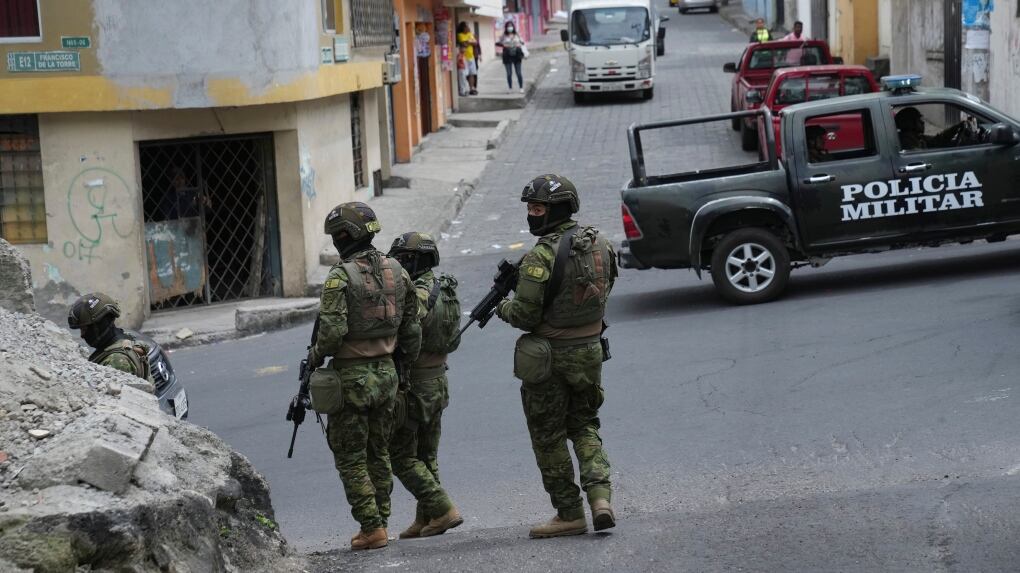
President Donald Trump declined Sunday to confirm whether the United States would withdraw troops from Kuwait and Bahrain, a stance likely to generate anxiety among Gulf states that rely heavily on American defense partnerships to deter regional adversaries.
“I don’t want to comment on that,” Trump told reporters aboard Air Force One when asked about a potential drawdown of U.S. forces in the two nations.
The comments follow a report by the Wall Street Journal on Thursday, which cited anonymous U.S. officials indicating that Washington is re-evaluating its military posture in Kuwait.
Newsweek has reached out to the White House via email. The U.S. Central Command (CENTCOM), which oversees all U.S. forces in the Middle East, referred queries to the White House and doesn’t usually comment on troop deployments because of operational security concerns.
A Pentagon official declined to comment.
Regional tensions have escalated significantly since the collapse of a ceasefire between Washington and Tehran, with Iranian strikes repeatedly targeting U.S. military infrastructure across the Middle East. Both Kuwait and Bahrain have emerged among the most frequently targeted nations since early July, alongside Iraq.
Data from the Armed Conflict Location & Event Data project shows Kuwait was targeted 64 times by Iran or aligned groups between mid-June and August 3, while Bahrain experienced 39 attacks.
Analysts suggest Tehran aims to pressure Gulf nations into reconsidering their hosting of U.S. forces, framing American military presence as a liability rather than a deterrent—particularly after regional capitals were caught off guard by the onset of the conflict involving the U.S., Israel, and Iran.
Kuwait and Bahrain host a combined U.S. military presence typically exceeding 20,000 personnel.
Bahrain serves as the headquarters for the U.S. Fifth Fleet, overseeing naval operations across the Middle East, Central Asia, and South Asia. The island nation also hosts the U.S. Coast Guard’s largest overseas unit and the headquarters of the Fifth Marine Expeditionary Brigade in Manama. Additionally, Bahrain’s Khalifa bin Salman Port accommodates American aircraft carriers essential for coordinating regional air operations.
Kuwait maintains a major U.S. Army presence alongside the Ali Al Salem Air Base near the Iraqi border.
While regional Gulf states remain eager to retain the U.S. security umbrella—amid broader questions regarding the “America First” agenda—they have increasingly diversified diplomatic and commercial partnerships. Several Gulf and Arab nations have strengthened ties with Ukraine, drawing on Kyiv’s expertise in countering Iranian-designed drones used extensively in the conflict. In late February, the United Arab Emirates (UAE) signed a $35 billion defense cooperation memorandum with South Korea.
The White House has previously emphasized a strategic pivot toward the Indo-Pacific to address security challenges involving China. Meanwhile, the Pentagon is reviewing force levels in Europe, prompting European allies to reassess regional security architectures and reinforce alternative alliances.
First U.S. Casualties Came in Kuwait
Eighteen U.S. service members have died in the Middle East since the conflict began, including six U.S. Army Reserve soldiers killed in an Iranian strike in Kuwait on March 1. More than 30 others were wounded when a drone breached air defenses at a command center in Port Shuaiba.
The service members killed in that attack were identified as Chief Warrant Officer 3 Robert Marzan, Major Jeffrey R. O’Brien, Captain Cody Khork, Sergeant Noah Tietjens, Sergeant Nicole Amor, and Sergeant Declan Coady. Additional U.S. personnel have died in Saudi Arabia, Iraq, and Jordan over the past five months from various causes.
Trump also stated Sunday that regional allies, including Qatar, Saudi Arabia, and the UAE, had dissuaded him from launching “the biggest attack since World War II” on Iran, adding that those countries had urged him to pursue diplomacy with Iran instead because they believed a deal was within reach.
The president also said new talks would begin Monday and expressed confidence that an agreement over the Strait of Hormuz could lead to a broader deal on Iran’s nuclear program.
Iran’s foreign ministry denied it was negotiating with the U.S. on Monday, saying Tehran was instead discussing safe passage for ships through the Strait of Hormuz with Oman.
Contact Newsweek editors for this story: Frances Mao and Anthony Murray.