
Introduction: UK unemployment rate falls in pre-budget boost
Good morning, and welcome to our rolling coverage of business, the financial markets and the world economy.
The UK unemployment rate has fallen, in a pre-budget boost to chancellor John Healey, but the number of vacancies available for workers continues to shrink.
The latest data on the UK labour market, just released, shows that the UK unemployment rate fell to 4.7% in June to August, down from 4.9% a month ago.
That's better than expected – City economists had forecast a rise to 5%.
In its final snapshot of Britain's jobs market ahead of the budget in two week's time, the Office for National Statistics reports that employment rose, by 102,000 jobs, to 34.577m in the last quarter.
The number of people unemployed fell by 47,000 in the quarter to 1.712m, and there was a small (16,000) drop in the number of people ‘economically inactive', to 9.091m.
But worryingly, the number of vacancies has seen its largest fall since the start of the year, falling by 21,000 in the last quarter.
That pulled the number of vacancies down to 691,000 in July to September, down from over 1.2m in early 2022. This is the first time the total has been below 700,000 since February to April 2021.
The ONS says:
double quotation mark This is mainly from smaller firms, who continue to suggest that they may not be recruiting because of increased labour costs.
That's a reference to the higher employer National Insurance Contributions (NICs) brought in by Healey's predecessor, Rachel Reeves, and the rise in the minimum wage, which have made it costlier to hire staff.
More to follow….
The agenda
-
7am BST: UK labour market data
-
10am BST: ZEW index of eurozone economic sentiment
-
10am BST: Eurozone construction output for August
-
2.30pm BST: BIST Committee questions Secretary of State Jonathan Reynolds
Key events
Pound jumps after UK jobs report
The pound has rallied after Britain's unemployment rate fell unexpectedly this morning to 4.7%.
Sterling has gained half a cent against the US dollar to $1.3352, as the City welcomes the news that employment rose in the last quarter.
The pound is also up 0.2% against the euro to €1.1888, close to the 17-month high touched yesterday.
Traders may be concluding that a stronger-than-expected jobs market will give the Bank of England confidence to raise interest rates to fight inflation.
Chris Beauchamp, chief market analyst at IG says sterling is “rampant†after the UK employment data.
double quotation mark “This data has caught the market on the hop, with traders scrambling to respond and boost exposure to the pound. Good news has been a touch more prevalent for the UK of late, which is just the kind of framing the government needs heading into the budget, though signs of more resilience in the labour market do of course mean the BoE has more room to respond to higher inflation.â€
The money markets indicate there's a 95.5% chance that the Bank raises interest raatest at its next meeting in November, to 4%. Three further rate rises are expected in 2027.
Here's Stephen Evans, chief executive at Learning and Work Institute (L&W), on the situation in the UK jobs market:
double quotation mark “The labour market remains relatively flat overall. This resilience in the face of headwinds driven by global events is welcome. But underlying problems remain, with around one million young people not in education, employment or training and overall employment more than two million short of the Government's 80% employment rate target.To fix those challenges we need to change the benefit system so it offers active help to all who need it, but also make it easier for employers to create jobs. “
Another interesting line in today's jobs report is that the number of workers on company payrolls has risen.
Payrolls increased by 13,000 in September, to around 30.3m.
But that's still 66,000 lower than a year ago.
UK suffering ‘jobs drought’ as vacancies drop
The government should not be complacent about the state of the labour market ahead of next week's budget, warns Ben Harrison, director of the Work Foundation at Lancaster University:
Harrison explains:
double quotation mark The UK is still amidst a jobs drought with vacancies at their lowest for over 12 years outside of the pandemic.“In particular, there are now 715,000 young people aged 16–24 unemployed, down by 28,000 on the quarter. Nevertheless, the number of young people out of work remains 54,000 higher than 12 months ago.
“For too many young people there are simply not enough suitable jobs available to them. Overall, vacancies have fallen to 691,000 – the lowest level outside the pandemic since 2014 – while Work Foundation research shows that adverts for starter jobs have almost halved over the past.
Here's ONS deputy director of labour market statistics, David Freeman, on today's jobs data:
double quotation mark “While the labour market remains broadly flat in 2026, data from the latest quarter shows the employment rate edging up and a small drop in unemployment. The number of workers on payroll remains slightly down over the same period, though data for the most recent month suggests that might be starting to level off.
“The number of vacancies has seen its largest fall since the start of the year, concentrated mainly within smaller businesses, which cite increased labour costs as a key factor.
“Regular wage growth remained relatively stable, though total pay – including bonuses – has eased to its lowest rate in nearly six years.â€
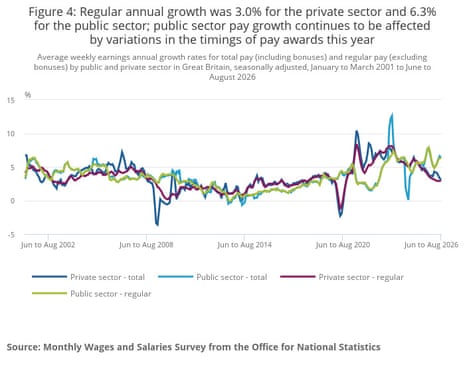
Public sector pay outpaces private sector, but….
Pay continued to rise faster in the public sector than in the private sector, today's labour market report shows.
Regular annual growth was 3.0% for the private sector and 6.3% for the public sector.
But as the ONS points out, public sector pay growth continues to be affected by variations in the timings of pay awards this year – largely to do with pay deals in the NHS.
Real wage growth remains weak
Once you account for inflation, UK real wage growth remained below 1% last month.
Annual real regular pay growth was broadly unchanged at 0.8% in June to August, the ONS reports, based on the CPI inflation measure.
Annual real total pay growth (using CPI) was 0.9% in June to August 2026, a slight decrease.
A mixed picture on wage growth
Regular pay growth rose in the last quarter, today's labour market report shows.
But once you account for bonuses, wage growth slowed.
The ONS reports that regulator pay grew by 3.7% in the June-August quarter, up from 3.6% a month ago.
But growth in total pay (including bonuses) was 3.7% in June to August 2026, down from 3.9% in May-July.
Construction led fall in vacancies
Vacancies fell particularly sharply across the construction sector, suggesting Britain's builders cut back on hiring last summer.
The ONS reports:
-
Vacancy estimates decreased on the quarter, with early estimates for July to September 2026 suggesting a decrease of 21,000 (2.9%) vacancies to 691,000, compared with April to June 2026; this is the first time the total has been below 700,000 since February to April 2021.
-
Vacancy estimates decreased in 14 of the 18 industry sectors, compared with April to June 2026; the largest industry decrease was in construction (down 7,000 vacancies).
-
Vacancy estimates decreased in 4 of the 5 employment size bands, compared with April to June 2026; the largest decrease was for businesses with 1 to 9 employees (down 21,000 vacancies).
Introduction: UK unemployment rate falls in pre-budget boost
Good morning, and welcome to our rolling coverage of business, the financial markets and the world economy.
The UK unemployment rate has fallen, in a pre-budget boost to chancellor John Healey, but the number of vacancies available for workers continues to shrink.
The latest data on the UK labour market, just released, shows that the UK unemployment rate fell to 4.7% in June to August, down from 4.9% a month ago.
That's better than expected – City economists had forecast a rise to 5%.
In its final snapshot of Britain's jobs market ahead of the budget in two week's time, the Office for National Statistics reports that employment rose, by 102,000 jobs, to 34.577m in the last quarter.
The number of people unemployed fell by 47,000 in the quarter to 1.712m, and there was a small (16,000) drop in the number of people ‘economically inactive', to 9.091m.
But worryingly, the number of vacancies has seen its largest fall since the start of the year, falling by 21,000 in the last quarter.
That pulled the number of vacancies down to 691,000 in July to September, down from over 1.2m in early 2022. This is the first time the total has been below 700,000 since February to April 2021.
The ONS says:
double quotation mark This is mainly from smaller firms, who continue to suggest that they may not be recruiting because of increased labour costs.
That's a reference to the higher employer National Insurance Contributions (NICs) brought in by Healey's predecessor, Rachel Reeves, and the rise in the minimum wage, which have made it costlier to hire staff.
More to follow….
The agenda
-
7am BST: UK labour market data
-
10am BST: ZEW index of eurozone economic sentiment
-
10am BST: Eurozone construction output for August
-
2.30pm BST: BIST Committee questions Secretary of State Jonathan Reynolds