FTSE 100 hits four-month high
Britain's blue-chip stock index has hit its highest level since the first week of the Iran war this morning.
The FTSE 100 climbed as high as 10,701 points this morning, up 0.4%, its highest level since 3 March.
Precious metals miner Fresnillo (+2.5%), engineering firm Weir Group (+2%), and energy company SSE (+1.8%) are the top risers.
Several factor are lifting the ‘Footsie', including hopes of a US-Iran peace deal which have pushed the oil price down (and could send it lower…)
A weaker-than-expected US employment report, released yesterday, has also cheered traders by dampening expectations of rises in US interest rates.
Dan Coatsworth, head of markets at AJ Bell, explained:
double quotation mark “Weak jobs numbers would normally be a key reason for central banks to consider cutting rates to stimulate the economy.The latest US jobs data confirms labour market disappointment but we're nowhere near the stage where the Fed will reach for the monetary policy scissors to start cutting. We're more likely to see an adjustment to the Fed's assessment that implies no change to rates, which is still a win for markets.
Thirdly, investors are ‘rotating' out of chip stocks (following a stellar start to the year) and into ‘old economy' companies instead, and there are plenty of those on the London stock market.
Key events
Brazil’s services sector gets World Cup lift

Brazil's services industry has won a boost from the World Cup.
Business activity at Brazilian services firms rose in June, a poll of purchasing managers shows. Companies reported a pick-up in sales last month, as World Cup-related viewing events, hospitality spending and media activity helped support demand.
But while demand to watch Vinicius Junior, Casemiro, Gabriel and the gang lifted output, firms cut jobs for the first time in five months.
Pollyanna De Lima, economics associate director at S&P Global Market Intelligence, explains:
double quotation mark “The renewed rise in new business and quicker growth in activity are certainly an improvement on the previous month's trends. But with Brazilian services firms mostly linking June's upturn to a World Cup boost, the recovery looks likely to be short-lived.“That temporary nature is already showing up elsewhere in the survey, with service providers cutting jobs and downgrading their business expectations.
“Services companies are also facing stronger cost pressures from the war in the Middle East, although inflation may have peaked this month. Many will likely try to recoup those costs gradually in the months ahead, which will further test demand. That comes on top of the expected slowdown as this year's presidential election approaches and external shocks continue to weigh on activity
Gulf oil exports jump in June
Back in the oil market, new data shows that exports from the Gulf jumped in June.
Gulf oil exports rose by more than 3 million barrels in June, compared with May, to exceed 10 million barrels per day.
Reuters has the details:
double quotation mark The United Arab Emirates led the recovery, allowing millions of barrels of crude stranded in the Gulf to reach international markets, enabling producers to raise output and lower oil prices to pre-conflict levels.Combined crude and condensate exports from Saudi Arabia, the UAE, Kuwait, Iraq and Iran rose by more than 3.5 million bpd from May to 10.07 million bpd, Kpler data shows.
UK electric car sales jumped in June
Elsewhere in the car industry, sales for electric vehicles jumped last month, according to new industry data.
Research organisation New AutoMotive has reported that 64,000 new electric cars were registered in June, a 37.7% year-on-year increase.
That means that electric cars made up 30% of the market last month, with some drivers keen to avoid the jump in petrol and diesel prices after the Iran war began.
Overall, car sales were up almost 15% year-on-year in June.
Ben Nelmes, CEO at New AutoMotive, explains:
double quotation mark “June's data shows that electric cars are rapidly becoming the mainstream choice for British drivers. With one in three new cars registered in June being fully electric, motorists are switching at an extraordinary pace.“As petrol and diesel sales continue their steady, structural decline, it's clear that drivers are voting with their wallets. EVs offer families and businesses lower and predictable running costs, a superior driving experience, and an escape from the volatile global oil markets that have squeezed household budgets for too long.â€
JLR sales hit by major fire and Iran war disruption

Jasper Jolly
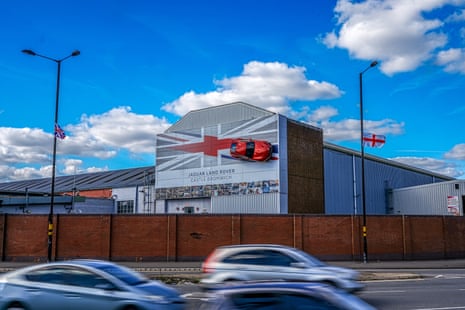
Jaguar Land Rover suffered a 9% drop in sales in the last quarter caused by disruption from the Iran war and a major fire at a Norwegian supplier that forced Britain's largest carmaker to shut its factories temporarily.
The manufacturer today reported sales of 79,300 cars to dealers in the three months to June, a 9.2% decline compared with the same period a year earlier.
The company insisted the disruptions were “temporary supply constraintsâ€, including the fire at Raufoss Technology, a Norwegian manufacturer of aluminium parts for car suspensions.
JLR also said the US-Israeli war on Iran caused “market disruptionâ€, as Iran responded by attacking several Gulf neighbours, several of which are large markets for luxury cars such as Range Rovers. Retail sales dropped by 42% in the Middle East and north Africa region, the company said.
Sales to customers were down across every market during the quarter, JLR said, although four-fifths of the sales were of more profitable models.
CNBC: Christine Lagarde leaves door open to early ECB exit
The European Central Bank's Christine Lagarde has declined to rule out an early end to her term as president, as she mulls a foray into French politics, CNBC report.
Lagarde, whose term as ECB President ends in October 2027, told French newspaper Les Echos an early departure is “possible†ahead of the country's presidential elections that year.
She said:
double quotation mark “I think a European voice must be heard in the French presidential debate.If this debate were to present a perspective that diminishes France's place within Europe, I think it would be necessary to explain why this would be a painful path for our country and our citizens.â€
Asked whether she would consider personal involvement in the French Presidential campaign, to support a candidate or run herself, Lagarde said: “I'm going to ask myself some questions.â€
Although UK service sector business optimism improved in June, it remains much softer than at the start of 2026, despite peace talk efforts between the US and Iran.
Thomas Pugh, chief economist at audit, tax and consulting firm RSM UK suggests UK political uncertainty hit confidence last month.
double quotation mark “The final composite PMI weakened further in June, suggesting that the economy has stagnated across Q2. Indeed, we doubt growth will pick up much through the rest of the year. Even if a Burnham coronation is likely, avoiding a protracted leadership contest, there will still be speculation about the direction of fiscal policy in the coming months. Meanwhile, the US-Iran peace deal isn't fully secured as yet. All of that will keep uncertainty elevated, limiting growth to around 0.1% per quarter for the rest of the year.“The weak PMI continues to be driven by services activity, which is the lowest since January 2023, where anecdotal evidence suggests that the war in the Middle East and domestic political turmoil continues to dampen sentiment, prompting consumers to pull back on discretionary spending. In the immediate term, activity may remain weak with new orders dropping to the weakest since July 2025 as uncertainty weighs on activity and stockpiling in the manufacturing sector inevitably unwinds.
“What's more, the downwards revision to the future activity balance between the flash and final release suggests that firms responding later in the month were more pessimistic about the outlook following Starmer's resignation. We think sentiment will remain weak until firms have a clearer idea of the direction of fiscal policy at the next budget.
Sterling set for biggest weekly jump since early April
The pound is heading for its biggest weekly jump in 12 weeks against the US dollar, as the City takes the looming coronation of Andy Burnham as Labour leader and prime minister in its stride.
Sterling has jumped by 1.2% so far this week, it's biggest weekly rise since the first week of April, to $1.3355.
The pound has risen against the US dollar for seven days in a row, helped by Burnham pledging to work within the existing fiscal rules.
The dollar has been dropping generally, as expectations of interest rate rises have fallen, and optimism over the US-Iran peace deal have spurred demand for riskier currencies.
The FTSE 100 couldn't hold onto its four-month high.
The blue-chip share index is now in the red, down 45 poinrs or -0.4% at 10,607 points, with the drop in UK service sector activity dampening the mood in the City.
Wider UK economy shrank too
The drop in service sector activity in June pulled the wider British private sector into contraction.
Services make up around three-quarters of the UK economy, which shrank slightly in June for the second month running.
The UK Composite PMI (which tracks activity across the economy) dropped to 49.3, down from 49.7 in May and below the neutral 50.0 value for the second month running.
Pay rises, higher motor fuel costs and more expensive IT equipment all drove up service sector costs in June, the PMI report shows.
It says:
double quotation mark Around 42% of the survey panel reported an increase in their average cost burdens in June, while only 3% signalled a reduction.However, the resulting seasonally adjusted index pointed to a further slowdown in the rate of input cost inflation following the 41-month peak seen in April.
Higher input costs typically reflected rising wages, transportation bills and prices paid for technology items (especially computer hardware).