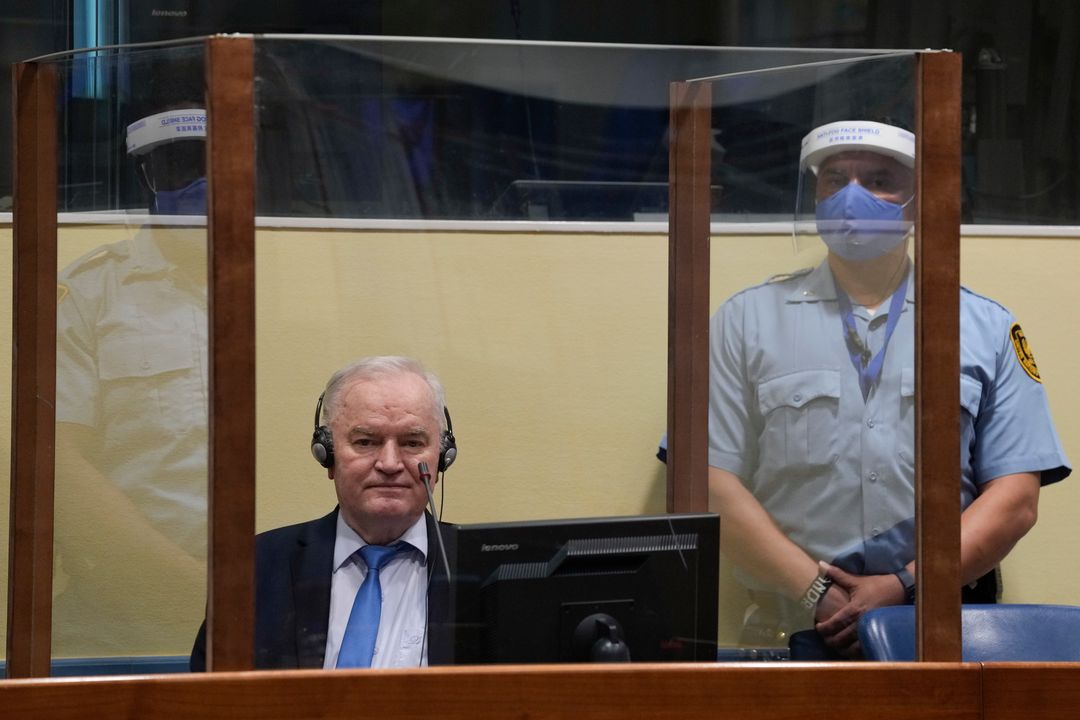
Ratko Mladic, the Bosnian Serb general convicted of genocide and other war crimes committed during the Bosnian war, died on Thursday at a UN detention hospital in The Hague. He was 84 and was serving a life sentence.
Mladic commanded Bosnian Serb forces during some of the war's worst atrocities, including the siege of Sarajevo and the 1995 Srebrenica genocide, in which more than 8,000 Bosniak men and boys were killed.Â
After spending 16 years as a fugitive, Mladic was arrested in 2011 and later convicted of genocide, crimes against humanity and war crimes. He spent the rest of his life in detention and never expressed remorse for the crimes he and his army committed.
Here is a look at Mladic's rise through the Yugoslav military, the atrocities committed under his command, and the years-long pursuit that ultimately brought him before an international tribunal.
The rise
Mladic was born in 1942 in the village of Bozanovici, in what was then the Nazi-aligned Independent State of Croatia, into a Partisan family that lost his father in the fighting when he was a child.Â
He trained at the Yugoslav military academy in Belgrade, graduated in 1965, and climbed steadily through the ranks of the Yugoslav People’s Army, a career officer forged in a military culture that prized martial ferocity as a virtue rather than a warning sign.
When Yugoslavia tore itself apart and Bosnia declared independence in the spring of 1992, Bosnian Serbs proclaimed their own breakaway state, Republika Srpska, and in May of that year handed Mladic command of its army.Â
He viewed Bosnia’s Muslims as the descendants of the Ottoman Turks and set out, with total conviction, to drive them from what he considered Serb soil for good.
When the Yugoslav People's Army formally withdrew from Bosnia in 1992, much of its weaponry, equipment, infrastructure and personnel remained behind and became part of the Bosnian Serb military, according to Albinko Hasic, founder of Bosnian History, a platform dedicated to the in-depth exploration of Bosnia and Herzegovina's history.
“Serbia and the Federal Republic of Yugoslavia provided enormous amounts of military and financial support, including weapons, ammunition, fuel, salaries, logistical assistance and personnel,†Hasic, also a history expert, tells TRT World.
That broader structure is essential to understanding how Mladic became so powerful, Hasic says.
“The genocide required soldiers, buses, trucks, fuel, weapons, communications, execution sites and a functioning chain of command. The Srebrenica genocide, and indeed the wider Bosnian genocide, itself demonstrates just how organised this machinery was,†he adds.
Related
The crimes
What followed was a genocide carried out through systematic, coordinated campaigns across towns and villages, each engineered to strip a people from their territory for good.Â
Civilians were trapped under sieges, herded into camps, or driven into exile as the machinery of ethnic cleansing ground forward.
The siege of Sarajevo was among the darkest chapters of that machinery.Â
Mladic’s forces encircled the capital for 1,425 days, the longest siege of a city in modern warfare, and rained shells and sniper fire down on a city with nowhere to run.Â
On a single day in July 1993, nearly 4,000 shells fell on the city.Â
By the time the siege broke, some 13,000 people were dead, and streets like Mesa Selimovic Boulevard had earned the name Sniper Alley, a corridor civilians had to sprint across to avoid being picked off by gunmen in the hills above.
Mladic directed the shelling personally, ordering his gunners to fire on Muslim neighbourhoods until, in his own words relayed by radio, the people inside were driven to the edge of madness.Â
“Shell the presidency and the parliament. Shoot at slow intervals until I order you to stop. Target Muslim areas – not many Serbs live there… Shell them until they are on the edge of madness,†Mladic said.
His death changes nothing about the historical or legal record, Hasic says.
“What strikes me most about Mladic’s death is the simple fact that he had the opportunity to grow old. Thousands of the people murdered at Srebrenica never did.â€
“They did not get another thirty years. They did not get careers, marriages, children, grandchildren, birthdays or ordinary afternoons with their families. Many of their mothers and wives spent decades searching for their remains,†he explains.