Kuwait responding to missile and drone attacks
The Kuwaiti army has said it is responding to missile and drone attacks, after Iran threatened retaliation for a wave of US strikes.
double quotation mark Kuwaiti air defenses are currently engaging hostile missile and drone attacks.
double quotation mark The General Staff of the Army notes that any explosions heard are a result of air defense systems intercepting hostile attacks.â€
Key events
A quick update: more sirens sounding in Bahrain.
If you are just tuning in, here is our wrap-up of today's events:
IRGC says US targets in Bahrain and Kuwait targeted
Iran's Revolutionary Guards (IRGC) has said they targeted dozens of US military facilities in Bahrain and Kuwait in response to the US strikes on Wednesday, in a statement carried by state broadcaster IRIB.
“In an initial response to this aggression, the IRGC Navy and Aerospace Force carried out a joint missile and drone operation, striking 85 key US military facilities†in the two countries, while also shooting down an MQ-9 drone, the statement said.
The US did not comment on the Iranian claims that facilities in Bahrain and Kuwait had been hit – or on whether a drone had been shot down.
Kuwait responding to missile and drone attacks
The Kuwaiti army has said it is responding to missile and drone attacks, after Iran threatened retaliation for a wave of US strikes.
double quotation mark Kuwaiti air defenses are currently engaging hostile missile and drone attacks.
double quotation mark The General Staff of the Army notes that any explosions heard are a result of air defense systems intercepting hostile attacks.â€
Iran's Revolutionary Guards say they targeted 85 US military sites in Bahrain and Kuwait ‘in response to US ceasefire violation'.
We'll keep you updated as more comes in.
Iran's Revolutionary Guards say they have downed a US MQ9 drone in the country's south, according to Iran's Press TV.
Sirens are also now sounding in Kuwait.
The Kuwaiti army says air defences are now confronting ‘hostile' missile and drone attacks.
More to come.
Iran's parliament speaker and top negotiator Qalibaf has commented on today's US strikes on Iran, saying on X:
double quotation mark The era of bullying and extortion is over. It leads nowhere. We don't fold.â€
An update on air sirens in Bahrain:
“The siren has been sounded,†the ministry said on X, without giving details of the apparent threat. “Citizens and residents are urged to remain calm and head to the nearest safe place.â€
Sirens sounded in Bahrain
Sirens have sounded in Bahrain, according to the country's interior ministry.
We'll keep you posted with more details as they come in.
US Central Command also said that it had struck “more than 60 Islamic Revolutionary Guard Corps small boats in and near the strait,†in addition to Iranian defense systems, command and control networks, coastal radar sites, anti-ship missile capabilities.
Iran's top joint military command, â Khatam al-Anbiya Central Headquarters, said on Wednesday that â Iranian armed forces â would ​deliver a “crushing response†and ‌warned that ‌Tehran would not allow US ‌interference in the management of the strait of Hormuz.
It said that the only safe passage for commercial vessels and oil ‌tankers through the waterway was the route determined ​by Iran.
US forces completed a new round of strikes against Iran, hitting more than 80 targets, US Central Command says.
The comments come as Iran's top joint military command says US army targeted parts of southern Iran in “blatant aggression†and vowed to give a “crushing responseâ€.
Some background on the latest escalation:
Iran's clerical rulers aim to install a permanent system to collect fees in what would amount to a huge shift of the balance of power in a region where Washington has long â acted as guarantor of security.
At home, the leadership has used the mourning for Khamenei that began last week to show its control after Khamenei was killed with his daughter, ​granddaughter, son-in-law and daughter-in-law on the war's first day.
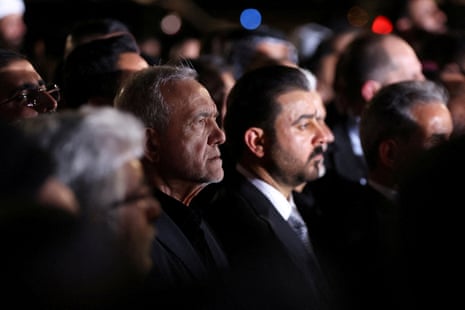
Iranian ​president Masoud Pezeshkian, who was in Iraq to participate ‌in the funeral ceremonies, left for Iran ​after the US strikes on southern Iran, state television ​reported.
The ceasefire was intended to provide a 60-day window for negotiations on a permanent agreement, but indirect talks in Qatar ended last week with no sign of headway.
President Trump has repeatedly threatened to resume bombing, most recently on Monday when he told reporters in the Oval Office: “We're either going to make a deal or we're going to finish the job… We can knock down their bridges in one hour, we can knock out their energy supply.â€
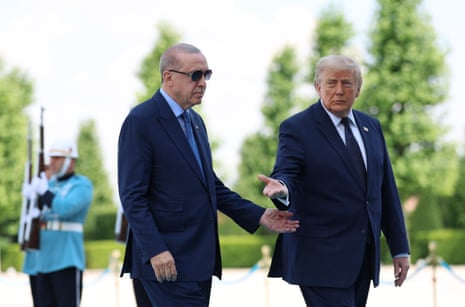
US president Donald Trump is currently in Turkey, where he met with Turkish leader Recep Tayyip ErdoÄŸan ahead of the Nato summit in Ankara.
Trump has criticised Nato's abilities to function without American leadership and power, expressing disappointment at the refusal of some Nato allies to join the Iran war he launched alongside Israel without consulting them.
Iranian Press TV says there are reports of renewed explosions on Qeshm island, and several blasts heard on Kharg island.
We'll continue to provide updates as they come in.
Qatar has blamed Iran for attacking commercial vessels in the strait of Hormuz on Tuesday, including the huge Qatari liquefied natural gas tanker, the Al Rekayyat, which was reportedly struck overnight by a drone that caused a fire in its engine room. The crew were safe and being evacuated.
A Saudi-flagged crude oil tanker, believed to be the supertanker Wedyan, was also damaged off Oman, maritime security sources ‌said. The cause was not immediately clear.
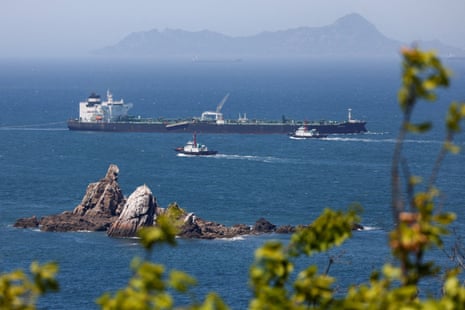
Qatar's foreign ministry said it had summoned Iran's deputy ambassador and handed him a protest note after the attack on the tanker.
Iran's foreign ministry said Qatar's accusations were perplexing and that Tehran was diligently fulfilling its commitments but asserted that commercial vessels faced risks for using routes not coordinated with Iran.
A second US official, speaking on condition of anonymity, said initial indications ​were that Iran had fired at three commercial vessels.
A quick wrap-up of the latest
Weeks after signing an interim MoU to end the war, the United States and Iran have struggled to maintain the fragile truce, with the fight over the control of the strait of Hormuz catalysing continued retaliatory actions.
A day after Iranian strikes on three commercial vessels, the US has today launched fresh strikes on Iran.
If you are just getting up to speed, here is the latest.
-
The â US military launched a series of strikes against Iran on Wednesday, â US Central â Command confirmed. A US official said those strikes targeted Iranian air defense systems, port facilities, coastal surveillance systems, ground-to-air missiles as well as launch sites for anti-ship cruise missiles and drones.
-
The US said the strikes were in response to Iranian attacks a day earlier on three commercial vessels that were â transiting the strait of Hormuz. “Iran's demonstrated aggression was unwarranted, dangerous, and a clear violation of ‌the ceasefire,†a US military statement said.
-
Prior to the attacks, the US also revoked a temporary sanctions waiver for Iranian oil with the US Treasury cancelling a license that had allowed Iran to produce, sell and deliver crude oil and related products through 21 August. Some have described the move as a potentially major blow to the agreement.
-
Iran's foreign ministry lashed out against the US, vowing to “take whatever measures it deems necessary to safeguard its national interests and securityâ€. The ministry also accused the US of “treacherous action†and “major violations†of the MoU. Kazem Gharibabadi, Iran's deputy foreign minister, insisted Iran would “take decisive actions to safeguard its national interests and securityâ€.
-
Iranian media said six projectiles hit the area of Taheroui pier in Sirik in southern Iran. No civilian deaths were reported, but several people were â injured by shrapnel from an “enemy projectile†that hit a commercial pier in Sirik, according to an Iranian state TV reporter. The reports said strikes also hit fishing piers in Sirik and in Bandar Abbas, where several fishing boats were set ablaze.
-
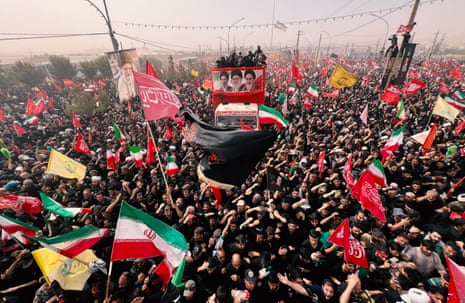
This marks â the first known US military strikes ​against ​Iran since late last ​month, when there were several ​days ‌of strikes and ​counterstrikes ​between the two. It comes a day after huge crowds mourned Iran's slain â Supreme Leader Ayatollah Ali Khamenei in the holy city â of Qom.
-
The benchmark US oil contract increased more than 2.5% when markets opened Wednesday, as Middle East tensions rose with new US attacks on Iran. West Texas Intermediate crude, one of the two major global benchmarks, was up 2.63% at $72.29 per barrel. It rose 2.76% on Tuesday.
-
A US official said earlier that negotiators ‌continued to work in good faith toward a final agreement with Iran. But control of the strait has given Tehran immense leverage, effectively allowing it to force a stalemate with the world's most powerful military. Analysts say Tehran uses attacks on ships to underscore ‌that leverage as it negotiates a long-term peace deal with the US.
Oil rises moderately as Middle East tensions spike again
The benchmark US oil contract increased more than 2.5% when markets opened Wednesday, as Mideast tensions rose with new US attacks on Iran.
West Texas Intermediate crude, one of the two major global benchmarks, was up 2.63% at $72.29 per barrel. It rose 2.76% on Tuesday.
The rise came after US forces launched strikes on Iran after three commercial vessels were attacked in the strait of Hormuz, according to the US military.
Iranian state media reported numerous explosions around the strait, including six on the island of Qeshm, seven in the city of Sirik and more in the major port city of Bandar Abbas.
Oil prices are still well below the peaks they shot up to as the war began in late February and Iran largely shut down the strait of Hormuz.