-

Bill Connelly
Multiple Authors
Back when the NIL era was in its nascent stages, with a new Big 12 and a 12-team College Football Playoff on the way, I wondered if there was room for the emergence of a Clemson-style dynasty from a conference known primarily for the endless number of close games. If some team could craft a recruiting boost from both solid spending and sustained success, perhaps they could ride that to a series of conference titles and, perhaps, even playoff runs?
I admittedly didn’t have a specific team in mind for this, and with so many programs seemingly equal in terms of spending potential and history, it wasn’t clear if something dynastic was possible. But damned if Texas Tech didn’t look like a team ready to rip off a major run of success last season. Even with an upset loss to Arizona State (suffered without their starting quarterback), the Red Raiders, with their roster upgraded by big spending and big-name transfers, outscored 10 Big 12 opponents by an average margin of 27.1 points — 32.0 from November onward — and rolled to their first Big 12 title. And even with BYU, Utah and others putting together excellent levels of talent and experience, Tech again appears to have the most talented and experienced roster by far.
For years, my joke about the Big 12 was that every game is decided by three points and anyone can make a run at any time. But while one year does not a dynasty make, the conference’s 2026 season will be defined by whether anyone can make a serious run at the champs.
There are certainly plenty of candidates. BYU looks great. Utah and Kansas State might contend with new coaches. Oklahoma State has been rebuilt from the ground up. Arizona and Houston will look to improve further after 2025 surges. Hell, even Colorado and West Virginia landed some serious talent in the portal. (Honestly, the Big 12 has my favorite set of transfer hauls in the country.)
There’s plenty of intrigue in this wild conference, but there’s also a growing behemoth. Can anyone slow down the burgeoning Clemson in Lubbock? Let’s preview the Big 12!

2025 recap
BYU and Utah both fielded excellent teams in 2025, but Tech won three games against them by a combined score of 97-24. The Red Raiders were genuinely fantastic, even if their limitations at quarterback were laid bare by Oregon in the CFP quarterfinals. They’ve made a QB upgrade this year, which sets the bar even higher for any potential challengers.
There were plenty of other noteworthy stories last season, from the aforementioned Arizona and Houston surges to a big collapse from Colorado and a spectacular collapse from Oklahoma State. The Cowboys might be the most interesting and hard-to-project team in the country this season.
Continuity table
The continuity table looks at each team’s returning production levels (offense, defense and overall), the number of 2025 FBS starts from both returning and incoming players and the approximate number of redshirt freshmen on the roster heading into 2026. (Why “approximate”? Because schools sometimes make it very difficult to ascertain who redshirted and who didn’t.) Continuity is an increasingly difficult art in roster management, but some teams pull it off better than others.
One of the stories of 2026 throughout FBS is that last year’s best teams now frequently lead the way in terms of returning production. (See also: Notre Dame ranking first nationally in returning production, with Texas, Georgia, Oregon, Texas Tech and Texas A&M all in the top 15.) But if you’re looking for a sleeper contender, Houston ranking near the top of this list and boasting potentially fantastic line play certainly merits a mention.
2026 projections
We start the season with last year’s two Big 12 championship game participants ahead of the pack, but while Texas Tech is an obvious No. 1, five teams are within a touchdown or so of No. 2 BYU, and wild cards like Oklahoma State could make things interesting as well.
The difference in schedule difficulty is pretty noticeable here — Arizona, for instance, is almost a full average win behind Kansas State despite having an almost identical SP+ projection, and the lack of connectivity among the top teams might preclude any major dark horse run. Then again, this is the Big 12; it usually figures out how to spring a surprise or two.
Five best games of 2026
Here are the five conference games that feature (A) the highest combined SP+ ratings for both teams and (B) a projected scoring margin under eight points.
Sept. 12: Arizona at BYU. With Texas Tech missing most of the top projected teams in conference play (and starting out so far ahead in the projections), the Red Raiders won’t play a role on this list. But both BYU and Utah face a run of challenges, starting early with Arizona’s visit to Provo. BYU stole an overtime win over the Wildcats last season, and this game, along with Houston’s Week 3 trip to Tech, should serve as a solid tone-setter.
Oct. 3: BYU at TCU. TCU has won nine games for two straight seasons, and a new offensive coordinator-quarterback combination could make the Horned Frogs wild cards in the title hunt.
Nov. 7: BYU at Utah. You don’t need me to tell you to watch the Holy War, but just in case, let’s relive last year’s.
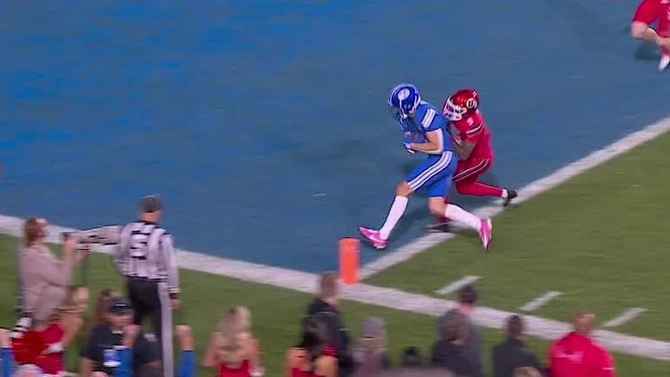
1:14
Utah Utes vs. BYU Cougars: Full Highlights
Nov. 14 and 21: Utah at Arizona and Utah at TCU. Morgan Scalley’s first Utah team faces a couple of enormous late challenges; these results might eliminate the Utes from title contention — or they might knock out a couple of other hopefuls instead.
My 10 favorite transfers
LB Gideon Lampron, Colorado. I love a good tackling-machine linebacker, and almost no one in the country was better at that than Lampron, who racked up 123 tackles, one for every 5.8 snaps he was on the field, in 2025. He made 18.5 tackles for loss and took part in 31 run stops — tackles at or behind the line of scrimmage — as well. (Plus, his amazing middle name doesn’t hurt his cause.)
RB Cam Cook, West Virginia. Rich Rodriguez got a gem from his former employer (Jacksonville State). Cook began his career in the Big 12, at TCU, but erupted for 1,659 rushing yards, 286 receiving yards and 16 touchdowns for a nine-win Gamecocks team. Now he’ll try to give the Mountaineers’ run game a much-needed shot in the arm.
DE Wendell Gregory, Kansas State. If he could make 15.5 tackles for loss with 19 run stops and four sacks as a redshirt freshman on a worst-in-a-generation Oklahoma State team, think what Gregory might be able to do with a decent supporting cast.
OLB Adam Trick, Texas Tech. The bar is impossibly high in replacing David Bailey and his 23 TFLs and 14.5 sacks, but Trick’s numbers at Miami (Ohio) last season (14.5 TFLs, 8.5 sacks, 13 run stops) were outstanding in their own right, and he’ll have quite the supporting cast around him.
QB Alonza Barnett III, UCF. One of the nation’s better dual-threat QBs, Barnett threw for 2,806 yards, rushed for 729 more (not including sacks) and created 38 combined touchdowns last season while leading James Madison to the Sun Belt title and CFP. Few portal quarterbacks are more tested and proven.
WR Kam Perry, Colorado. Take your pick between Perry and San José State transfer Danny Scudero. Scudero averaged 14.7 yards per catch and 2.5 yards per route in SJSU’s pass-heavy system, but Perry was Mr. Big Play for Miami (Ohio), averaging 22.7 yards per catch and 2.8 yards per route and nearly hitting 1,000 yards without a huge number of opportunities.
DT Hosea Wheeler, Baylor. If you’re desperately trying to improve your defense, landing a guy who started five games for national champion Indiana — he took part in 13 run stops among just 30 total tackles — isn’t a bad place to start. The more Cignetti aura you can bring to your program, the better.
WR Malcolm Simmons, Texas Tech. Texas grabbed Auburn’s biggest-name receiver, Cam Coleman, but Simmons, like Coleman a former blue-chipper, averaged more yards per catch (18.3) and more yards per route (2.1) than Coleman, and he could end up a useful piece in the Tech return game as well.
WR Omari Hayes, Iowa State. There are lots of proven QBs in this league, and the portal evidently brought lots of exciting receivers as well. Typically, anything above 2.0 yards per route is a good average; Hayes averaged 3.0 last season at Tulane. He averaged 13.2 yards per catch despite primarily running shorter routes, and he didn’t suffer his first drop of the season until the American Conference title game.
LB Mekhi Mason, Kansas State. I really like K-State’s front-six additions. To complement Gregory and another disruptive end in Elijah Hill (Kennesaw State), Collin Klein grabbed Mason, who made 15 tackles for loss and took part in 24 run stops for Louisiana Tech last season. There’s a lot of speed and havoc potential in Manhattan.
Conference title (and, therefore, CFP) contenders
Head coach: Joey McGuire (fifth year, 35-18 overall)
2026 projection: seventh in SP+, 10.7 average wins (7.8 in the Big 12)
I’m not going to lie: I’m absolutely floored that Brendan Sorsby is eligible to be Texas Tech’s quarterback this season. I assumed that admitting you gambled on your own team would be a red line that even a local county court wouldn’t cross, but I was incorrect. No matter our own personal opinions — of which I have plenty — he’ll evidently play (after a two-game suspension). And that’s unquestionably good news for Texas Tech.
Tech sliced through the Big 12 with little resistance in 2025 thanks to a dynamite transfer class and a dominant defense, but the Red Raiders couldn’t damage Oregon enough in the College Football Playoff due to limitations at quarterback. In Sorsby, McGuire grabbed one of the best available QBs in the portal to headline this year’s expensive and exciting transfer haul. With a new set of super-disruptive defenders, a nearly 2,000-yard running back duo, a super-seasoned offensive line and new upside at QB, Tech very much looks like a potential top-five team. The rest of the roster is so good that missing Sorsby might have only made the difference in a couple of games, but that’s somehow no longer a concern.
It’s hard to find much of a weakness now. The run game was a little more all-or-nothing than preferred last season, with a few too many negative plays, but the return of not only Cameron Dickey and J’Koby Williams (combined: 1,992 yards and 20 TDs) but also Quinten Joyner — who averaged 7.6 yards per carry at USC in 2024 but missed last season with a knee injury — is a great thing, especially when paired with the return of three offensive line starters and the addition of Louisville guard Jordan Church. Five-star freshman tackle Felix Ojo could quickly carve out a role too. The receiving corps needed sprucing up after the loss of last year’s top two targets, and McGuire landed four high-ceiling wideouts in Kenny Johnson (Pitt), Malcolm Simmons (Auburn), Donte Lee Jr. (Liberty) and Jalen Jones (Alabama State). (Johnson is also a dynamite return man.)
It’s funny: Tech lost maybe the top two defensive players in the country from last season (edge rusher David Bailey and linebacker Jacob Rodriguez), plus four of its top six linemen, and I can’t even pretend to worry. McGuire and general manager James Blanchard attacked the vacancies with both volume and upside, signing four tackles, four edge rushers and two inside linebackers. Many of them were among the most disruptive defenders available in the portal: tackles Julien Laventure (Akron) and Jojo Johnson (Oregon State) combined for 21 TFLs last season, edge rushers Adam Trick (Miami-Ohio) and Trey White combined for 25.5 TFLs and 15.5 sacks, and linebackers Austin Romaine (Kansas State) and Corey Platt Jr. (Houston) took part in 18 run stuffs and made tackles on 14.8% of their snaps (Rodriguez was at an otherworldly 16.6%). Combined with the return of linebacker Ben Roberts and tackle A.J. Holmes Jr. — and simply assuming Blanchard keeps his hot hand going until proven otherwise — this should still be the conference’s best front six.
With corners Brice Pollock and Amier Boyd, safety Brenden Jordan and nickel John Curry also back, the secondary should be the conference’s best, too. Pollock picked off five passes and allowed a paltry 11.3 QBR, and if returning blue-chip sophomores in safety Peyton Morgan and corner Tarrion Grant continue to develop, this will be an even deeper unit than last year’s.
Even without Sorsby, Tech was going to be the obvious Big 12 favorite both because of the talent on hand and because of how shockingly light the Red Raiders’ schedule turned out to be: They somehow don’t play any of the next three projected teams in the conference. (And their nonconference slate doesn’t feature a top-90 team.) There are always challenges in store, but it would take quite the run of surprises to prevent Tech from returning to Arlington and racking up a huge win total in the process.

Head coach: Kalani Sitake (10th year, 84-45 overall)
2026 projection: 18th in SP+, 8.7 average wins (6.5 in the Big 12)
You can feel free to skip this section because, as I wrote a couple of months ago, I’m always wrong about BYU. I predict a breakthrough when a collapse is imminent; I give up assuming great things right before a run of great things.
Sitake’s program is good at keeping opponents on their toes, but over the last couple of years it has been even better at knocking them on their backside. The trick will be keeping it going for more than a two-year span.
BYU, 2020-21: 21-4, 15.0 average SP+ ranking (18.5 offense, 18.0 defense)
BYU, 2022-23: 13-12, 71.0 average SP+ ranking (61.0 offense, 85.0 defense)
BYU, 2024-25: 23-4, 17.5 average SP+ ranking (30.0 offense, 21.5 defense)
The Cougars fell into a brief funk on either side of joining the Big 12, but this has been a legit top-20 program for four of the past six years, and while I may always be wrong about them, there’s nothing hinting at a downward spiral at the moment. Quarterback Bear Bachmeier returns after playing at a deliciously high level for a true freshman, and even with the return of Sorsby and Utah’s Devon Dampier (and the addition of North Texas-turned-Oklahoma State QB Drew Mestemaker), Bachmeier should still be one of the conference’s safest bets in 2026.
Bachmeier gets 1,300-yard rusher LJ Martin and four veteran linemen back (including all-conference center Bruce Mitchell), and Sitake was aggressive in adding three more linemen with starting experience, including a potential day-one starter in former blue-chip tackle Paki Finau (Washington). If Bachmeier has pass catchers, this offense could be BYU’s best since the incredible 2020 unit.
That’s a pretty big question mark, though. Last year’s top three targets are gone, and while Martin and tight end transfer Walker Lyons (USC) could become reliable safety valves, no one is proved from a big-play perspective. Juniors Jojo Phillips and Kyler Kasper (Oregon) are big targets with potential, but it’s only potential right now.
Defensively, the biggest loss was in the booth. Jay Hill was a transformative hire three years ago, but he left for Michigan, and Kelly Poppinga, a former BYU linebacker and longtime assistant, takes over as coordinator. He has a high bar to clear, but he also has one of the most experienced units in the conference. Ten of the 16 defenders with 200-plus snaps return, including a great linebacker pairing in Isaiah Glasker and Siale Esera, ruthless cornerbacks Evan Johnson and Therrian Alexander III and a big, physical safety in the 6-foot-4 Faletau Satuala. The pass rush wasn’t good enough last season, though young ends Nusi Taumoepeau and Tausili Akana both produced pressure rates that suggest sacks could be on the way. Either way, the Cougars should force enough passing downs to keep their defensive ratings high.
The Cougars get a rough early schedule, hosting Arizona and visiting TCU within their first four games of the year, then welcoming Notre Dame in an enormous mid-October nonconference game. While my confidence is typically the kiss of death here, and while the lack of proven receivers is problematic, it’s hard to think of them as anything but a top-15 — and, therefore, CFP — contender.

Head coach: Morgan Scalley (first year)
2026 projection: 24th in SP+, 8.4 average wins (5.7 in the Big 12)
On Nov. 28, 1989, Utah fired future New York Giants coach Jim Fassel after a frustrating 4-8 campaign. The school has been led by only three coaches in the 36 seasons since. Ron McBride left as the school’s second-winningest coach, a peak-of-his-powers Urban Meyer went 22-2 in two seasons and Kyle Whittingham took it from there. After 21 seasons and the most wins in Utah history, Whittingham passed the reins to longtime defensive coordinator Scalley.
Whittingham left after a particularly high-upside and what-if-heavy season. The Utes finished eighth in SP+, winning 11 games — 10 by double digits — and losing only to Texas Tech and, in a road nail-biter, BYU. Utah at least briefly found a new level of offensive upside with the combination of coordinator Jason Beck and dynamic quarterback Devon Dampier, ranking seventh nationally in success rate and first in red zone touchdown rate and crafting a few more big plays than normal. The defense, meanwhile, played at its normal top-20 level under Scalley.
Succeeding a legendary figure is usually a fraught experience, but Scalley certainly knows as well as anyone what wins in Salt Lake. He has quite a bit of rebuilding to do in Year 1, though. He held on to Dampier and 900-yard rusher Wayshawn Parker, but they’re the only offensive returnees who started more than five games. Beck’s system was pretty unusual — he followed Whittingham to Michigan — but Scalley brought in another former Bronco Mendenhall assistant, Utah State coordinator Kevin McGiven. He crafted a pretty fun system of his own around dual-threat quarterbacking in Logan, and he brought his top receiver, 6-3 senior Braden Pegan, with him. Pegan and some returning part-time starters such as Larry Simmons and tight end Hunter Andrews will need to play well immediately. So will last year’s backup linemen. All five starters are gone, though there’s still a pretty solid senior presence among returnees (and Scalley added big Montana State transfer Cedric Jefferson).
The defense doesn’t always remain awesome when a coordinator gets promoted to head coach, but we’ll give Scalley and his longtime linebackers coach (and new coordinator), Colton Swan, the benefit of the doubt for now. The Utes return stars in linebacker Johnathan Hall and nickel Jackson Bennee, but with last year’s top four defensive linemen and three of the top four DBs gone, they’ll need some transfers to click. Up front, that means the likes of Ethan Day (North Texas) and tackle Lucas Samsula); in the back, that means corners Elijah Reed (Akron) and James Chenault (South Florida). As with the offensive line, there are lots of seniors in the pipeline: Veterans such as end Lance Holtzclaw, linebacker Trey Reynolds and safety Nate Ritchie could ease seamlessly into leadership roles. With lots of veteran leaders, the forever-important culture might hold without Whittingham. Some new playmakers definitely need to emerge, though.
The schedule is friendly enough, with the Utes missing Texas Tech and hosting BYU. If the Utes are a top-25 level team as projected, they’ll be in the hunt all season. But it wouldn’t be a total surprise if the turnover in the offense and on both lines creates a bit more of a reset than SP+ expects. We’ll see.

Head coach: Collin Klein (first year)
2026 projection: 29th in SP+, 8.2 average wins (5.5 in the Big 12)
Just because a hire seems perfect doesn’t mean it’s guaranteed to work out — hello, “Scott Frost to Nebraska” — but man, Collin Klein taking over at K-State seems perfect, doesn’t it? He led the Wildcats to their second Big 12 title as quarterback, served as offensive coordinator for the team that won their third, then went off to Coach Finishing School for two years, working with Mike Elko and helping Texas A&M reach the CFP. He was an absolute no-brainer replacement for the retiring Chris Klieman.
Klieman’s last Wildcats team began the season 17th in the AP poll and 18th in SP+, made plenty of big plays and played fun, aggressive pass defense. But the Wildcats were surprisingly inefficient running the ball, lost more third downs than they won and went just 2-5 in one-score finishes. Klein held on to quarterback Avery Johnson, who seemed to alternate between successfully deploying his athleticism and unsuccessfully trying to play like an NFL pocket passer last season. If Klein, who was basically a human third-down conversion as a dual threat in college, can rub off on Johnson a little bit, that could be a great thing.
Johnson’s offensive line could be a concern. All-conference left tackle John Pastore returns, but that’s almost it. Klein grabbed a juco player and six other transfers, including starters from Colorado State (Tanner Morley) and Cal Poly (Charlie Adams), and although size won’t be an issue, portal-built lines don’t have the highest success rate. But if the line holds up, a veteran skill corps should be fun. Running back Joe Jackson is good after contact, as is sophomore transfer Rodney Fields Jr. (Oklahoma State), and while big-play slot man Jayce Brown left for LSU, Johnson’s other two main targets — receiver Jaron Tibbs and tight end Garrett Oakley — return and are joined by three transfers, including two former blue-chippers (Missouri’s Josh Manning and Texas A&M’s Izaiah Williams).
Klein handed his first defense over to Jordan Peterson, an A&M co-coordinator over the past two seasons. The Wildcats slumped to 58th in defensive SP+ last season, their worst ranking since 2015, and while massive turnover doesn’t have to be a good thing — only six of 19 players with 200-plus snaps return, but 12 new transfers (and a juco player) have arrived — I like a lot of the new names. Almost no one in FBS added a more disruptive pair of ends than Wendell Gregory (Oklahoma State) and Elijah Hill (Kennesaw State), who combined for 29.5 TFLs and 13 sacks and took part in 26 run stops last season. Hill is a little undersized, as is the line as a whole, but Gregory could come up huge, as could linebacker Mekhi Mason (15 TFLs and 24 run stops at Louisiana Tech). In the secondary, solid cornerbacks Zashon Rich and Donovan McIntosh are joined by safety Koy Beasley (Miami-Ohio) and nickel Ja’son Prevard (Virginia).
By simply not starting this season in Dublin — and therefore leaving themselves exposed to the curse that seems to take down most of the teams that lose that Week 0 game — K-State is already ahead of the curve compared with last year. The Wildcats somehow avoid Texas Tech, BYU and Utah in conference play. (These conferences are too damn big. I miss connectivity.) SP+ projects them as underdogs in only one game (at TCU), so they’ll absolutely have a chance to make a run if the new players click on both lines and Johnson plays a bit more instinctively.
A couple of breaks away from a run

Head coach: Brent Brennan (third year, 13-12 overall)
2026 projection: 30th in SP+, 7.6 average wins (4.8 in the Big 12)
Arizona doesn’t do mediocre. For seven straight years, the Wildcats have finished the season either in the SP+ top 30 or outside the top 75. After going a combined 1-16 in 2020 and 2021, they surged to 10-3 in 2023, plummeted to 4-8 after losing head coach Jedd Fisch, then charged back to 9-4 in Brennan’s second year.
The defense wobbled in the middle of 2025, but it was good enough otherwise to finish 18th in points allowed per drive and ninth in yards allowed per dropback. Under new coordinator Seth Doege, the offense didn’t bounce back to 2023 levels (the Wildcats averaged just 22.3 PPG against top-60 defenses), but it at least torched lesser defenses (39.4 PPG against everyone else).
Defensive coordinator Danny Gonzales generated improvement despite loads of injuries and shuffling: Only two defenders started all 13 games and 21 started at least one. Eleven of the 21 return, including edge rusher Chase Kennedy, linebacker Taye Brown and major secondary playmakers in corner Jay’Vion Cole and nickel Gavin Hunter. But there was still solid attrition on the line and at safety, and Brennan brought in 11 defensive transfers to assure depth. He added mid-major starters such as OLB Everett Roussaw Jr. (Memphis) and corner Tyrese Boss (Wyoming) and small-school stars including linebacker Cooper Blomstrom (Georgetown) and safety Cam Chapa (Northern Colorado), and in linebacker Matai Tagoa’i (USC) and safety Daylen Austin (Oregon) he grabbed a couple former blue-chippers. Gonzales has a history of strong defenses, and he should have another one.
The defense consistently set the offense up with great field position, which allowed the Wildcats to do damage despite ranking just 60th in success rate and 52nd in yards per successful play. Brennan leveraged fourth downs well, and aside from the first half of 2024, fourth-year starting quarterback Noah Fifita has been great at avoiding turnovers. (His career stat line is going to end up pretty fabulous. He’s currently at 9,183 career yards and 73 TDs.)
This was still only a decent offense last year, though, and the Wildcats needed some new playmakers following the loss of their leading rusher and two leading receivers. Sophomore slot receiver Gio Richardson could develop nicely, last year’s backup RBs were solid, and newcomers in running back Antwan Roberts (Marshall) and tight end Cole Rusk (Illinois) could be useful. A decent line returns four of the seven players who started games last season and adds veterans from Washington (Zach Henning) and San José State (Nathan Hale).
While I’ve been complaining about the top teams seemingly missing each other in conference play, Arizona plays pretty much everyone, starting with the huge Week 2 trip to BYU. That could make it difficult for them to contend, but which contenders they beat might determine who makes the title game.

Head coach: Sonny Dykes (fifth year, 36-17 overall)
2026 projection: 34th in SP+, 7.1 average wins (4.6 in the Big 12)
Is Sonny Dykes underrated? He has won 36 games in four seasons, and his Horned Frogs have made a run to the national title game. That’s really good! But the title-game run was almost four years ago, and they got blown out in record fashion before briefly collapsing the next season. They’ve gone 9-4 each of the past two seasons, but they were pretty dependent on tight wins last year and ranked just 37th in SP+.
Whether he’s underrated or properly rated, Dykes has a big year ahead. His Horned Frogs play each of the top five teams in the conference, including four straight in a ruthless November stretch, and he’s putting his faith in a new-to-the-family offensive coordinator and an Ivy League quarterback.
Gordon Sammis was last seen coordinating an almost mistake-free UConn offense that graded out as the Huskies’ best in 22 years and threw just one interception all season. With quarterback Josh Hoover off to Indiana, Dykes replaced him with Harvard’s Jaden Craig, a 6-3, 230-pounder who threw for 5,299 yards, 48 touchdowns and only 10 picks over 21 games in 2024 and 2025. He looks the part, and he’ll theoretically get some time to find his sea legs, as TCU’s first four opponents are projected 58th or worse in SP+.
(It’s worth noting that TCU starts the season against North Carolina in Dublin, which opens the Horned Frogs up to the dreaded Dublin Loser Curse that seems to destroy the season of whoever is bested in that game. They’ll be favored, at least, though that doesn’t seem to matter for that overseas trip.)
Leading rusher Jeremy Payne returns after a late-2025 breakout (last five games: 476 yards at 6.4 per carry), and while three of Hoover’s top four targets are gone, I still like the potential of the receiving corps with senior Jordan Dwyer, sophomore Ed Small, South Alabama transfer Jeremy Scott (zero drops in 2025) and a number of young recent blue-chippers. The line also got hit by turnover, but left tackle Ben Taylor-Whitfield (two sacks allowed) is back, and Dykes added All-Conference USA guard Jaheim Buchanon (Florida International) and guard Noah McKinney (Oklahoma State). If Sammis and Craig are good grabs, they’ll make this supporting cast shine.
Andy Avalos’ 2025 defense was excellent until opponents had to pass. The Frogs ranked 19th in yards allowed per carry (no sacks) but 109th in yards allowed per dropback. The pass rush was nonexistent, and they ranked 131st in conversion rate allowed on third-and-11 or more. The line was incredibly young, which didn’t help, but six of seven linemen return, end Paul Oyewale could be ready for a star turn, and two incoming transfers — Cheta Ofili (Texas Tech) and Koron Hayward (Western Kentucky) — had great pressure rates last season (which eventually tends to lead to sacks). I’d bet the pass rush improves a bit, and Dykes will ask three transfers to fix the secondary: corners Kalen Carroll (Central Michigan) and Teon Parks (Colorado) and safety Jacob Fields (Louisiana Tech). Another year of development for nickel (and former blue-chipper) Kylin Jackson will help too.

Head coach: Willie Fritz (third year, 14-11 overall)
2026 projection: 36th in SP+, 7.4 average wins (4.7 in the Big 12)
Fritz is one of the most underrated coaches of the 21st century. He won two juco national titles, reached two FCS title games with Sam Houston, engineered immediate FBS success at Georgia Southern and turned Tulane into a mid-major powerhouse. In his latest move, the 66-year-old needed only one year to create something viable at Houston: After a 4-8 debut, his Cougars charged to 10-3 with only their second SP+ top-40 finish in nine years.
In his first year in a job, Fritz’s all-time win percentage is just .507. But it rises to .730 in Year 2 and holds steady at .725 in Year 3. And with a veteran quarterback, a new/old running back and dynamite additions on both lines, I could see the Coogs overachieving their No. 36 projection.
Both of last year’s new coordinator hires clicked. Austin Armstrong held the fort on defense after Shiel Wood left for Texas Tech, while the offense surged from 118th to 44th under Fritz’s former Tulane coordinator Slade Nagle. Quarterback Conner Weigman (2,705 passing yards, 795 non-sack rushing yards, 36 total TDs last season), leading slot receiver Amare Thomas and sophomore big-play man Koby Young return, and Fritz put together an exciting transfer class. He grabbed three all-conference linemen in tackle Drew Terrill (Miami-Ohio), guard Shadre Hurst (Tulane) and sophomore center Anthony Boswell (Toledo), landed Oregon State’s leading receiver (Trent Walker) and added an old friend in Makhi Hughes, who rushed for 2,779 yards and 22 TDs at Tulane in 2023 and 2024 before a surprising dud transfer to Oregon. Returning to a Fritz-Nagle offense could get Hughes going again. And Nagle can feel comfortable in continuing to run Weigman a lot knowing that if he gets banged up, five-star freshman Keisean Henderson, a top-five recruit in 2026, could fill in capably.
The defense was secondary-driven last year, with aggressive on-ball coverage and strong big-play prevention. Losing corner Latrell McCutchin Sr. hurts, but safeties Kentrell Webb and Jordan Allen and corner Will James return, and Fritz added another Tulane veteran in nickel Javion White. The front six returns outside linebackers Brandon Mack II and Latreveon McCutchin, sure-tackling linebacker Sione Fotu and veteran big men Khalil Laufau and Myles Parker. Fritz didn’t mine the portal for too much on defense, but in addition to White he grabbed an aggressive corner in Jalen Mayo (Stephen F. Austin) and an intriguing trio of tackles in Ashton Porter (Oregon), De’Marion Thomas (Oklahoma State) and Ejiroghene Egodogbare (Yale).
The schedule isn’t particularly kind — Houston will play at Texas Tech, Kansas State and Utah — but the Coogs could have some of the best trench play in the Big 12 and plenty of upside elsewhere. And Year 3 Willie Fritz definitely gets the benefit of the doubt.

Head coach: Eric Morris (first year)
2026 projection: 39th in SP+, 6.4 average wins (4.6 in the Big 12)
Deion Sanders’ Colorado in 2023. Curt Cignetti’s Indiana in 2024. Bill Belichick’s North Carolina in 2025. Each offseason, a new coach swoops into a new job, signs loads of transfers and commands a lot of the space in my head because I just can’t figure out how and where to set the bar. My track record is pretty good — I thought Indiana would exceed expectations (OK, yes, I thought that meant they would threaten to reach 6-6), and I thought Colorado and North Carolina absolutely wouldn’t — but I’m struggling mightily with Oklahoma State this year because I just can’t stop thinking they’re going to be really damn good this season.
Yes, Oklahoma State, the team last seen going 1-11 with its worst squad in more than 60 years. And also the team that just signed a new head coach who brought half of last year’s No. 1 offense with him.
With 4,300-yard quarterback Drew Mestemaker, 1,400-yard running back Caleb Hawkins, 1,200-yard receiver Wyatt Young, 500-yard receiver Miles Coleman, all-conference tackle Braydon Nelson and all-conference guard Johnny Dickson III all following former North Texas head coach Morris to Stillwater, I’ll be shocked if the Cowboys don’t have a top-20 offense. That becomes even more true when you throw in the additions of running back Tre Page III (7.5 yards per carry at Tarleton State) and receivers Chris Barnes (14.0 yards per catch at Wake Forest) and Israel Polk (15.9 per catch at Akron). This is a delightful cast of characters, and I promise I’m not giving bonus points to Morris for bringing on a player from my hometown SW Oklahoma State (tight end Bodie Boydstun).
Defense will determine whether we’re talking about a fun .500 team or something more. Coordinator Skyler Cassity crafted a brilliant Sam Houston defense in 2024 and made North Texas’ defense suddenly competent last fall, and he brought in quite a few former Mean Green starters — end Keviyan Huddleston, tackle Saadiq Clements, linebacker Ethan Wesloski, cornerback Kollin Lewis, safety Evan Jackson and nickel Quinton Hammonds. He also added starters from UCLA (linebacker Isaiah Chisom) and Liberty (nickel Christian Bodnar) and took some risks on high-level Division II talent (Central Oklahoma linebacker Jack Puckett) and power-conference backups with great numbers (Vanderbilt corner Trudell Berry and Texas Tech DB Maurion Horn). This compilation isn’t nearly as impressive as the offense, but it just needs to be average for the Pokes to win quite a few games.
OSU is projected an aggressive 39th in SP+, which feels right to me but is still awfully ambitious. The Cowboys’ conference schedule features seven games projected within 6.9 points, which means that if they over- or underachieve by a decent amount, their win total could swing pretty wildly. But if nothing else, it’s going to be pretty easy to improve on 1-11.

Head coach: Kenny Dillingham (fourth year, 22-16 overall)
2026 projection: 42nd in SP+, 6.0 average wins (4.1 in the Big 12)
After 19 wins in two years — complete with a Big 12 title in 2024 — a new cycle begins at ASU. Dillingham’s Sun Devils were too injury-addled for a serious run at another title last year, but they still scored the conference’s biggest upset (over Texas Tech) and won a solid eight games. Only 11 of 34 regulars (200-plus snaps) return, and 25 transfers arrive, including 16 from power conferences. ASU should still have quite a bit of upside, but the cast of characters has changed dramatically.
That’s especially true at quarterback, where none of last year’s passing yards return and four very different QBs are fighting for the starting job: sixth-year veteran Mikey Keene (Fresno State/Michigan), sophomore Cutter Boley (Kentucky) and four-star youngsters Cameron Dyer (redshirt freshman) and Jake Fette (true freshman). Boley should have the edge after producing decent numbers under a high degree of difficulty at UK, but the competition will continue in fall camp.
The reset is almost as significant in the skill corps.
Six of last year’s top eight (in terms of yards from scrimmage) are gone, though there’s again plenty of upside thanks to returning reserves and incoming transfers. Running backs Kyson Brown (injured for most of 2025) and sophomore Jason Brown Jr. combined to average 7.5 yards per carry in 34 touches last season, and receivers Derek Eusebio, Jalen Moss and Jaren Hamilton averaged more than 15 yards per catch over a combined 45 receptions. But newcomers will play a huge role, especially running back Marquis Gillis (1,264 yards from scrimmage at Delaware State) and receivers Omarion Miller (Colorado) and Reed Harris (Boston College), who, like Boley, posted solid numbers on awful offenses. Coordinator Marcus Arroyo tends to keep things simple, determining his best players and giving them the ball as much as they can handle, but he’ll have lots of candidates for touches. Dillingham gave a show of confidence to his offensive line, adding only two transfers despite losing five of last year’s top seven. We’ll see if he’s rewarded for his faith.
Brian Ward’s defense is taking on just as much change. Tackle C.J. Fite, safety Adrian Wilson and a couple of exciting reserves (nickel Montana Warren and corner Rodney Bimage Jr.) return, but the portal will have to provide experience and disruption. End Emar’rion Winston (Baylor), linebacker Owen Long (Colorado State), cornerback Ashton Stamps (LSU) and safety Lyrik Rawls (Kansas) could certainly bring both, though the only player on the roster who had more than three sacks last season is linebacker transfer Ramere Davis (Northern Arizona). I do like that while Dillingham landed veterans such as Winston, Rawls and Stamps (who had a huge season for LSU in 2024), he also grabbed high-upside sophomores such as Davis and safety Jessiah McGrew (Florida International). That could pay off long term.

Head coach: Scott Satterfield (fourth year, 15-22 overall)
2026 projection: 50th in SP+, 5.9 average wins (3.5 in the Big 12)
Transition and slight improvement, rinse and repeat. It’s the story of Satterfield’s Cincinnati tenure. He set the bar nice and low out of the gate (3-9 and 87th in SP+ in 2023), and his Bearcats improved to 5-7 (72nd) and 7-6 (56th) in the years that followed. But it’s hard to tell if he’s actually gaining traction or not. His 2026 team will feature new coordinators, a new quarterback, a new skill corps, a mostly new defensive line and a new secondary. He did a solid job in the portal and might have just the guys to engineer another round of slight improvement, but it’s fair to wonder what the ceiling is here.
There’s an interesting dynamic on offense, where maybe the most proven line in the conference — three returning linemen (tackle Joe Cotton and guards Evan Tengesdahl and Taran Tyo) have all earned at least third-team All-Big 12 honors in their careers — will support a quarterback and skill corps plucked almost entirely from mid-majors and smaller schools.
To replace Brendan Sorsby at quarterback, Satterfield added two veterans: JC French IV (Georgia Southern) and Liam O’Brien (Penn). French has thrown for 5,882 career yards and probably holds the edge over O’Brien and sophomore Samaj Jones, and whoever wins the job will bring a run threat to the table. Veteran running back Zylan Perry (Louisiana) is a solid yards-after-contact guy, and Cade Wolford (Kent State) was one of the most dangerous slot receivers in the MAC as a freshman last season. But Satterfield reached even deeper down to grab the receiver trio of Larenzo Fenner (South Dakota), Flynn Schiele (Colorado Mines) and Malachi Henry (Central Arkansas), who combined for 3,085 receiving yards (17.2 per catch) and 37 TDs but are making huge jumps up in competition.
As with the offense, the defense’s success will be determined by whether Satterfield added the right mid-major or smaller-school guys. That includes veteran coordinator Nate Woody, who was solid for years at Army but failed in his only season as a power-conference DC (2018 with Georgia Tech). Woody will have a few solid returnees in end Marquaze Parker, linebackers Jonathan Thompson and Simeon Coleman, and nickel Antwan Peek Jr. But success will have to be derived from mid-major veterans such as tackle Chidera Otutu (UTSA), linebacker Filip Maciorowski (Northern Illinois), safeties Jasper Beeler (Northern Illinois), MJ Cannon (Bowling Green) and Ty Goodwill (South Alabama), and corners Jacob Finley (Northern Illinois), KK Meier (UTSA) and Kenny Worthy (Washington State), as well as a trio of smaller-school stars: Thomas Johnson (NC Central), tackle Josh Hough (California-PA) and linebacker Patrick Bauer (Illinois State).
If Satterfield has called up the right guys, the Bearcats could surprise. But a lot of right guys are needed.

Head coach: Dave Aranda (seventh year, 36-37 overall)
2026 projection: 51st in SP+, 5.9 average wins (3.8 in the Big 12)
Baylor wasted a good offense and a great special teams unit last season. Sawyer Robertson threw for 3,681 yards, the top three backs combined for 1,577 rushing yards, kicker Connor Hawkins and punter Palmer Williams were excellent, and the Bears lost every single game in which they didn’t score at least 30 points.
Aranda has to hope his third defensive coordinator hire is the charm. Baylor has averaged a 92.0 ranking in defensive SP+ over the past three seasons and has gone a combined 16-21 in that span — safe to say, Aranda’s seat is among the hottest in the country — but he brought in a solid DC in former Kansas State coordinator Joe Klanderman, who has a lineup’s worth of new transfers to work with.
Klanderman’s six K-State defenses averaged a 37.7 defensive SP+ ranking, with two landing in the top 25. He brought four former Wildcats with him, including outside linebacker Ryan Davis and dynamite nickel Daniel Cobbs. They’re two of 10 newcomers who started games for FBS teams last year. The Bears could see a nice upgrade up front with Hosea Wheeler (Indiana) and Jamaal Whyce Jr. (Marshall) among those joining senior Devonte Tezino at tackle. And a secondary with Cobbs, aggressive (sometimes too aggressive) corner LeVar Thornton Jr. and safety Devin Turner (a 2025 transfer who was injured last season) could be fun to watch. This should be a physically impressive, junior- and senior-heavy defense, and I would assume decent improvement.
That’s good because the offense is getting a massive makeover whether it wanted one or not. Sixteen players saw at least 200 snaps on offense, and only backup running back Caden Knighten, eight-catch tight end Matthew Klopfenstein and right tackle Kaden Sieracki return. But Aranda added some high-upside replacements for coordinator Jake Spavital. Former blue-chipper and Florida starter DJ Lagway takes over at QB; he looks the part and can throw a ton, but Spavital will still need to make him an actual quarterback after two inconsistent seasons in Gainesville. At receiver, Aranda added slot man Gavin Freeman (Oklahoma State) and well-traveled former blue-chipper Dre’lon Miller (Colorado), and while an excellent line lost four starters, the coach grabbed four veteran starters from elsewhere, including almost mistake-free guard Asher Hale (South Alabama). Known depth is questionable, but the starting 11 should have comparable talent to last year’s — and maybe a higher ceiling.
I like the moves Aranda made to save himself, but the Bears will have to either overachieve their projections quite a bit, or win a ton of close games, to move up the standings. Eight of Baylor’s 12 games are projected within one score, but the Bears are favorites in only two. There’s opportunity there, but Lagway and Klanderman both need to be immediate hits.

Head coach: Lance Leipold (sixth year, 27-35 overall)
2026 projection: 55th in SP+, 5.8 average wins (3.6 in the Big 12)
At this point, Leipold is hoping to pull a Matt Campbell. After scoring Iowa State’s first-ever top-10 finish in 2020, Campbell’s Cyclones lost 12 of 13 one-score finishes and went a combined 18-20 from 2021 to 2023. Their luck began to reverse in 2023, however, and they won 10 of their next 11 one-score games, which drove an 11-win season in 2024.
Kansas hasn’t enjoyed the same heights under Leipold, but going 9-4 in 2023 with a No. 25 SP+ ranking was shocking for a program that had averaged just 1.9 wins per season from 2010 to 2021. The Jayhawks are still playing at a top-60 level, but they’ve lost nine of their past 11 one-score finishes. (And that doesn’t include a pair of 10-point losses in 2025 that were within three points in the final minutes.) Back-to-back 5-7 records are still impressive considering KU’s recent history, but frustration is rising. And now the offense that has carried the program for a while is undergoing a massive facelift.
Only five of 16 offensive players with 200-plus snaps return, and longtime starting QB Jalon Daniels is finally out of eligibility. Leipold has won 173 career games thanks to building with grade-A culture, but if his program is going to turn back around in 2026 it will be because of transfers: running backs Dylan Edwards (Kansas State), Yasin Willis (Syracuse) and Jalen Dupree (Colorado State), receivers Nik McMillan (Buffalo) and Nahzae Cox (Middle Tennessee), tight end Carter Moses (Albany) and three offensive linemen who started games for power-conference teams last year.
There are exciting new players — namely, Edwards (a dynamite return man) and McMillan — and the return of coordinator Andy Kotelnicki is promising. (KU had a top-30 offense in each of his last two seasons in Lawrence.) But junior Cole Ballard, sophomore Isaiah Marshall or Rice transfer Chase Jenkins will need to clear the bar at QB. Both Ballard and Marshall have solid dual-threat potential, and Jenkins is an excellent runner (passer, not so much), but none is a proven option.
Defense has long held back Leipold’s program. The Jayhawks have averaged a defensive SP+ ranking of 68.7 over the past three seasons, and that’s a massive improvement over the two before that. Second-year coordinator D.K. McDonald returns a few solid starters: end Leroy Harris III, tackle Blake Herold, linebacker Trey Lathan, and cornerbacks Jalen Todd and Austin Alexander (who were up and down but young last season). But again, transfers will have to dictate improvement. Leipold landed quite a few veterans with starting experience, and he did a good job of bringing in quite a bit of size up front, but there aren’t many proven playmakers. I don’t see a Big 12 contender here, but if Kotelnicki and the new blood give the Jayhawks a fourth-quarter edge for once, they could enjoy a solid season.

Head coach: Scott Frost (fourth year over two tenures, 24-14 overall)
2026 projection: 60th in SP+, 6.0 average wins (3.7 in the Big 12)
I have to compliment Scott Frost for his dedication to replication. The last time he was UCF’s head coach (2016-17), he battled through a mediocre first season, then stepped on the gas, leading the Knights to a 13-0 charge in Year 2. You can’t say 2025 looked all that different from 2016.
2016: 6-7 record, 73rd in SP+ (85th offense, 60th defense)
2025: 5-7 record, 76th in SP+ (98th offense, 51st defense)
Granted, the 2016 season was coming off of a dire 0-12 campaign, so it represented plenty of improvement in itself. The 2025 season, not so much. Still, Frost planted decent seeds in 2025, especially on a defense that returns coordinator Alex Grinch and most of a senior-heavy secondary. Corners Jayden Bellamy, Antione Jackson and DJ Bell are a fantastic trio, and the UCF pass defense should be dynamite as long as a transfer pass rusher such as end Bruno Dall (Akron) or linebacker Jahleel Culbreath (Old Dominion) can do some damage. Culbreath and returning linebacker Lewis Carter should provide proper run support too, but at least two of three transfer tackles — Thomas Collins (Oregon State), Artavius Jones (Miami) and Brad Gurley (Eastern Kentucky) — will need to provide something valuable next to incumbent RJ Jackson Jr.
Newcomers will play an even larger role on offense, where nothing really stuck last season. The tempo that was once Frost’s calling card was nowhere to be seen, and there were far too many third-and-longs and turnovers. Slot receiver Duane Thomas Jr. and tight end Dylan Wade are reliable, and right tackle Preston Cushman is back, but otherwise UCF’s success will depend on transfers.
Frost did land some pretty exciting newcomers, starting with quarterback Alonza Barnett III, who immediately becomes one of the Big 12’s most proven signal-callers after throwing for 5,404 yards, rushing for 1,398 (not including sacks) and creating 71 total TDs over two seasons as James Madison’s starter. If running back Duke Watson (Louisville) can stay healthy, he and Barnett could form a scary duo: Injuries washed out Watson’s 2025 campaign, but in just 67 carries as a freshman in 2024, he ripped off runs of 68, 58, 58, 54 and 40 yards. Watson and Landen Chambers (Central Arkansas) are a potentially explosive new RB duo, and Frost added Jonathan Bibbs (14.7 yards per catch at Louisiana-Monroe) and Josh Derry (14.8 at Monmouth) to the receiving corps as well. And the line should be experienced as well, even if the experience from four key transfers was derived elsewhere.
There’s reason to expect improvement on both sides of the ball, though I’m going out on a limb and guessing that a 2017-esque 13-0 run (or anything close) isn’t in the cards. But hey, we didn’t see it coming in 2017 either, did we?
Just looking for a path to 6-6

Head coach: Jimmy Rogers (first year)
2026 projection: 64th in SP+, 5.3 average wins (3.2 in the Big 12)
Matt Campbell’s 10-year tenure at Iowa State was transformative, with 72 wins and the Cyclones’ first two AP top-15 finishes ever. Now we’ll see if his departure is just as transformative. Over the past decade, ISU’s attendance and investment levels have soared, and it sure seems that the infrastructure has grown quite sound. But until someone else captains this ship well, we don’t know anyone else can.
Campbell left for Penn State, and 55 transfers took off as well, about half of them for PSU. No offensive returnee had more than 87 yards from scrimmage (or any passing yards) or took more than 48 snaps on the offensive line. On defense, 23 players saw at least 100 snaps last season, and five return. None had even 250 snaps.
This is one of the biggest teardowns in the country, and it’s up to Rogers to make something of it. ISU could certainly do worse. Rogers went 27-3 in two seasons at South Dakota State, winning an elusive FCS national title in his first year succeeding John Stiegelmeier. And in one season at Washington State, he improved the Cougars from 68th to 61st in SP+ despite his team ranking 130th in returning production.
Most of Wazzu’s success last year came from Jesse Bobbit’s defense, and Rogers brought both Bobbit and 12 former Cougars, including six linemen, with him. Ends Isaac Terrell and Malaki Ta’ase are excellent. Other Group of 6 transfers such as nickel Malcolm Jones (Jacksonville State) and corner Keyon Washington (Bowling Green) could be important, and Rogers loaded up on smaller-school stars too, including end Caden Crawford (South Dakota) and linebacker Tristan Exline (Texas-Permian Basin).
I’m guessing Bobbit can make something pretty solid of the defense, which is good because I’m not sure about the offense. Quarterback Jaylen Raynor comes to Ames after throwing for 8,694 yards and rushing for 1,707 more at Arkansas State, and the receiving corps could have potential with newcomers such as Omari Hayes (Tulane) and Cody Jackson (Tarleton State). Seven new linemen bring starting experience to the table, and grabbing Tarleton State sophomore tackle Braden Smith might turn out to be astute. But there isn’t as much ready-made talent as on the defensive side.

Head coach: Rich Rodriguez (ninth year over two tenures, 64-34 overall)
2026 projection: 66th in SP+, 5.2 average wins (3.0 in the Big 12)
I like to mention when I disagree with an SP+ projection, and I often am proved correct when doing so. And sometimes I’m not. SP+ projected WVU 57th with a win total around 5.2 in Rodriguez’s first season back in Morgantown, but I was enamored enough with the transfers he brought in to think the Mountaineers were capable of a bit more.
Instead, they went 4-8 and finished 93rd in SP+. They pulled off a lovely comeback to beat Backyard Brawl rival Pitt during a 2-1 start, but the offense showed life only briefly after that, and an aggressive defense got burned too many times to make up the difference.
Rodriguez can still coach an awfully fun offense when he has the right quarterback, but he didn’t have that in 2025. He started four different QBs at least once, but only freshman Scotty Fox Jr. really showed potential, with a pair of 300-yard passing efforts and three games with more than 60 non-sack rushing yards. He was inconsistent, though, and now he’ll be pushed by another sophomore, former Oklahoma blue-chipper Michael Hawkins Jr. I’m excited about the thought of Hawkins pairing with Jacksonville State mega-transfer Cam Cook (1,659 rushing yards and 14 TDs last season) in the backfield, with another couple of Jax State guys, all-conference linemen Amare Grayson and Cam Griffin, blocking for them. But I was high on a number of WVU transfers last year, and few clicked.
Coordinator Zac Alley gets a complete do-over this fall: Of the 21 defenders with 200-plus snaps in 2025, only two return. Two! After last year’s heavy turnover, almost no one on this defense has been around for more than a couple of years, so the Mountaineers will be once again hoping transfers — and/or eight juco players — hold the key. Edge rushers Harper Holloman (Western Kentucky) and David Afogho (Bowling Green) are excellent against the run, and corners Jaire Rawlison (Kent State) and Chams Diagne (Georgia State) and safeties Kamari Wilson (Memphis) and Andrew Powdrell (UNLV) posted solid disruption numbers last year. I doubt this defense will be worse, but there could be severe depth issues after all the turnover.
Rodriguez should have a QB and a more enjoyable offense. But I won’t talk about overachieving this time around.

Head coach: Deion Sanders (fourth year, 16-21 overall)
2026 projection: 65th in SP+, 4.6 average wins (2.9 in the Big 12)
I clearly haven’t learned my WVU lesson: Here’s where I once again tell you the team with the worst projected record in the Big 12 might be underrated because of how much I love its transfer class.
If you want to think the Deion Sanders era at CU is coming to a meek ending this year, there’s plenty of evidence on your side. With Travis Hunter and Shedeur Sanders gone and Coach Sanders dealing with a run of health problems, the Buffaloes collapsed to 3-9 and 96th last season. The coach made a run of QB changes that further confused a dreadfully inefficient offense, and the defense gave up far too many big plays. In Sanders’ fourth year in charge, he’s looking at his third or fourth total reset.
The thing is, I like nearly everyone he added. New offensive coordinator Brennan Marion brings instant improvement wherever he goes (and he goes lots of places), the new receiver trio of Danny Scudero (San José State), Kam Perry (Miami-Ohio) and DeAndre Moore Jr. (Texas) is outstanding, and the offensive line added three power-conference starters and four other veterans. If Marion and blue-chip redshirt freshman QB Julian Lewis form a solid partnership, the offense will improve quite a bit.
I’m less sure about the defense, with a pretty unproven coordinator, Chris Marve, taking over. But Sanders landed some potential stars: Ends Santana Hopper (Tulane) and Balansama Kamara (Albany) and tackles Ezra Christensen (New Mexico State) and Dylan Manuel (Appalachian State) produced solid disruption numbers last year, and Gideon Lampron (Bowling Green) might have been the best sideline-to-sideline tackling machine in FBS. In the secondary, Randon Fontenette (Vanderbilt) was one of the SEC’s better nickels, corner Justin Eaglin (James Madison) picked off five passes, big corner Paul Omodia (Lamar) broke up 13 passes, and Sanders took a flyer on Tennessee transfer Boo Carter, a great playmaker who wore out his welcome with rules violations in Knoxville.
We saw last year that Colorado still has an awfully low floor, but if Lewis indeed comes into his own at QB, the ceiling could be just as high: There’s more proven production on this roster than even the nine-win 2024 team had. It has to jell, and massive makeovers always come with risks. But I like this team’s potential a lot more than SP+ does. And when have I ever been wrong?
One big anniversary
Thirty years ago, Big 12 football began. The great conference realignment wars of the early 1990s got us rolling toward everything we see today. The Big Ten got things started by adding Penn State, the SEC expanded to 12 teams and broke into divisions while adding a conference title game, and once those things didn’t end the world, it was time for another superconference: The members of the Big 8 merged with half the remaining Southwest Conference to form the Big 12. Both Nebraska (1997) and Oklahoma (2000) scored national titles in its early days, but no league had a wilder or more impactful run of conference title game upsets. That began right from Year 1 with Texas’ stunner against Nebraska.
Thirty years later, only seven of the original 12 members remain, but the drama certainly carries on.