ECB raises eurozone interest rates by 25 basis points
Newsflash: the European Central Bank has increased borrowing costs across the eurozone for the first time since September 2023.
The ECB's governing council voted to increase interest rates by a quarter of one percentage point.
Policymakers hiked borrowing costs after eurozone inflation rose to 3.2% last month, as the Middle East crisis pushed up energy costs.
Announcing the decision, the ECB says:
double quotation mark The war in the Middle East is generating inflation pressures, and the decision to raise rates is robust across a range of scenarios mapping out how the shock might evolve and affect the medium-term outlook for the euro area.
This increases the rate on the ECB's deposit facility, which banks can use to make overnight deposits with the Eurosystem, to 2.25% up from 2%.
The interest rate on the ECB's main refinancing operations, which commercial banks use to borrow funds from the ECB, is going up to 2.4% from 2.15%.
And the rate on the marginal lending facility, which offers overnight credit to banks, rises to 2.65% from 2.4%.
Key events
Closing post
Time to wrap up….
The European Central Bank has raised interest rates for the first time since 2023 in response to higher inflation caused by the war in Iran.
The ECB raised its main deposit rate from 2% to 2.25% in a move that financial markets expect to be the first of three rises by next spring.
Eurozone consumer price inflation rose to 3.2% in May 2026, from 3% in April, sparking concerns that the conflict in the Middle East will force manufacturers and retailers to push through price increases into the summer and autumn to maintain profit levels. The ECB's inflation target is 2%.
The ECB's president, Christine Lagarde, said the outlook for inflation and the broader economy was uncertain while the war in Iran continued to push energy costs higher.
She said:
double quotation mark “The full implication of the war for medium-term inflation and growth will depend on the intensity and duration of the energy price shock, as well as the scale of its indirect and second-round effectsâ€.
And in other news:
Denmark’s central bank raises interest rate in line with ECB
The ECB's decision has had a knock-on impact in Copenhagen.
Denmark's central bank has raised its key interest rate by 25 basis points to 1.85% on Thursday, saying:
double quotation mark “The interest rate increase is a consequence of the increase by the European Central Bank of its main monetary policy rate, the deposit facility rate, by 0.25 percentage point.“Thereby, the monetary policy spread vis-à -vis the euro area will remain unchanged.â€
Global growth is slowing to lowest level since pandemic, says World Bank

Heather Stewart
While Lagarde was speaking, the World Bank warned that global economic growth will slow to 2.5% this year as a result of the war in the Middle East – the weakest since the Covid pandemic – as inflation and borrowing costs rise.
The Washington-based development bank has downgraded growth forecasts for two-thirds of countries in its half-yearly Global Economic Prospects report. The bank estimated that global growth was 2.7% in 2025.
Even if the disruption to oil flows in the strait of Hormuz shipping channel triggered by the Iran war abates next month, the World Bank expects global inflation to rise to 4% in 2026, up significantly from 3.3% in 2025.
Average fertiliser prices are expected to jump by as much as 38% this year, as a result of disruption of supplies through the strait, and shortages of the inputs for fertiliser production from the Gulf.
Economists predict more ECB hikes ahead
With the ECB's press conference over, several economists are warning that today's rate hike may not be the last we see in 2026.
Here's some early reaction to the first rise in eurozone interest rates in almost three years:
Holger Schmieding, chief economist at Berenberg:
double quotation mark A modestly hawkish message: Upon delivering the expected 25bp rate hike today, the European Central Bank (ECB) did not answer the key question: will it make a follow-up mistake by tightening the monetary screws again in July or September? As expected, the ECB emphasised that the outlook remains uncertain and that it will follow a “data-dependent meeting-by-meeting approach†and is “not pre-committing to any particular rate pathâ€.However, the significant upward revision to the call for core inflation in 2027 from 2.2% to 2.5% relative to very modest cuts to its staff projections for growth by 0.1ppt each for 2026 (to 0.8%) and 2027 (to 1.2%) sends a hawkish message.
That today's decision to raise rates today was unanimous, as ECB president Christine Lagarde explained at the press conference, also indicates a clear risk that the ECB will tighten policy again in coming months.
Alex Nairn, economist at the Centre for Economics and Business Research:
double quotation mark The ECB hopes to prevent price pressures from becoming more entrenched and to contain their pass-through into other sectors of the economy as much as is possible. The rate increase was accompanied by an upward revision to the ECB's inflation forecast for 2026 and 2027 and a downward revision to the growth outlook. Looking ahead, the ECB is expected to maintain a data-dependent approach with future policy decisions guided by inflation dynamics and the broader economic outlook. We expect further tightening may be required this year, although the timing of any additional rate increases remains uncertainâ€
Neil Birrell, CIO of Premier Miton:
double quotation mark The ECB delivered its first interest rate increase since 2023; unsurprising given the inflation backdrop and their own rising forecasts for this year and next. More encouragingly, they don't see much risk to GDP, although growth expectations are already muted. This is likely to be followed by more rate hikes this year, depending on the data, but it's hard to think this is the end of the policy move.
Christine Lagarde also touched on AI, pointing to the “new, faster, more intuitive developments†taking place.
This is creating security worries, she points out, explaining that the ECB is taking steps to ensure it is safe from potential intrusion and potential hacking attacks.
[Reminder, there are concerns that Anthropic's Mythos AI tool is an unprecedented risk because of its ability to expose flaws in IT systems.]
Q: What would it take for the ECB to reverse today's interest rate rise?
“We will be deciding meeting by meeting, we will be data dependent, we will have no preset predetermined rate path going forward. That's the way we will be operating,†Christine Lagarde replies.
Q: The ECB's monetary policy statement no longer says that longer term inflation expectations remain well anchored. Has your view changed?
Christine Lagarde says short term inflation expectations have risen on, but longer term expectations look to be broadly anchored at the ECB's 2% target.
Lagarde: This is a good decision
Earlier in the press conference, Christine Lagarde rejected suggestions that the ECB might make an “insurance†interest rate hike.
That prompts a teasing question …
Q: If it's not an insurance hike, what is it then? Is it the start of a new hiking cycle or something else?
Lagarde tries to sweep this aside, calling today's rate rise “a good monetary policy, interest rate decisionâ€.
She insists it is a “sensible monetary policy decision … that standsâ€.
Christine Lagarde then insists that the ECB has not been complacent in its handling of the eurozone economy.
“I don't like to brag and I'm not full of vanity,†she insists, before pointing out that the ECB had kept inflation near its 2% target for the last 12 months (before the Iran war pushed up costs).
“We have not been complacent, we have done our job.â€
Lagarde: A bank’s gotta do …
Q: Quite a few economists had warned that an interest rate rise today would be a mistake – what's your response?
Christine Lagarde replies that “everybody has to do what they have to doâ€.
The ECB's job is price stability, she points out, and to follow its reaction function [how it adjusts monetary policy in response to evolving economic conditions].
She then cites the inflation outlook, and the risks to the upside on inflation, to defend today's interest rate hike.
Lagarde: decision was unanimous
On to questions!
Q: Did the ECB's governing council consider holding interest rates today, or consider a larger increase in rates?
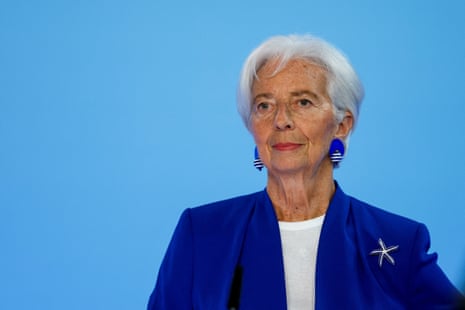
Lagarde (who appears to be sporting a starfish brooch) reveals that the decision to raise rates by a quarter-point was unanimous, and based on the latest forecast from ECB economists.
She says:
double quotation mark The decision that we took today to raise, by 25 basis points, our three interest rates was a unanimous decision without reservation.We did not discuss or debate any other alternative proposal.
Lagarde: The risks to the growth outlook are to the downside, due to Middle East war
European Central bank president Christine Lagarde then warns that the ongoing Iran war is threatening the eurozone's growth outlook.
“The risks to the growth outlook are to the downside, mainly owing to the war in the Middle East, which has added to the volatile global policy environment. Prolonged disruption of energy supplies could increase energy prices further and for longer than currently expected,†Lagarde tells reporters in Frankfurt.
These factors would erode real incomes, and make firms and households more reluctant to invest and spend, she warns.
And the situation could worsen, she warns, if European companies are hit by shortages due to supply chain disruption.
Lagarde says:
double quotation mark The drag on growth would intensify if the closure of major shipping routes were to cause acute shortages of key inputs that forced euro area firms to curtail output.A worsening of global financial market sentiment, or a tighter supply of credit, could company demand. Additional frictions in international trade could also further disrupt supply chain, reduce exports, and weaken consumption and investment.
On the economic situation, Christine Lagarde argues that the euro area economy grew in the first quarter if you adjust for a temporary factor in Ireland.
That “temporary factor†is that Ireland's GDP shrank by 12% (!) in the last quarter, due to a plunge in activity at its multinational companies.
That pulled the eurozone into an official contraction in the first three months of 2026, but yet the picture is better if you exclude Irish GDP (and GDP is not a good measure of Ireland's economy).