Key events
Closing summary: FTSE 100 limps to end of month, but share prices still up
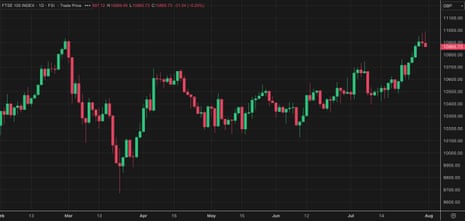
The FTSE 100 is losing a bit of momentum as the month crawls to its end, but it is still a much more positive picture than might have been expected during the turmoil of March.
The index reached a new record earlier this morning and – barring a significant worsening in the next hour or so – will finish the month up by about 3.5% at around 10,840 points. It was down 0.5% after 3pm BST.
That came after a year low below 9,700 points at the worst point of the rout triggered by the attacks on Iran ordered by Donald Trump and Benjamin Netanyahu.
The broader European Stoxx 600 index is up 1.2% this month, after dropping 8% in March.
In other business and economics news today:
-
BP has put its North Sea oil and gas business up for sale as it looks to end six decades of production from the basin.
-
The price of petrol has hit a new Iran War high at UK forecourts, adding to the financial pressure on millions of households about to embark on their annual holiday.
-
Morrisons has revealed losses widened to £926m last year and it cut almost 5,000 jobs as it struggles with heavy debts and competition.
-
Sainsbury's has agreed to sell the Argos retail chain for £120m to allow it to concentrate on its core food business.
-
Great Britain has recorded more new solar power installations in the first half of this year than in any six-month period since 2011.
-
Economic uncertainty dampened UK house price growth in July as prospective buyers remained cautious about interest rates during the Iran war in what should be the peak housebuying season.
That's it for this week's live coverage of business, economics and financial markets. Thanks for reading today, and please do join us on Monday for August. JJ
Wall Street is also determined to end the month in a good mood: its biggest companies' share prices have risen at the opening bell.
Here are the opening news snaps from Reuters:
-
S&P 500 UP 39.96 POINTS, OR 0.54%, AT 7,477.59
-
NASDAQ UP 231.33 POINTS, OR 0.92%, AT 25,353.51
-
DOW JONES UP 225.88 POINTS, OR 0.43%, AT 52,433.94
FTSE 100 on course for best month since February
The FTSE 100 is now flat for the day, but it is still on course for its best month since February in the long rebound from Donald Trump's war on Iran.
London's benchmark index reached a new record high this morning of 10,989.45 – although it is looking like it will remain about a hundred points shy of the 11,000 mark.
But over the course of July so far – with two hours of trading left – it has gained about 407 points, putting it on course for a gain of nearly 4% for the month.
The index lost 6.7% in March after the US-Israeli attacks on Iran began, but it has since recovered that ground and edged above the previous high point in February.
Amazon's share price has jumped 11% in pre-market trading, after investors were reassured last night by above-expectations earnings and strong growth in its cloud computing.
That share price gain would translate to another $280bn on its $2.53 trillion market value.
However, Apple's share price is down 8% pre-market after the iPhone maker's forecasts were hit by supply chain problems.
Amazon is nevertheless expected to help the Nasdaq 100 index to rise by about 0.9% at Friday's opening bell. The broader S&P 500 index is due to rise by 0.3%, while the Dow Jones industrial average is set for a 0.5% gain.
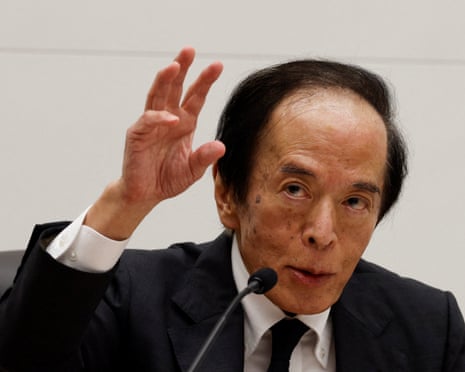
The Bank of England yesterday held interest rates steady, but some econmists believe it could be on track to raise them in September. A similar dynamic is playing out in Japan, which suggested its own rate hike could be coming after the summer as well.
The Bank of Japan on Friday kept its rates steady at 1%, as expected, but gave a hawkish signal in a press conference.
Reuters reported:
double quotation mark The Bank of Japan on Friday warned for the first time that underlying inflation could exceed its target and said future policy discussions would focus on upside price risks, signalling the chance of a rate hike as soon as September.The BOJ's decision and its hawkish statement pushed up the two-year Japanese government bond yield. The yen initially posted little reaction to the decision but jumped sharply in European morning trade, with traders alert to the prospect of fresh intervention.
Governor Kazuo Ueda said:
double quotation mark Given underlying inflation is approaching our 2% target, we must be mindful of upside price risks more than ever. We will debate our policy from our next meeting onward with this point in mind.
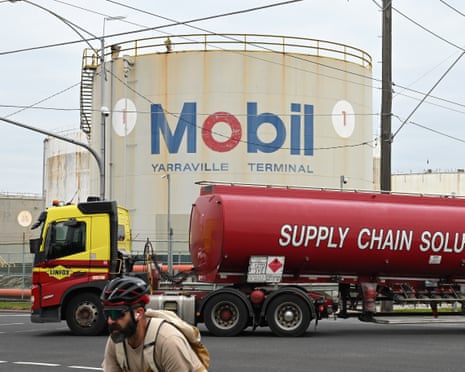
The US's biggest oil company, ExxonMobil, has reported a big jump in profits as it benefits from Donald Trump's war on Iran.
The oil supermajor's adjusted earnings rose 67% from the first quarter to $14.7bn in April, May and June, it said on Friday. The earnings were nearly double the same period a year earlier, but Exxon's share price still fell 2% in pre-market trading as it missed analysts' forecasts.
Exxon said it had ramped up production in Texas's Permian basin to a new record as oil companies around the world raced to cash in on Iran's blockade of the strait of Hormuz, a key export route for Gulf oil to global markets. It is also increasing production off the coast of Guyana, in one of the biggest oil rushes of recent decades.
The company said it was the highest upstream production in more than two decades, excluding the “Middle East disruptionsâ€.
Darren Woods, ExxonMobil chair and chief executive officer, said:
double quotation mark The second quarter was shaped by disruption, but defined by execution. Markets were supportive, but our performance reflected the strength of the portfolio and operating model we have built over many years. As conditions changed, we moved products where they were needed, optimized assets, and supported customers, leveraging our global integrated portfolio.

Gwyn Topham
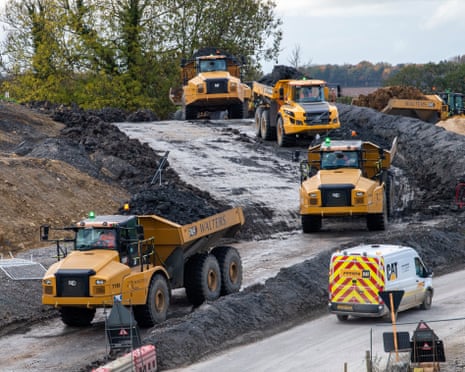
HS2 has announced it has renegotiated two of its biggest contracts to ensure cost control on the troubled high-speed railway as part of the promised “reset†under Labour and chief executive Mark Wild.
Wild has blamed much of the cost overrun on the project, which the government now hopes will cost £93bn instead of an original £32.7bn for a much larger railway, on the way contracts were structured, leaving all risk and inflation with the taxpayer.
The renegotiated contracts with two joint ventures, EKFB and Align, account for a 100km of the route between London and the West Midlands. HS2 said the new contracts would “reset incentives by rewarding efficient delivery and cost controlâ€.
Lord Hendy, rail minister, said:
double quotation mark These new contracts are an important milestone in the reset of HS2. The waste and mismanagement of the past are behind us – we are now laser-focused on delivering this project efficiently and responsibly for taxpayers.
Wild said:
double quotation mark This is good news, but there's more to do, Bringing an end to HS2's cost over-runs and delays is a shared ambition, and I'd like to thank every one of the parent companies at both EKFB and Align for their willingness to negotiate and their commitment to doing the right thing for British taxpayers.
Negotiations with HS2's two other civil engineering joint ventures – BBV and Skanska Costain STRABAG – are ongoing.
The estimated cost range for the scheme was set out in May as £87.7bn to £102.7bn, in a long-awaited reset that confirmed the extent of the budget overrun in current prices. Trains from London to Birmingham may not run until 2039 with links to the north in the 2040s. Wild and ministers are expected to set out a full schedule for building HS2 early next year.
Gwyn Topham
High fuel prices have slashed profits by a third at British Airways owner International Airlines Group (IAG).
The group's pre-tax profits fell to €995m (£852m) in the last quarter, from €1.5bn (£1.3 bn) in the same period in 2o25.
Fuel costs rose by more 400 million euros as the price spiked due to conflict in the Middle East, despite most of IAG's requirements being hedged at a lower price.
Revenues were up 1% with passenger numbers flat.
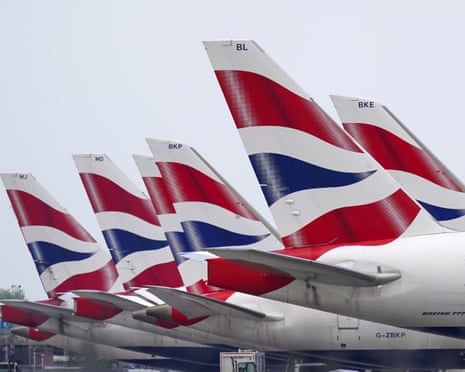
Chief executive Luis Gallego said the results demonstrated IAG's “excellent fundamentals†despite geopolitical headwinds.
British Airways chief executive Sean Doyle said that the airline was transforming its head office with better technology, and “driving efficiency because more and more transactions can be serviced onlineâ€. Around 200 jobs have gone and Doyle said AI could drive more efficiency, but added: “At the same time, we're recruiting a lot more frontline people that are growing the airline. The net employees of BA are increasing.â€
He said BA was continuing to “monitor closely†the effects of EES, the EU's entry-exit system, which has sparked concerns of summer queues, but there had not been flight delays or missed flights so far. Doyle said: “We do have the odd flash point pop up. But we deal with this.â€
UK petrol prices hit highest this year
The AA's rival, the RAC, has called it: UK petrol prices have reached the highest this year after Donald Trump renewed attacks on Iran.
RAC head of policy Simon Williams said:
double quotation mark In very unwelcome news for drivers the average price of petrol has hit a new Iran War high of 160p a litre having increased more than 9p (9.38p) since falling to a low of 150.59p on 6 July. Diesel has now shot up 14.5p since its low point on 9 July to 179p, but fortunately is still 12.5p below its conflict high of 191.54p on 15 April.This means the cost of filling a family-size car with unleaded has gone up to £88 while a tank of diesel is £10 more. The wholesale price of petrol eased very slightly this week but it is not enough to make a difference at the pumps. Diesel looks set to keep on rising and is likely to reach 185p a litre in the next few weeks, barring any major oil price reduction.
Morrisons reveals 5,000 job cuts after £900m loss

Sarah Butler
Morrisons has revealed losses widened to £926m last year and it cut almost 5,000 jobs as the Bradford-based supermarket continues to struggle with heavy debts and competition.
Pre tax losses widened in the year to October 2025 from £612m in the year before as sales rose 3.2% to £15.8bn despite hefty grocery inflation throughout the year.
A spokesperson for Morrisons said it had: “demonstrated our resilience in the face of some tough external headwinds,†which included a cyber-attack on a key IT provider, rising inflation and government cost increases.
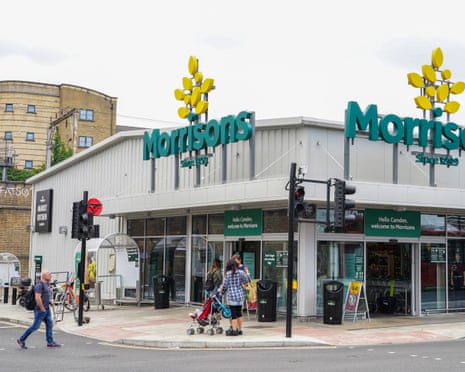
The company said debt and interest costs were both reduced and “the underlying performance of the business was robustâ€.
At the year end net debt was £3.2bn, down 46% since Morrisons was bought by private equity firm CD&R in 2022. Interest costs were reduced by 29% to £281m.
It said profits had been hit by a write down on the value of the McColls convenience store estate before it closed dozens of the small outlets last year.
However, the accounts filed at Companies House show Morrisons reduced staff numbers by 4,912 as it ditched a newspaper delivery service and reduced jobs at head office and in its Rathbones bakery division.
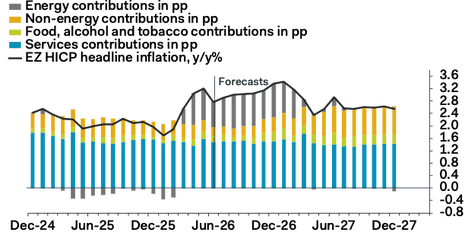
Eurozone inflation nudged up from 2.8% to 2.9% in July, but economists are worried about the possibility of further price increases down the line given the US's continued attacks on Iran.
Core inflation rose by 0.1 percentage points, to 2.5%, marginally above the 2.4% expected by economists.
August inflation is likely to be significantly higher, because of higher oil prices when the Donald Trump decided to renew bombing against Iran.
Bert Colijn, chief economist for the Netherlands at ING, an investment bank, said:
double quotation mark While energy inflation is on the move again, the question remains when second round effects will show up in core inflation data. The increase from 2.4% to 2.5% in core inflation in July was small, but does reflect both goods and services inflation trending slightly higher.We do expect goods inflation to still rise from the current inflation rate of 0.9% (an increase from 0.8% in June), but so far there has not been much movement. While businesses continue to indicate caution in increasing selling prices, the months ahead should bring more pass-through of higher input costs.
Claus Vistesen, chief eurozone economist at Pantheon Macroeconomics, a consultancy, said that he thought the data would persuade the European Central Bank to raise interest rates by 0.25 percentage points at its September meeting.
Vistesen said he expected that to be “the final increase before the ECB pauses to assess the outlook†– although who knows what will be happening in Iran by then?
Pantheon's forecasts predict that energy prices will cause a large part of inflation over the next six months, as the below chart shows.