Introduction: Markets hit by Iran crisis and tech sell-off
Good morning, and welcome to our rolling coverage of business, the financial markets and the world economy.
Stock markets across Asia-Pacific countries are in retreat today, as investors fear a rise in US interest rates, renewed conflict in the Middle East, and an end to the AI boom.
Major bourses are all in the red; South Korea's KOSPI index fell by amost 9% at one point, forcing trading to be briefly suspended, while Japan's Nikkei 225 index is 3.8% lower.
The sell-off followed a painful Friday on Wall Street, where the S&P 500 fell by 2.64%.
Friday's drop was triggered by a surprisingly strong US employment report, which left many traders concluding that the next move in US interest rates will be up, not down.
Technology stocks have also been pummelled in recent days, on fears that the AI race is turning into a battle over who can raise, and spend, the most money, as ChatGPT and Anthropic prepare to float on the stock market.
Add in renewed conflict in the Middle East today, and it's a recipe for more losses across global markets…
Kyle Rodda, senior financial market analyst at Capital.com, explains:
double quotation mark Things could get a bit hairier today in the markets after a flare-up in geopolitical tensions over the weekend.Iran launched strikes on Israel for its attacks on Hezbollah targets in Beirut, leaving a nervous wait for the Israeli response. There is the heightened risk the war escalates again as peace talks between the US and a clearly emboldened Iran stall.
The agenda
-
7am BST: German factory orders
-
4pm BST: US inflation expectations
Key events
After a weak start, the UK's FTSE 100 share index has now pushed into positive territory.
The ‘Footsie' is up 22 points, or 0.2%, at 10,390 points.
Traders may be reassured that Donald Trump has demanded Israel and Iran both “immediately stop shootingâ€:
Weapons maker BAE Systems is among the top risers, though, up 1.45%…
The GMB union's annual congress in Blackpool has heard that driverless taxis could cost 300,000 drivers their jobs.
The congress agreed to call on the Government to introduce laws to protect taxi and private hire drivers from job losses and reductions in earnings caused by the rollout of driverless vehicles.
Ali Haydor, private hire driver and GMB Congress delegate told the event:
double quotation mark “We hear a lot from those on the right of politics about people not working and relying on benefits, but replacing human workers will potentially push thousands into unemployment and poverty.“The gig economy firms present driverless taxis as progress – they tell us this technology will increase efficiency, reduce costs and benefit society, but progress for whom?
“Technology will continue to develop, but workers should not be expected to carry all the risks while companies take all the rewards.â€
Battle over world’s oldest bank

Kalyeena Makortoff
A fresh battle is taking place over the future over the world's oldest bank: Italy's Monte dei Paschi di Siena (MPS).
Intesa Sanpaolo, which is currently Italy's largest bank, tabled an unsolicited €30.6bn bid for its rival on Monday. If successful, that would create the euro zone's second biggest banking group by market cap, worth €126bn, behind Spain's €155bn Banco Santander.
However, that proposal came hours after Italy's fourth largest lender, Banco BPM, on Sunday sent a letter to MPS suggesting a merger that would create a “new national championâ€, and the second largest bank in Italy, leapfrogging Unicredit – with a market cap of around €50bn.
The tug of war comes two years after MPS returned to private ownership, having been bailed out by the Italian government in 2017 and privatised in 2023/2024. It has been eyed as a potential takeover target since, but took markets by surprise when it bought and merged with rival Mediobanca in a €16bn deal last year.
Intesa's gatecrashing bid could have consequences for the historic MPS brand, which dates back to 1472. Intesa's bid involves breaking up the bank, selling 635 MPS branches and the MPS brand to insurer Unipol Assicurazioni. Intesa would keep Mediobanca, as well as its 13% stake in insurer Generali.
The hope is that the arrangement would head-off any competition issues.
All eyes are now on MPS bosses' response, which could ultimately transform Italy's banking landscape.
Over in Copenhagan, shares in drugmaker Zealand Pharma are down 25% after trial data showed its injectable obesity drug survodutide had worse side effects and higher patient dropout rates than rival treatments.
Late-stage data from two studies of the drug, presented last weekend at a medical conference, showed that nearly one in four patients taking the highest 6-milligram dose of survodutide stopped treatment due to side effects, with about one in five dropping out specifically because of gastrointestinal problems.
Jefferies: not worried about an AI bubble
The markets “turned ugly†on Friday, says Mohit Kumar, economist at investment bank Jefferies, as tech companies led a sell-off in equity markets.
But despite that, Kumar says “We are not worried about an AI bubble,†explaining:
double quotation mark Capex spending is still strong and capex spending as a proportion of free cash flow remains well below the 1999–2000 levels.One area where we differ relative to 1999-00 is that in the dot com era, a bulk of capex spending was done though debt and equity issuance. The mix is changing, but we are still far from concerning levels of the dot-com era.
After a rough day on Friday, US tech stocks may recover some losses today.
The Nasdaq Composite index is on track to rise by 0.6%, according to the futures market.
Derren Nathan, head of equity research at Hargreaves Lansdown, says:
double quotation mark Despite the overnight sell-off in Asia, US investors look to be taking a more measured view with futures in the tech-led NASDAQ holding firm compared to a 0.4% decline in the more broadly focussed Dow Jones Industrial Average.With SpaceX, potentially the largest IPO in history, now teed up on the launch pad for Friday, and UK retail investors being offered unprecedented access, the market mood in this week's countdown will be closely monitored.â€
An index of European tech stocks, the Stoxx Europe 600 Technology Price Index, is down almost 0.5% this morning.
Nvidia CEO: selloff in tech stocks is a buying opportunity
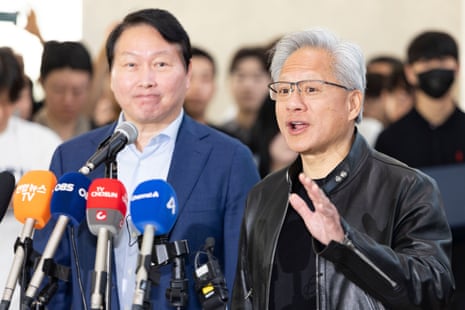
Nvidia chief executive officer Jensen Huang has called the global tech stocks selloff that began last week a buying opportunity, Bloomberg reports.
During his trip to Seoul (see earlier post), Huang argued that the buildout of artificial intelligence has just begun.
Asked selloff should be perceived, Huang said the industry was still in the early stages of constructing infrastructure that will serve as the foundation of an AI-fueled future.
Huang said:
double quotation mark “We're at the beginning of it, and whatever happened to the stock market, you should be very happy because now you can buy at a discount.Everybody should be very excited.â€
More here.
Oil his $98 after explosions heard in central Tehran
Reports that explosions have been heard in central Tehran this morning have pushed the oil price higher.
Brent crude just hit $98 a barrel, a rise of 5% today, up from $93.08 on Friday night.
Israel's IDF have also said in a post on X that dozens of air force fighter jets have “completed an extensive strike†on “strategic defence systems†in Iran.
My colleagues Dan Milmo, Aisha Down and Ana LucÃa González Paz have looked into the AI boom here:
Here are some charts from their report:
A chart showing the share price rise for AI companies
A chart showing rising AI capital expenditure
Europe's Stoxx 600 share index has dropped to a two-week low this morning, weighed by escalating tensions in the Middle East and a global selloff in AI stocks
Why AI stocks are selling off
Several factors came together to trigger the stock market sell-off which began on Friday, and is continuing today, says Charu Chanana, chief investment strategist at Saxo.
Chanana explains that while Friday's strong US jobs report was the trigger, but the deeper issue was crowded positioning in the market for shares in AI and semiconductor companies.
Chanana cites five reasons why shares in the AI sector are falling:
-
AI crowding: Semiconductors and AI-linked names had become the default long trade. When everyone owns the same winners, even a small disappointment can lead to a much bigger unwind.
-
Top-heavy leadership: A small group of AI winners had been doing a lot of the heavy lifting for the broader index. That can make the market look stronger on the way up, but more fragile on the way down.
-
Expectations were too high: The reaction to Broadcom showed that “good†is no longer enough for AI-linked names. Investors want upside surprises, stronger guidance, clear monetisation and proof that AI demand is still accelerating. Anything short of that can become an excuse to take profits.
-
AI funding questions: AI is not just a growth story; it is also a very capital-intensive one. Alphabet's funding moves, and now Meta's, are reminders that the next leg of AI infrastructure needs serious money. Investors are becoming more focused on who funds that buildout, whether capex remains disciplined, whether dilution risk rises, and whether returns can justify the spending.
-
Geopolitical risk added pressure: Rising Middle East risks, oil volatility and fading peace hopes were not the main reason AI sold off, but they added another layer of uncertainty. When markets are already stretched, bad news travels faster.
Tate & Lyle agrees to be taken over
Ingredients developer Tate & Lyle has become the latest UK company to fall to an overseas takeover.
Tate & Lyle has agreed to be bought by US rival Ingredion in a £2.7bn deal, sending its shares up 12% this morning.
Once famous for sugar refinering, Tate & Lyle now makes sweeteners, fibres and stabilisers for food producers to include in their products.
Victoria Scholar, head of Investment at interactive investor, says:
double quotation mark This is a very attractive offer for Tate & Lyle at 595p a share plus 20p a share in dividends, equivalent to a 64% premium prior to its recent surge. The announcement comes at a time when the UK business has been struggling with a weak share price performance and disappointing financial results, leaving the company vulnerable to a takeover.There are clear synergistic benefits to the deal, with both companies focused on growth in the sugar substitute space. For Ingredion, the acquisition will help boost its presence in Europe too.
Sugar is very much out of fashion. Rising awareness of its negative impact on health combined with the growth in weight loss jabs has shifting consumer preferences towards healthier alternative products instead.
Shares in Ingredion are down 6% over the last month and 9% so far this year.â€
Nvidia’s Huang draws crowd at chicken restaurant
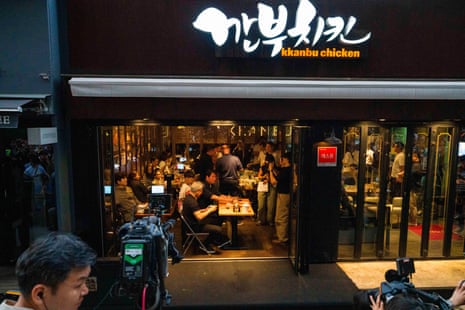
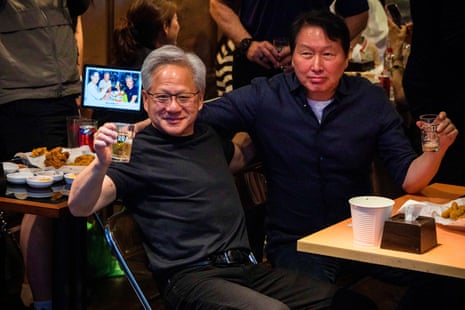
The sell-off in AI stocks last night didn't dampen the mood at Kkanbu Chicken restaurant in Seoul lst night, where Nvidia CEO Jensen Huang met with senior executives from SK Group.
Huang and SK chairman Chey Tae-Won drank beer, scoffed fried chicken, and even handed out food to a large crowd who gathered at the scene.
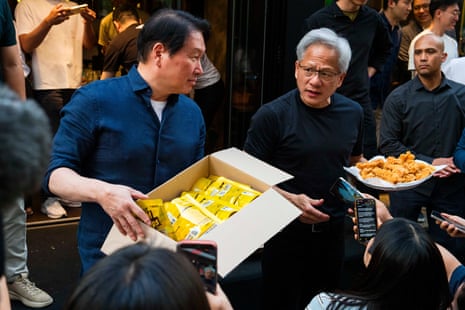
The pair were in a convivial mood, as they celebrated a tie-up between the two companies to advance the development, design and manufacturing of next-generation memory for AI factories.