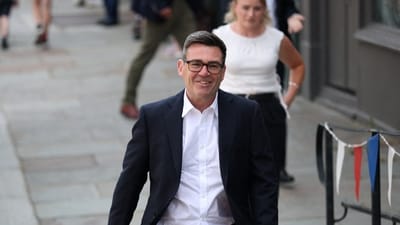
Andy Burnham will enter 10 Downing Street on Monday with a wave of enthusiasm behind him and a mountain of challenges ahead.
His coronation as British prime minister may be short-lived as he faces the same struggles as his predecessor in trying to temper a cost-of-living crisis, improve overstretched public services, and step into the international spotlight during major wars in Ukraine and the Middle East.
He arrives after spending most of the past decade running Greater Manchester, in northwest England, before winning his ticket back to Parliament in a special election last month.
Leading a government delivering services for 70 million people will be a monumentally larger task with problems on a larger scale and facing issues foreign to a leader of a region with 3 million residents.
Also Read: All about UK’s new PM-designate Andy Burnham: The ‘King of the North' heading to 10, Downing Street
Here are the main issues confronting Burnham and some hints to how he may approach them:
Boosting the economy and decentralizing government
Burnham has been vague, but promised to provide details this week about how he would fund a domestic agenda to kick-start a sluggish economy, enhance services and raise living standards.
“This change today is the most significant change moment in our politics for 40 years,” he said Friday as he became Labour Party leader. “It will take us to a country where life is more affordable, and all people and places are lifted from where they are now.â€
Burnham inherits an economy that was improving until the Iran war upended forecasts and growth is now widely predicted to slow sharply over this year while inflation rises.
He has said he wants to equalize opportunities around the U.K., particularly by decentralizing government, funneling money to local governments and taking back some services that were privatized four decades ago.
His brand of business-friendly socialism — known as “Manchesterism†and aiming to harness private and public money to invest in areas like transportation, housing and infrastructure — could take years to put in place.
Joshi Herrmann, founder of Manchester news site The Mill, who has covered Burnham for years, said he may be able to soften the blow for some people who are struggling.
“But if the essay question is who can get economic growth and who can remodel the economy in the post-Brexit, post-financial crash era, I'd be very surprised if the answer to that question is Andy Burnham,†Herrmann said.
With the uncertain state of public finances, Burnham won't have much room to raise spending. He is replacing Prime Minister Keir Starmer, who was elected on a manifesto that ruled out increases in the government's major tax rates, so he's locked in unless he breaks those pledges.
Burnham said he would not rule out a wealth tax, telling Gary Lineker on the Goalhanger podcast last week that the government “might be having to ask for a little more.”
Foreign policy and striking the right tone with Trump
Burnham has little foreign policy experience, but has promised to continue the government's NATO commitment and support for the U.K.'s nuclear deterrent.
He said Britain will remain a strong booster of Ukraine and a firm United States ally.
Relations with the U.S. could depend on how he interacts with a capricious President Donald Trump, who initially gave Starmer glowing reviews only to sour on him for not supporting his war with Iran.
Burnham has publicly criticized Trump in the past but has said he would deal with him respectfully, as he does with others, but would also be willing to disagree.
“I like to think I've got some personality myself and I'll just, you know, I'll deal with him very upfront in the same way,†he told Lineker. “Where you disagree, do it, but do it in a way that is kind of meeting him where he's at.â€
Trump has pushed NATO members to significantly boost military spending, and Burnham will be under pressure to exceed the defense spending goals set out by Starmer.
The defense plan calling for a 15 billion pound ($20 billion) spending boost is much smaller than military leaders had sought and has been criticized for not being fully funded under the current budget.
Sensitive messaging about Israel’s war with Hamas
Burnham has criticized Starmer’s approach to Israel’s war with Hamas and the devastation of Gaza.
Burnham condemned the Oct. 7, 2023, attacks on southern Israel by Hamas militants, who killed around 1,200 people and took 251 others hostage, but said the British government waited too long to call for a ceasefire.
More than 73,000 Palestinians have been killed, according to the Gaza Health Ministry, which is part of the Hamas-led government. The ministry, which does not differentiate between civilians and combatants, is staffed by medical professionals who maintain detailed records viewed as generally reliable by United Nations agencies and independent experts.
Burnham said the U.K. would consider further sanctions against Israelis involved in Gaza violence and illegal West Bank settlements.
The issue is a sensitive one for Labour, which was found to be tainted with antisemitism before Starmer took over, and also relies on the support of a large Muslim population.
Burnham's comments drew a backlash from Jewish groups, but he’s also been criticized by pro-Palestinian groups for not declaring Israel’s bombardment of Gaza a genocide.
The thorny issue of migration
During his acceptance speech as Labour's leader on Friday, Burnham did not mention immigration, which is a top issue for many voters.
Like much of Europe and other wealthier nations, the U.K. has seen an influx of migrants fleeing war-torn areas, famine, climate-driven crises, political persecution and poverty.
Concerns over English Channel crossings in overcrowded inflatable boats has helped propel the anti-immigration Reform UK party to victory in recent local and regional elections that led Labour to oust Starmer as leader.
Burnham has largely said he would follow the current Labour playbook on migration, which has touted reductions in net migration from more than 900,000 in 2023 to 171,000 last year. Channel crossings are down 40% this year compared to the same time in 2025.
Burnham wants to continue reducing net migration and voted in support of a bill that aims to further cut channel crossings and direct people to safer, legal routes.