
Brent crude rising higher as Iran ‘pulls out of message exchanges’ with the US
The oil price is moving higher now, after a report that Iran will not hold peace talks with the US until Israel ends its operations in Lebanon and Gaza.
According to the IGRC-affiliated Tasnim news agency, Iran says there will be no peace talks with the US until its demands on the cessation of Israeli operations in Lebanon and Gaza are met
Tasnim reported that Iran's negotiating team is pulling out of message exchanges through mediators with the US over Israel's offensive in Lebanon, our Middle East liveblog reports.
This has pushed Brent crude up to $95.75 a barrel, up from $92 at the end of last week.
Key events
Closing post
Time to recap…
The oil price is moving back towards the $100 a barrel mark, as hopes of a breakthough in the US-Iran peace deal talks evaporate.
Brent crude has now hit $97.58 a barrel, following reports that Tehran's negotiating team is stopping exchanges of messages with the United States through mediators due to attacks on Lebanon.
Iran has said there will be no peace talks with the US until its demands on the cessation of Israeli operations in Lebanon and Gaza are met, according to the IRGC-affiliated Tasnim news agency.
This has damaged confidence that a breakthrough to end the conflict and reopen the strait of Hormuz may be close.
Anxiety over the conflict has pushed down house prices in the UK for the first time this year in May, as rising mortgage rates hurt homebuyer demand.
The price of the average UK home dropped 0.6% in May compared with the month before, according to the lender Nationwide.
And in other news:
Brent crude has now climbed over $97 a barrel, as fears of the Iran crisis grip the energy markets again.
The London stock market has dropped deeper into the red, as the Middle East crisis deteriorates.
House builders are among the fallers, wth Persimmon down 4.2% and Barratt Redrow off 3.2%. That reflects fears that inflation will be pushed up by the ongoing crisis, leading to borrowing costs and weaker demand for new homes.
The dollar is strengthening, as nervous investors seek out a safe haven for their money.
This has pushed the pound down by half a cent today, to $1.341. The euro has also lost half a cent., to $1.16.
IG: Not hard to imagine oil hitting $100 again
Oil could hit $100 a barrel again soon, fears Chris Beauchamp, chief market analyst at investing and trading platform IG, as relations between the US and Iran deteriorate.
Following the news that Iran is pulling out of message exchanges with the US, Beauchamp says:
double quotation mark “The weekend's exchange of projectiles has been followed up by signs that Iran's stance is hardening.It looks like the floor for oil prices lies around $90 for Brent and $85 for WTI, and if these comments on the ceasefire lead to further escalation then it is not hard to imagine both oil prices breaching $100 again, putting pressure on equity markets and imperilling the remarkable winning streak for the S&P 500.â€
Government bond yields rising
Government bond prices are falling, as the jump in the oil price fuels inflation fears.
This is driving up the yield, or interest rate, on UK, US and Germam bonds.
UK benchmark 10-year government bond yields are up almost 7 basis points (0.07 of a percentage point) to 4.88%, up from 4.81% on Frday night.
Brent crude rising higher as Iran ‘pulls out of message exchanges’ with the US
The oil price is moving higher now, after a report that Iran will not hold peace talks with the US until Israel ends its operations in Lebanon and Gaza.
According to the IGRC-affiliated Tasnim news agency, Iran says there will be no peace talks with the US until its demands on the cessation of Israeli operations in Lebanon and Gaza are met
Tasnim reported that Iran's negotiating team is pulling out of message exchanges through mediators with the US over Israel's offensive in Lebanon, our Middle East liveblog reports.
This has pushed Brent crude up to $95.75 a barrel, up from $92 at the end of last week.
Lactalis acquires Britain’s Protein Works
The protein boom has prompted France's Lactalis to flex its muscles and acquire UK lifestyle nutrition brand Protein Works.
The deal will boost Lactalis's presence in the market for protein, used to build muscle, produce hormones, regulate mood and appetite, and strengthen bones.
Lactalis chairman Emmanuel Besnier said in a statement:
double quotation mark “By combining our longstanding expertise in dairy proteins and health nutrition with Protein Works' strong brand and innovative approach, we are confident we can continue to create products that respond to changing consumer expectations in this dynamic and growing category.â€
Protein Works sells a range of health and well-being products, including whey protein concentrate, vitamin tablets that claim to accelerate fat breakdown, and food such as protein porridge and protein pancake mix. It began in founder Mark Coxhead's spare bedroom back in 2012.
Bank of England watching public-sector pay for inflation risks
The rise in the oil price today may add to concerns that the Iran war will push up inflation.
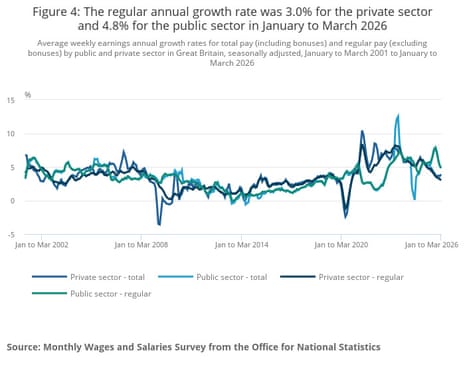
On that topic, the governor of the Bank of England had pointed to public-sector pay as a potential source of inflation pressure.
Andrew Bailey told the Financial Times:
double quotation mark In terms of the pay statistics, we have got more of a wedge opening up between private sector pay and public sector pay.Traditionally, in the MPC [monetary policy committee], we've put much more weight on private sector pay because we think it feeds more directly through enterprises. But I think the more that wedge opens up, you start to have a few doubts on that front.
Official statistics last month showed that pay in the public sector rose by 4.8% per year in the January-March quarter, ahead of 3.0% in the private sector.
However, that shouldn't fuel a ‘wage-price spiral', as the public sector doesn't charge for services such as education, health or defence. Plus, there are only around six million public sector employees, out of over 30m workers in the UK.
Today's jump in the oil price follows a month in which crude prices dropped quite significantly.
In their round-up of market moves in May, Deutsche Bank told clients this morning:
double quotation mark Hopes for some kind of US-Iran deal meant that Brent crude oil fell -19.3%, marking its biggest monthly decline since March 2020 as the pandemic lockdowns began.Those hopes for an end to the conflict meant that fears about stagflation eased dramatically, which supported risk assets as well.
Some UK motor fuel retailers hiked their profit margins in April to take advantage of the Middle East crisis, it appears.
A new report from the UK's Competition and Markets Authority today has found that “in a number of cases†individual retailer margins increased slightly in April.
The CMA is also concerned that retailers have generally pursuing “largely passive pricing policiesâ€, rather than actively competing to win customers by cutting costs.
The CMA says:
double quotation mark We have some concerns about persistently high and in some cases increasing margins in April.Whilst this may reflect continued wholesale price volatility driving continued high retail prices, high retail prices and the increase in ppl (price per litre) margins in April could also result from weak price competition including the continued use of passive pricing strategies by retailers rather than retailers responding promptly to wholesale price movements and/or trying to win market share by reducing retail prices
Top executives from shipping companies are warning that any US-Iran peace deal must include clear rules allowing vessels to resume normal business via the strait of Hormuz.
Shipping executives are meeting in Athens today at a shipping exhibition, where Pankaj Khanna, president of Heidmar Maritime Holdings, said:
double quotation mark “What we need is obviously a framework, a rules regulation, whatever tells us exactly how we can go in and get out. So even if a peace deal was signed, that needs to be clarified and that we don't know as yet.â€â€Obviously the seafarers on board are missing out, not only on seeing their families but also on births, on deaths, on marriages.â€
UK petrol and diesel prices have dipped slightly today, further away from their Iran war highs.
This morning, the average price of a litre of petrol has fallen by 0.02p to 159.37 a litre, with diesel down 0.07p a litre to 183.75p, on average.
The RAC report:
double quotation mark The average price of diesel has fallen by nearly 8p (7.79p) a litre to 183.75p since peaking on 15 April at 191.54p. Petrol's peak occurred on 28 May at 159.53p – it's now 26.5p more than it was at the start of the conflict in Iran at 159.37p.A tank of petrol for a 55-litre family car currently costs £87.65 – £14.60 more than 28 February. For diesel it's £101.06 – £22.75 more than it was at the start of the Iran war.
Ofcom investigates Royal Mail's failure to hit delivery targets
Ofcom has opened its now-traditional investigation into Royal Mail's failure to meet its delivery targets.
The communications regulator says service levels have remained “unacceptable†at Royal Mail. In the year to the end of March, 75.7% of First Class mail was delivered the next working day – well short of its then-target of 93%.
Only 90.2% of Second Class mail was delivered within three working days – missing the target of 98.5%.
Ian Strawhorne, enforcement director at Ofcom, says:
double quotation mark “A reliable postal service is vital to many people across the country. We share the deep frustrations of customers who have missed important letters because of Royal Mail's consistent failure to improve its service over the years.While the company is now making progress through its improvement plan, we will continue to hold it to account for its unacceptable performance to date.â€
That £500m improvement plan includes second-class post being delivered every other weekday, and scrapped on Saturdays.
Wise shares drop as Belgian prosecutor probes fintech
Shares in fintech Wise have dropped by over 10% today after reports that it was being investigated over half a billion euros of suspicious transactions.
The Bureau of Investigative Journalism reported this morning that Wise was under investigation over concerns that its accounts have been used by criminals to launder the proceeds of fraud, corruption and drug trafficking.
The BIJ reported that prosecutors in Belgium opened the investigation last year after noticing that Wise accounts had featured in hundreds of requests for cross-border help in criminal proceedings from more than 30 countries across Europe.
Wise confirmed this morning that it was working with the Belgium authorities, saying:
double quotation mark Combating financial crime is an industry-wide challenge that Wise takes extremely seriously as a financial institution with over 80 regulatory licences globally, enabling us to serve more than 19 million active customers worldwide and process around 4.7 million transactions per day.We are currently working with the Brussels prosecutor to respond to queries about our business, as we routinely do with regulators and law-enforcement authorities. His office's enquiries are still incomplete and no specific findings have been shared with us to date. As such, it would be speculative for us to comment on any allegations. We will continue to engage with the Brussels prosecutor's office if and when any specific findings are made available to us.
Wise's shares are currently down 12.6% in London.
Aluminium hits four-year high
Aluminium prices have hit their highest point in more than four years as Middle East supply risks escalated after the U.S. and Iran traded military strikes.
The benchmark aluminium contract on the London Metal Exchange hit $3,707.50, equalling the four-year high hit in May.
Drax to buy Bluefield Solar
Elsewhere in the world of energy, power plant operator Drax has agreed to buy green energy investor Bluefield Solar Income Fund.
The all-cash deal values Bluefield at around £550m, and has pushed the company's shares up 16% to the top of the FTSE 250 risers.
Bluefield operates a portfolio of UK based renewable energy infrastructure assets, including photovoltaic plants, wind farms and small-scale wind turbines. Drax, which runs a biomass power plan in Yorkshire, says the deal is an “attractive opportunity†to grow its UK renewable generation business.
Dan Coatsworth, head of markets at AJ Bell, says:
double quotation mark “The commitment Drax is showing to diversifying its business is striking. Having lost out in a bid battle for storage play Harmony Energy to Foresight in 2025, Drax has now put in an all-cash bid for renewable energy investment vehicle Bluefield Solar. With the unanimous approval of Bluefield's board it feels nailed on that the takeover will be successful.“The deal could boost Drax's earnings and cash flow visibility while expanding the breadth of its footprint in renewable energy. Drax's existing interests include pumped hydro, gas and biomass assets – with the latter facing scrutiny over their sustainability credentials.
“An FCA probe is continuing to progress in the background, centred around the sourcing of pellets for its biomass facilities, but this acquisition suggests this matter is not stopping Drax from pursuing its strategic goals.
UK factory input price inflation near four-year high
The Iran war has driven up costs for UK manufacturers (as for their eurozone counterparts).
The latest poll of purchasing managers at British factories found there was “substantial pressure†on their input prices and supply chains during May.
Prices rose at the fastest in nearly four years, due to increased prices for chemicals, electronics, energy, foodstuff, fuels, plastics, metals, packaging, paper and timber.
Bosses cited “the war in the Middle East, commodity market gyrations, geopolitical strife, supply chain issues, material shortages, tariffs, rising labour costs and higher taxes,†according to data firm S&P Global.
Their report also found that the upturn in the UK manufacturing sector gathered pace, with the rate of expansion in production volumes hitting a three-month high.
This lifted the UK manufacturing PMI to a four-year high of 53.9 in May, up slightly from 53.7 in April (any reading over 50 shows growth).
Oil and gas prices rise as US and Iran trade strikes
Oil and gas prices have jumped this morning after Iran and the US continued to launch attacks on each other, dampening hopes of a peace deal.
Early this morning, US central command said that it had hit Iranian “radar and command and control sites for drones in Goruk, Iran and Qeshm Island†over the weekend; actions it called “self-defence†after “aggressive Iranian actionsâ€.
Iran's Islamic Revolutionary Guard Corps said on Monday it had targeted an air base used by the U.S. for an attack on southern Iran, without identifying which base.
Our Middle East liveblog has full details:
This latest exchange of strikes has pushed Brent crude back up to $94.29 a barrel, up 3.5% from Friday night's closing level of $92 a barrel (a six-week low).
Gas prices are rising too; the month-ahead British wholesale gas contract is up almost 6% at 117.3p a therm, compared with 78.5p before the Iran war began.
Donald Trump has insisted that “Iran really wants to make a dealâ€, but markets seem somewhat unconvinced that a major breakthrough is close.
Paul Donovan, chief economist at UBS Global Wealth Management, says:
double quotation mark Oil prices have edged higher on the lack of any discernible progress toward an Iran-US agreement. As with reports of an imminent deal last week, the reaction is muted. A jaded cynicism has come over investors, and in the absence of a definite statement from Iran there is a tendency to downplay comments from the US administration.